 King County
 Two Different Materials, One Decision
Homeowners in King County comparing siding products often assume James Hardie and LP SmartSide are two versions of the same thing. They're not. Hardie is fiber cement — sand, cement, and cellulose fiber cured into a rigid board. LP SmartSide is engineered wood — wood strands and fiber bonded with resins, then coated. Both are legitimate, widely used products with real engineering behind them. But they behave very differently once they're on a house in the Pacific Northwest, and that difference matters more here than it does in drier climates.
This page walks through both products honestly, including what LP SmartSide gets right, so you can understand why our company made the decision to install only James Hardie siding across King County.
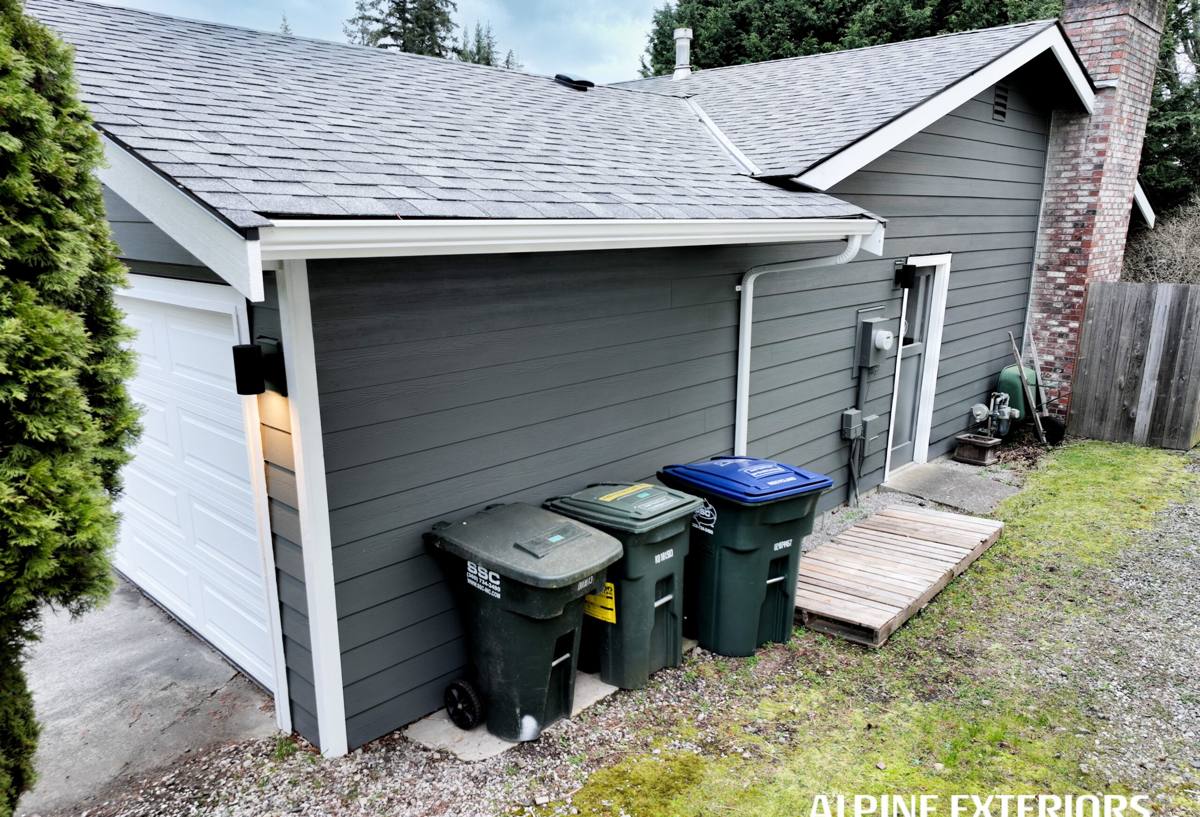
What LP SmartSide Actually Is
LP SmartSide is a strand-based engineered wood product. Wood strands are combined with resins and waxes, pressed into panels or lap boards, then treated with a zinc borate additive intended to resist fungal decay and insects. The surface is primed at the factory and finished with paint after installation, or in some product lines, pre-finished.
It has real advantages. It's lighter than fiber cement, which can make it faster and less physically demanding to install. It holds a nail well, cuts easily, and in dry, moderate climates it has a long track record of solid performance. LP has also worked to address the wood-composite failures of the 1990s that gave the category a bad name, and their current product is a meaningfully better engineered product than what came before it.
What James Hardie Actually Is
James Hardie fiber cement is a different category of material entirely. It contains no wood fiber that can host rot or insects, because the base material is cement, sand, and cellulose — the cellulose acts as reinforcement, not as a food source for organisms. It's manufactured with regional climate exposure in mind, and the HZ5 product line specifically is engineered for cold, wet, high-moisture regions like ours.
The finish is the other half of the story. James Hardie's ColorPlus technology bakes a factory-applied finish onto the board before it ever reaches a job site, using a process designed to hold color and resist fading, chipping, and peeling far longer than field-applied paint on a job-site-primed product.
How Each Performs in King County's Climate
This is where the comparison stops being theoretical. King County siding lives through nine months of wet weather a year, salt-laden air off Puget Sound in many neighborhoods, driving wind-driven rain that hits walls at an angle rather than falling straight down, and a moss and algae season that can run from October through May. Every siding product on the market is rated to survive rain. Not every siding product is rated to survive constant, sustained moisture exposure combined with organic growth pressure and salt air corrosion over 20-plus years.
Fiber cement doesn't absorb water into a wood structure the way engineered wood does. Moisture that reaches the surface of a properly installed and sealed Hardie board sits on a non-organic surface. Engineered wood, even with borate treatment, is still fundamentally a wood product — its core can absorb moisture if the factory seal or field-applied paint is ever compromised at a cut edge, a fastener hole, or a butt joint that wasn't sealed correctly.
Moisture, Rot, and the Wood-Based Trade-off
The zinc borate treatment in LP SmartSide is a genuine engineering improvement, and it does resist decay under normal conditions. But "normal conditions" assumes the factory seal stays intact everywhere, including every field cut, every fastener penetration, and every seam — for the life of the product, in a climate that gives siding very little time to dry out between rain events. In King County, boards spend long stretches of the year at high moisture exposure with limited drying windows. That's a tougher environment for any wood-based product than the drier regions where a lot of engineered wood siding performance data was generated.
Fiber cement removes that variable. There's no wood core to protect from moisture intrusion at a cut edge, so a missed field-seal on an end cut is a maintenance issue rather than a structural one.
| Factor | James Hardie (Fiber Cement) | LP SmartSide (Engineered Wood) |
|---|---|---|
| Base material | Cement, sand, cellulose fiber | Wood strands, resin, zinc borate |
| Combustibility | Non-combustible | Combustible (treated wood product) |
| Moisture behavior | No wood core to absorb water | Wood core protected by seal/coating |
| Factory finish | ColorPlus baked-on finish (select lines) | Factory primed; painted after install |
| Weight | Heavier, more rigid | Lighter, easier to handle |
| Repaint interval | Longer, if ColorPlus is chosen | Standard exterior paint cycle |
| Typical warranty | 30-year limited, transferable | 5-year finish / longer substrate limited |
Fire Performance
This is a straightforward, non-controversial difference: James Hardie fiber cement is non-combustible. LP SmartSide, like any engineered wood product, is a combustible building material, even with treatments intended to slow flame spread. For homeowners in the wildland-urban interface areas of King County — the foothill communities and forested edges east of the urban core — this is a legitimate factor in a siding decision, and it's part of why we don't offer wood-based siding products as an option.
Finish, Color, and Maintenance Over Time
A factory-applied finish behaves differently than a job-site-applied one, and this shows up most clearly in year 8 through year 15 of a siding's life. ColorPlus finishes are engineered and tested specifically for UV and moisture exposure before they ever leave the factory. LP SmartSide's factory primer is designed to be painted after installation, which means the finish quality depends heavily on the paint product used, the weather conditions during application, and the skill of the painter — variables that are out of the manufacturer's control.
In practice, that means a Hardie ColorPlus home in King County can often go a decade or more without a repaint, while a painted engineered wood home is on a more conventional exterior repaint cycle — every 5 to 10 years depending on exposure, sun direction, and how much wind-driven rain a particular wall takes.
Installation Sensitivity
Both products are sensitive to installation quality, but in different ways. LP SmartSide's long-term performance depends heavily on field-sealing every cut edge, maintaining correct clearances from grade and roofing, and using compatible caulks and paints. Fiber cement has its own installation requirements — correct fastener placement, proper clearances, and following James Hardie's published fastening and flashing details — but because there's no wood core to protect, a small installation miss is far less likely to turn into a rot problem years later.
This is worth saying plainly: most siding failures on either product trace back to installation, not the material itself. That's a big part of why we standardized on one product line we can install to spec, every time, rather than spreading crew knowledge across multiple systems with different rules.
Warranty Comparison
| James Hardie | LP SmartSide | |
|---|---|---|
| Substrate warranty | 30 years, limited, transferable one time | Typically 5-year limited to longer prorated coverage varies by line |
| Finish warranty | ColorPlus finish warranty separate, often matches or exceeds substrate term | Depends on paint product used after installation, not manufacturer-backed the same way |
| Transferability | Yes, adds resale value | Varies, often more limited |
Always read the actual warranty document for any product before assuming coverage, and pay attention to what voids it — improper installation clearances, incompatible caulk, or missed maintenance steps can void either manufacturer's warranty.
Cost Considerations
LP SmartSide is generally a lower material cost than James Hardie fiber cement, and it's lighter to install, which can modestly reduce labor time. If upfront cost is the only variable, engineered wood will usually come in under fiber cement. The comparison changes when you factor in repaint cycles, expected service life in a wet climate, and resale value — a 30-year transferable warranty on a non-combustible product tends to matter to buyers when a King County home eventually goes on the market.
What to Ask Any Siding Contractor Before You Hire
- Which specific product line and climate rating are you quoting — is it engineered for wet, coastal, or moss-prone conditions?
- What does the manufacturer's warranty actually cover, and what voids it?
- Who is doing the field cutting and sealing, and how are cut edges treated?
- What fastener type and spacing will be used, and does it match manufacturer specs?
- How is moisture managed behind the siding — house wrap, flashing, rainscreen gap?
- Is the crew factory-certified for the specific product being installed?
- What's the expected repaint or refinish interval for this specific product and finish?
Why We Standardized on James Hardie
We made a deliberate decision years ago to install only James Hardie fiber cement and to stop offering engineered wood, vinyl, and other alternative siding products. It's not that LP SmartSide is a bad product — it isn't, and it has a legitimate place in the market. It's that for the specific conditions our crews see across King County — salt air near the Sound, sustained wind-driven rain, and a moss season that gives siding very little time to dry — we wanted a product with no wood core to protect, a factory-applied finish we don't have to gamble on field paint quality for, non-combustible performance, and a warranty structure that holds up when a home changes hands.
Standardizing on one manufacturer also means our crews install one system, to one spec, repeatedly — not switching between different fastening rules, clearance requirements, and sealing details across product lines. That consistency is part of how we protect the warranty coverage a homeowner is actually paying for.
If you're weighing James Hardie against LP SmartSide, or against any other siding option, for a home in King County, we're happy to walk through your specific house, its exposure, and what we'd actually recommend. Reach out for a free, no-pressure estimate — there's a form right below this page.