 King County
 A Decision We Get Asked About Often
When a homeowner in King County calls us for a siding quote, one of the first questions we hear is some version of "do you do vinyl?" or "what about LP SmartSide, that's cheaper, right?" The honest answer is that we don't install those products, or several others that are common in this market. We install James Hardie fiber cement siding, and only James Hardie. That's not a marketing gimmick or a manufacturer kickback — it's a standard we set after years of tear-offs, warranty calls, and repair jobs on other products that didn't hold up the way homeowners expected them to in this specific climate.
This page explains the reasoning in plain terms. We're not going to tell you that other siding products are junk, because that's not true and it's not fair to the manufacturers who make them. What we will tell you is why the trade-offs of those products stopped making sense for the way we build here, and why we'd rather turn down a job than install something we don't believe will perform on your house for the next 30 years.
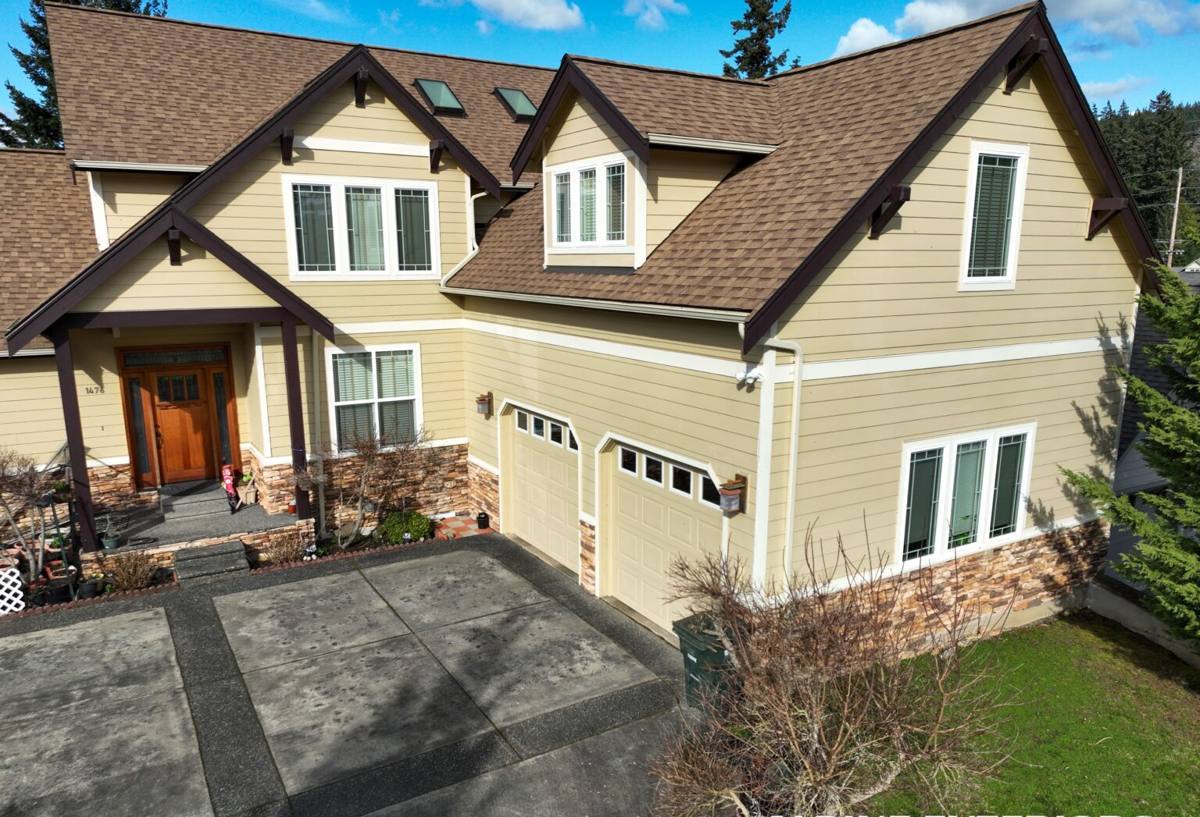
What King County's Climate Actually Does to Siding
Siding here doesn't fail because of one dramatic event. It fails slowly, from repeated exposure to a specific combination of conditions that's more punishing than most homeowners realize:
- Salt air along the Sound corridor accelerates corrosion of fasteners and metal trim, and it degrades certain coatings faster than manufacturers' inland test data suggests.
- Driving rain off Puget Sound doesn't just fall straight down — wind-driven rain gets forced sideways into seams, laps, and butt joints, which is where most siding failures actually start.
- A long moss and algae season, often eight months or more of damp shade under our tree canopy, keeps organic growth active on north-facing walls and anywhere siding stays wet longer than it can dry.
Individually, none of these are exotic problems. Combined, and repeated year after year, they punish any siding product with a weak point in its moisture management, its factory finish, or its fastening system. That's the lens we use to evaluate every product, not just Hardie.
Why We Stopped Installing Wood-Based Composite Siding
Products like LP SmartSide use an engineered wood strand core with a resin-saturated overlay and a factory primer or finish. When installed to spec on a well-ventilated wall with disciplined caulking and painting maintenance, it performs reasonably well in drier climates. Our problem isn't the product's engineering — it's that it's still wood at its core, and wood-based composites depend entirely on an intact outer skin to keep moisture out.
In our climate, that skin gets tested constantly. Cut edges have to be field-sealed every time, on every job, without exception — miss one and that's the entry point for swelling. Butt joints and corners are the highest-risk spots on any house, and they're exactly where wood composite is most vulnerable to expansion, cracking, and edge swelling once water gets behind the finish. We've pulled off composite siding that looked fine from the street and found soft, delaminating panels underneath, usually starting at a joint that wasn't perfectly sealed or a spot where paint maintenance had lapsed by a year or two. We stopped installing it because the product's long-term performance here is only as good as every future homeowner's maintenance discipline, and that's not something we can guarantee when we drive away from a finished job.
Why We Stopped Installing Vinyl Siding
Vinyl's appeal is straightforward: it's inexpensive, it's fast to install, and it never needs painting. For a lot of climates and budgets, that's a legitimate value proposition. Here, we ran into three recurring issues that changed our minds about it:
It moves with temperature
Vinyl expands and contracts significantly across our seasonal temperature swings, which means it has to be installed with hanging clearance rather than nailed tight. Done correctly this isn't a defect, but it does mean vinyl can never be face-nailed solid, and that looseness shows over time, especially on longer wall runs.
It doesn't stop water, it redirects it
Vinyl siding is not a waterproof skin. It's designed to shed the bulk of the water while your weather-resistive barrier does the real work behind it. That's a fine system when the wall assembly behind it is flawless, but it means vinyl gives you almost no forgiveness if there's ever a flashing detail, window integration, or barrier lap that isn't perfect. In driving-rain conditions, we'd rather the cladding itself be doing more of the work.
Impact and UV wear
Vinyl becomes more brittle with age and UV exposure, and it can crack from impact in ways that are hard to patch invisibly. On homes near trees dropping limbs, or in high-traffic yard areas, we saw enough cracked and warped panels over the years that we didn't want to keep standing behind the product.
Why We Stopped Installing Other Fiber Cement Brands
This one surprises people, since fiber cement is fiber cement, right? Not exactly. We looked seriously at both Cemplank and Allura before settling on James Hardie exclusively, and the differences that mattered to us were in manufacturing consistency, factory finish quality, and regional engineering:
| Factor | What we found |
|---|---|
| Factory finish | James Hardie's ColorPlus finish is baked on in a controlled process with a documented multi-coat system; we found more finish-batch inconsistency with some alternative brands over multiple orders. |
| Climate-specific product lines | Hardie engineers distinct HZ5/HZ10 formulations for wet, high-moisture climate zones like ours; not every competing brand offers that level of regional differentiation. |
| Warranty structure | Hardie's transferable warranty terms and claims process are well documented and something we can explain to a homeowner with confidence; we found other brands' warranty language less clear or less consistently honored. |
| Installer network and support | Hardie's certified installer program and technical support gave us direct access to installation guidance specific to our region. |
None of this means other fiber cement is a bad product category. It means that when we narrowed our supplier relationships down to one, in order to guarantee consistency across every job, Hardie was the one whose finish quality and regional engineering we trusted most.
Why We Stopped Installing Primed Spruce and Cedar
Natural wood siding, whether primed spruce lap or cedar shingle and shake, has a genuine appeal that fiber cement doesn't fully replicate — the texture and depth of real wood grain. We still respect that. But solid wood siding demands a maintenance schedule that most homeowners underestimate when they first choose it: repainting or restaining on a multi-year cycle without fail, immediate attention to any checking or cupping, and constant vigilance against moisture intrusion at end grain and fastener heads.
In a climate with an eight-month damp season and heavy moss pressure, cedar and spruce are fighting an uphill battle against organic growth and moisture retention almost year-round. We watched too many wood siding jobs turn into five-year repaint-and-repair cycles, and too many homeowners get surprised by soft boards behind trim they thought was fine. We'd rather set expectations honestly up front than sell a product that quietly becomes a recurring maintenance bill.
What Correct James Hardie Installation Actually Involves
Standardizing on one product doesn't mean the work is simple — Hardie's own data shows that most siding failures are installation failures, not product failures. The things we hold non-negotiable on every job:
- Proper water-resistive barrier and rainscreen or drainage plane behind the siding, not siding installed flat against sheathing
- Correct clearances at grade, roofline, and deck ledgers so the siding never sits in standing water or snow
- Hardie-specified fastener patterns and blind-nailing where called for, matched to our wind-exposure zone
- Factory-mitered or properly caulked joints using compatible sealants, not generic caulk
- Flashing integration at every window, door, and penetration, installed before siding goes on, not patched afterward
- Following Hardie's published installation instructions for our specific climate zone, which is a condition of the warranty itself
Skip any one of these and you can install the best siding product on the market and still get a callback in three years. That's why our standardization is really two decisions stacked together: one product, installed the same disciplined way every time.
The Trade-Off We're Asking You to Accept
Being honest about our position also means being honest about its downside: Hardie fiber cement costs more upfront than vinyl or wood composite, and it's heavier and slower to install, which shows up in labor cost. We're not going to pretend that's not real. What we'd ask you to weigh against that is the total cost over the life of the siding — repainting cycles, patch repairs, moss remediation, and early replacement all have real costs too, they're just spread out and easy to underestimate at the time of the original decision.
For a lot of King County homeowners, especially those closer to the Sound or under heavy tree cover, the math favors paying more once for a non-combustible, climate-engineered product with a factory finish and a strong warranty, rather than paying less now and managing a maintenance schedule for the next two decades.
What This Means If You Call Us
If you're set on vinyl, LP SmartSide, or another product we don't carry, we'll tell you plainly that we're not the right contractor for that job, and we won't try to talk you out of a product that might genuinely suit your budget and situation. If you're open to hearing why we think James Hardie is worth the investment for a King County home, we're glad to walk your specific house — sun exposure, tree cover, proximity to water, existing moisture issues — and give you a straight answer about what we'd recommend and why.
If you'd like a free, no-pressure estimate on a James Hardie installation for your home, use the form below and we'll get in touch to schedule a walkthrough.