 King County
 Why Shoreline's Climate Is Hard on Siding
Shoreline sits right along Puget Sound, which means homes here deal with a combination that inland King County neighborhoods don't face as directly: salt-laden air coming off the water, wind-driven rain that hits siding at an angle instead of falling straight down, and a wet season that stretches long enough to give moss, algae, and mildew months to take hold on anything that stays damp. Add in the tree cover common in many Shoreline yards — more shade, more falling debris, more standing moisture on north-facing walls — and you have a set of conditions that punishes cheap materials and sloppy installation faster than almost anywhere else in the region.
This page is specifically about fiber cement siding for Shoreline homes: what the climate demands from the material, what a correct installation actually involves, and why our process is built around the realities of this particular stretch of Puget Sound, not a generic siding job.
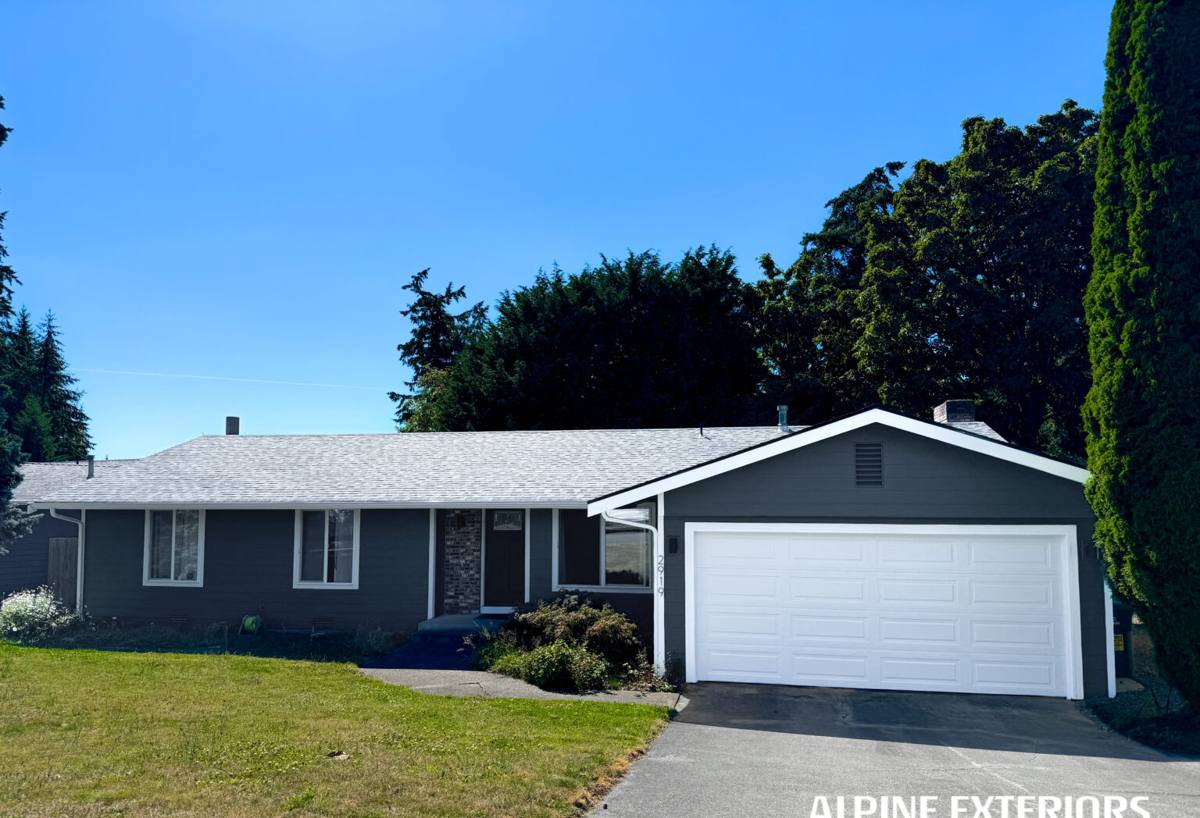
What Shoreline Homes Need From Their Siding
Siding on a Shoreline home is doing more work than siding on a house thirty miles inland. It needs to:
- Resist moisture intrusion from horizontal, wind-driven rain — not just water running down a wall
- Hold up to salt air without the finish chalking, fading, or breaking down prematurely
- Resist moss and algae growth during the long stretch of gray, damp months each year
- Stay dimensionally stable through repeated wet-dry and freeze-thaw cycles
- Not become a fuel source in wildfire-adjacent conditions, which matter more each summer across the Pacific Northwest
Vinyl siding flexes, gaps, and can warp under sustained wind-driven rain, and it offers nothing in the way of fire resistance. Untreated or primed wood products need a maintenance schedule most homeowners can't keep up with in a climate this wet. This is why we install James Hardie fiber cement siding exclusively — it's a non-combustible material engineered specifically for climates like this one, and it holds a factory finish that doesn't rely on the homeowner repainting every few years to keep water out.
James Hardie's Climate-Engineered Product Line
James Hardie manufactures different siding formulations for different climate zones, and the HZ10 product line is the one engineered for the Pacific Northwest — a wetter, milder climate than the HZ5 line built for harsher freeze-thaw regions elsewhere in the country. That distinction matters: it means the board itself is formulated for exactly the moisture load Shoreline sees, not a generic all-climate compromise.
ColorPlus Finish
We install Hardie boards with the factory-applied ColorPlus finish rather than field-painted siding. The finish is baked on in a controlled environment and backed by its own finish warranty, which means better fade resistance and a cleaner line at butt joints than site-applied paint typically achieves. In a climate with this much UV-and-moisture cycling, a factory finish is a meaningful advantage, not a cosmetic upsell.
Non-Combustible Material
Fiber cement doesn't ignite the way vinyl or untreated wood siding can. As wildfire smoke and ember exposure become a more regular part of Pacific Northwest summers, that's a real, practical benefit for homes throughout King County, including Shoreline.
What Correct Installation Actually Involves
Fiber cement siding is only as good as its installation. Most siding failures we're called out to inspect — cupping, staining, soft trim, water intrusion behind the wall — trace back to installation shortcuts, not the material itself. On a Shoreline home, where wind-driven rain is a regular occurrence, these details aren't optional:
- Weather-resistive barrier and proper flashing at every window, door, and penetration, installed shingle-style so water sheds outward and never behind the barrier
- Correct fastener placement and spacing per James Hardie's published fastening schedule — under-fastened boards work loose over time in sustained wind
- Proper clearance between the bottom edge of the siding and grade, decks, patios, and roof lines, so splash-back and ponding water can't wick into the board
- Gapped and caulked joints at the correct width, with a compatible, paintable sealant rated for the exposure
- Rainscreen or drainage plane detailing where the wall assembly calls for it, giving any moisture that does get behind the siding a path to drain and dry
None of this is unusual or specialized in the trade — but it's exactly the set of details that gets rushed on a job priced or scheduled too tight, and it's exactly what fails first in a climate that gives water this many chances to find a way in.
Moss, Algae, and the Long Wet Season
Shoreline's moss season isn't a minor annoyance — it's a multi-month condition that most siding materials in this region deal with every year. Moss and algae need sustained moisture and shade to establish, which is exactly what north-facing walls, tree-shaded siding, and slow-drying surfaces provide for much of the fall through spring stretch here.
Fiber cement doesn't feed mold and algae growth the way wood-based products can, and a smooth, factory-cured ColorPlus finish gives spores less to grip onto than a porous, field-painted surface. But installation still plays a role: proper clearance from landscaping, correct flashing that keeps water from pooling at trim and joints, and adequate ventilation behind the cladding all reduce how long a wall stays wet after a rain event — which is the real variable that determines how much moss and algae growth a home sees over the years.
Our Process on a Shoreline Project
- On-site inspection — we walk the exterior, check for existing moisture damage, evaluate the current wall assembly, and note drainage, grading, and shade conditions specific to the property
- Scope and product selection — we confirm which Hardie profile and ColorPlus color fit the home and discuss any trim, fascia, or soffit work that should happen alongside the siding
- Tear-off and wall prep — old siding comes off, the sheathing is inspected for hidden rot or moisture damage, and any needed repairs happen before a single new board goes up
- Weather barrier and flashing installation — this is the step that determines how the wall performs for the next several decades, and we don't compromise on it to save time
- Siding installation — fastened, gapped, and caulked to James Hardie's specifications for the HZ10 product line
- Final walkthrough — we review the completed job with the homeowner before considering it finished
Correct Installation vs. Common Shortcuts
| Detail | Correct Approach | Common Shortcut |
|---|---|---|
| Flashing at openings | Shingle-lapped, integrated with the weather barrier | Caulk-only, no flashing integration |
| Bottom clearance | Set per manufacturer spec above grade, decks, and roofs | Siding run tight to grade or hard surfaces |
| Fastening | Correct spacing and fastener type per Hardie's schedule | Under-fastened or wrong fastener for the substrate |
| Joints | Gapped and sealed with compatible sealant | Butted tight with no room to move |
| Finish | Factory-applied ColorPlus with its own warranty | Field-painted after installation |
Signs a Shoreline Home Needs New Siding
- Visible cupping, warping, or gaps between boards
- Soft or spongy spots when pressed near trim, corners, or the base of walls
- Persistent moss or dark staining that returns quickly after cleaning
- Peeling or bubbling paint on wood siding, especially on north- or shaded-facing walls
- Visible daylight or drafts at siding seams from inside the home
- Rising energy bills without another clear cause, which can point to a compromised wall assembly
Why Local Experience With Shoreline Homes Matters
A crew that already works in Shoreline knows the practical realities of the area: the mix of housing stock and ages common to the neighborhood, how close many lots sit to mature trees and shaded exposures, the permitting expectations of the local jurisdiction, and how differently a wall performs on a water-facing elevation versus a sheltered one. That local pattern recognition shortens the inspection phase and helps catch problems — hidden moisture, undersized flashing, prior repair shortcuts — before they become part of the new installation.
It also means a contractor who isn't guessing at how a King County jurisdiction handles siding permits or inspections, and who has already seen how James Hardie siding performs on homes with this exact salt-air, high-rainfall, long-moss-season combination — not just in a manufacturer's climate zone map, but on actual roofs and walls in the area.
Get a Free, No-Pressure Estimate
If your Shoreline home's siding is showing its age, or you're planning ahead of a wet season, we're happy to take a look and walk you through what correct James Hardie installation would involve for your specific property — no pressure, no obligation. Use the form below to request a free estimate.