 King County
 Why Bellevue Roofs Age Differently Than a Manufacturer's Spec Sheet Assumes
Every asphalt shingle sold in the Pacific Northwest carries a warranty written for average national conditions. Bellevue doesn't have average conditions. Sitting between Lake Washington and Lake Sammamish, homes here deal with a nearly constant marine air layer, long stretches of driving rain off the Sound, and a moss season that can run from late fall through spring in shaded, north-facing yards. None of that is catastrophic on its own, but stacked together year after year, it shortens the useful life of a roof that wasn't installed with this specific climate in mind.
Salt-laden marine air accelerates corrosion on exposed metal fasteners, flashing, and vent caps faster than it would inland. Driving rain finds its way into laps and seams that would stay dry in a lighter, more vertical rainfall pattern. And moss doesn't just look bad — its root structure lifts shingle edges and holds moisture against the mat, which is exactly the condition asphalt shingles are designed to avoid. A roof built to a generic spec can look fine for a few years and then fail early in all three of these areas at once.
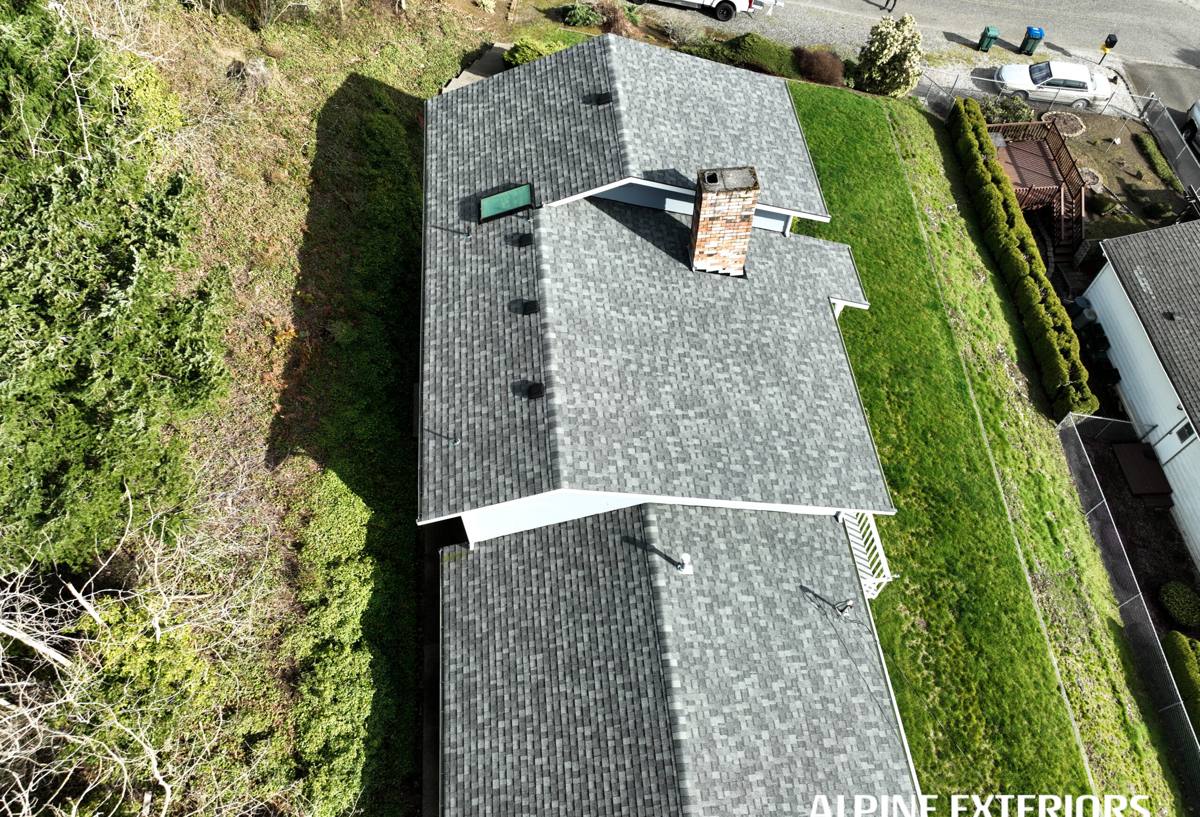
What a Correctly Installed Asphalt Shingle Roof Needs in King County
Underlayment and Ice/Water Barrier
In this climate, we treat synthetic underlayment as the baseline, not the upgrade. It resists moisture absorption far better than old-style felt, which matters when a roof deck can stay damp for days during a wet stretch. Self-adhered ice-and-water membrane belongs at eaves, valleys, and around every penetration — not because Bellevue gets heavy ice, but because wind-driven rain behaves a lot like ice damming in the way it pushes water backward under shingle laps.
Flashing That's Actually Sized for This
Step flashing at walls, counter-flashing at chimneys, and properly lapped valley metal are where most leaks in this region actually start — not in the field of the roof. We size and lap flashing for sustained wind-driven rain, not just a light shower, and we never rely on caulk or roof cement as a substitute for correctly installed metal.
Fasteners and Hardware
Given the marine air, we specify corrosion-resistant fasteners and hardware throughout, including at ridge vents and pipe boots. Cheaper fasteners can start showing rust streaks within a few seasons in this environment, which stains the shingles and signals a weak point underneath.
Choosing the Right Shingle for a Marine Climate
Not every asphalt shingle line performs the same way under sustained damp conditions and moss pressure. The table below reflects the honest trade-offs we walk homeowners through during an estimate — no single option is "best," they fit different priorities.
| Shingle Type | Typical Lifespan Here | Moss/Algae Resistance | Best Fit |
|---|---|---|---|
| 3-Tab Asphalt | 15-20 years | Lower unless algae-resistant granules specified | Budget-conscious rentals, secondary structures |
| Architectural (Laminate) | 25-30 years | Good, especially with copper/zinc granule blends | Most Bellevue homes — best balance of cost and durability |
| Impact-Resistant Architectural | 25-30 years, often with insurance discount eligibility | Good | Homes wanting storm-debris resilience |
| Premium/Designer Laminate | 30+ years | Very good with proper maintenance | Homeowners prioritizing appearance and longevity |
For most Bellevue properties, we recommend an architectural shingle with algae-resistant granules as the practical starting point. The upgrade cost over standard 3-tab is modest relative to the added years of service in a climate that punishes cheaper materials.
Moss, Algae, and Debris: The Maintenance Reality Homeowners Don't Expect
A shingle roof in this part of King County isn't a set-it-and-forget-it system the way it might be in a drier region. Shaded roof planes, especially those facing north or sitting under tree canopy near greenbelts, will develop moss and algae growth over time regardless of shingle quality. The question isn't whether it happens — it's how you manage it before it does damage.
- Zinc or copper control strips near the ridge let rain carry metal ions down the roof plane, which suppresses new moss growth over time without chemical treatment
- Gentle removal methods only — pressure washing and aggressive scraping strip granules and shorten shingle life
- Gutters and valleys need clearing more often here than in drier climates, since wet leaf litter combined with moss debris clogs drainage fast
- Overhanging branches should be trimmed back where practical to reduce shade and organic debris landing on the roof
We treat moss control as part of a maintenance plan, not a one-time fix. A roof that gets an annual check and light cleaning will consistently outlast one that's ignored until moss is visibly thick.
Ventilation and Attic Moisture: The Problem You Can't See From the Ground
Sustained regional humidity makes proper attic ventilation more important here than in drier parts of the country. Without balanced intake and exhaust airflow, moisture from daily household use gets trapped in the attic, condenses on the underside of the roof deck, and can lead to sheathing rot or mold — from the inside, independent of anything happening on the shingle surface. When we replace a roof, we evaluate existing soffit and ridge ventilation as part of the job, not as an upsell added later. Underventilated attics are one of the most common hidden problems we find on older Bellevue homes, and it's a major reason a "new roof" can still develop deck problems within a few years if ventilation isn't corrected at the same time.
Our Process, From Estimate to Cleanup
- On-site inspection: We walk the roof (weather permitting) and the attic, checking deck condition, ventilation, flashing points, and any existing moss or moisture issues — not just the shingle surface.
- Written estimate: You get a clear scope covering materials, underlayment, flashing detail, ventilation adjustments, and a firm price — no vague allowances.
- Material selection: We walk through shingle options with the comparison above in mind, matched to your home's exposure, shade level, and budget.
- Scheduling around weather: Given how much of the year involves rain in this region, we plan installation windows carefully and won't start a tear-off without a realistic dry-in timeline.
- Installation: Deck inspection and repair as needed, ice-and-water membrane at vulnerable areas, correctly lapped flashing, ventilation corrections, and shingle installation to manufacturer spec.
- Final walkthrough and cleanup: Magnetic sweep for stray fasteners, full debris haul-away, and a walkthrough so you know exactly what was done and what to watch for going forward.
Repair vs. Replace: How We Help You Decide
Not every roof problem in Bellevue means a full replacement. We look at age, extent of damage, and underlying deck condition before recommending either path.
| Factor | Favors Repair | Favors Replacement |
|---|---|---|
| Roof age | Under 15 years | Approaching or past 20-25 years |
| Damage extent | Isolated to one area or a few shingles | Widespread granule loss, multiple leak points |
| Deck condition | Sound, dry sheathing | Soft spots, rot, or signs of long-term moisture intrusion |
| Moss/algae staining | Surface-level, recently developed | Long-standing growth with visible shingle lifting |
| Ventilation | Already adequate | Needs correction — often bundled with replacement |
If a repair is the honest answer, that's what we'll recommend. Replacement only makes sense when the underlying system — deck, ventilation, and flashing — needs work that a patch can't reasonably fix.
Signs You Should Get a Roofing Estimate Soon
- Granules collecting in gutters or at downspout outlets
- Visible moss or algae streaking, especially on shaded slopes
- Curling, cupping, or cracked shingles
- Daylight visible through the roof deck from inside the attic
- Water stains on interior ceilings or upper walls after heavy rain
- Missing or lifted shingles after a windstorm
- A roof approaching 20+ years old with no recent inspection
Any one of these on its own isn't necessarily an emergency, but catching them early is what keeps a repair a repair instead of turning it into a full replacement.
Why Hiring a Crew That Already Works in Bellevue Matters
A roofing crew that works regularly across King County brings more than a truck and a nail gun to your driveway. We know how local building department permitting works for reroofs in this area, how HOA architectural review timelines typically run in Bellevue neighborhoods, and how to schedule tear-offs around the region's rain patterns instead of getting caught mid-job by a system moving in off the Sound. We also know which details — ventilation, flashing, fastener choice — actually matter for a roof that has to survive King County's specific combination of salt air, sustained rain, and moss pressure, because we see the failures that come from skipping them on other people's shortcuts, not just our own work.
That local familiarity translates into fewer surprises during the job and a roof that's built for the conditions it will actually face, not a generic install dropped into a marine climate it wasn't planned around.
If your roof is showing any of the signs above, or it's simply due for an honest look, we're happy to walk it with you. Reach out for a free, no-pressure estimate using the form below — we'll give you a straight assessment of what your roof needs and what it doesn't.