 King County
 Capitol Hill's Climate Is Harder on Roofs Than It Looks
Capitol Hill has some of the older, denser housing stock in King County, and that combination — age plus a long wet season — is exactly what wears a roof down faster than most homeowners expect. The Pacific Northwest doesn't hit roofs with hailstorms or extreme heat the way other regions do. Instead it wears them down slowly: months of driving rain pushed sideways by wind, a moss season that can run from fall through spring, and enough humidity in the air near Puget Sound to keep organic growth active even in the cooler months. None of that looks dramatic from the ground. It shows up later as a soft spot in the decking, a stain on a ceiling, or a slow drip that only happens during a hard storm.
We work roofs in Capitol Hill and the surrounding King County neighborhoods often enough to know the pattern. It's rarely one catastrophic failure. It's small, unaddressed wear — a lifted shingle tab, a gap in flashing, a clogged gutter backing water up under the roof edge — that turns into a repair call once it starts showing up inside the house.
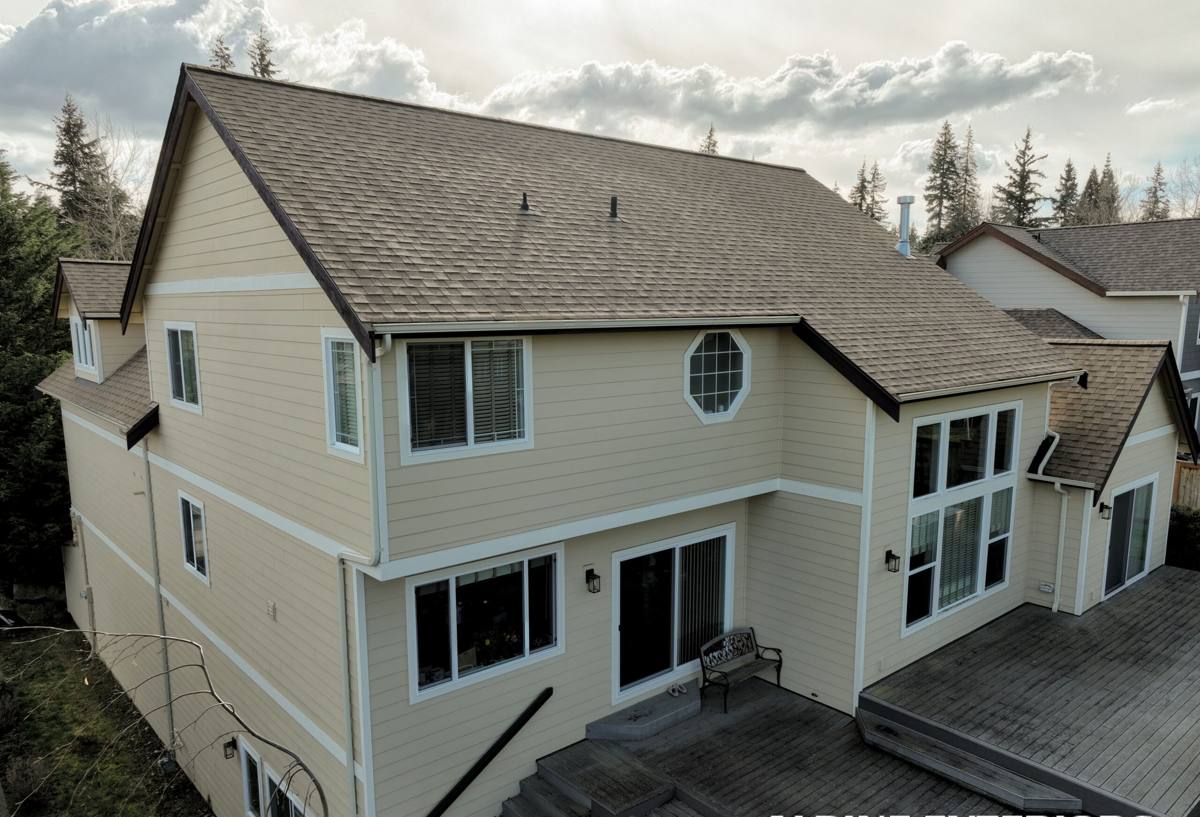
Where Repairs Usually Start: The Weak Points We Check First
Moss and Organic Growth
Moss doesn't just sit on top of a roof looking bad. Once it establishes itself, it holds moisture against the roofing material around the clock, even on days it isn't actively raining. On composition shingles, that constant dampness accelerates granule loss and can lift shingle edges. On any roof type, moss growing in a mat traps debris and creates small dams that redirect water sideways instead of down toward the gutters — which is how water finds its way under shingles or flashing that would otherwise have shed it fine.
Flashing and Transition Points
Almost every leak we trace back starts at a transition point, not the open field of the roof itself. That means valleys, chimney flashing, skylight curbs, vent boots, and the point where a roof meets a wall. Driving rain — rain pushed at an angle by wind instead of falling straight down — finds the small gaps at these points that would never leak in a light, straight-down rain. Capitol Hill's exposure to wind off the water makes this a bigger factor here than it would be in a more sheltered inland location.
Gutters and Edge Drainage
A gutter clogged with moss debris and fir needles doesn't just overflow — it backs water up under the first course of shingles or shakes, right at the roof edge. This is one of the most common "mystery leak" causes we find, and it's often mistaken for a roofing material failure when the real problem is drainage.
Aging Materials on Older Homes
A lot of Capitol Hill's housing predates modern roofing underlayment standards. Older felt paper underlayment, original flashing metal that's thinned with age, and decking that's seen decades of seasonal wetting and drying all mean a repair on one of these homes needs more judgment than a straight material swap. We check condition, not just age, before recommending anything.
What a Correct Roof Repair Actually Involves
A roof repair that actually holds up isn't just patching the spot where water showed up inside. Water travels — it can enter several feet from where a stain appears on a ceiling, running along rafters or sheathing before dripping down. A repair done right traces the entry point, not just the symptom.
- Confirm the actual entry point by inspecting the roof surface, not just the interior stain location
- Check the decking underneath the damaged area for soft spots, rot, or delamination before replacing anything on top of it
- Match or properly integrate new material with the surrounding roofing so the repair doesn't create its own new seam
- Re-flash any penetration, valley, or wall transition involved rather than caulking over old flashing
- Clear and check nearby drainage — a repair next to a clogged gutter is a repair that fails again
- Verify the fix from inside the attic or crawlspace where accessible, not just from the roof surface
Skipping any of those steps is how a repair ends up being temporary. Caulk and sealant have a place in roofing, but they're not a substitute for correct flashing or sound decking — they buy a season or two at best when used as the primary fix.
Our Repair Process
We keep the process straightforward because homeowners deserve to know what's happening to their roof and why.
- Inspection and diagnosis. We get on the roof (weather permitting) and look at the suspected area plus anything upstream of it — valleys, penetrations, gutters — that could be feeding water toward the problem.
- Honest assessment. We tell you what we found, what's causing it, and whether it's a contained repair or a sign of broader wear that's worth planning around. If it's not urgent, we say so.
- Written scope and price range. Before any work starts, you know what's being repaired and roughly what it will cost — no surprise add-ons once we're already on the roof.
- The repair itself. Decking replaced if needed, flashing rebuilt where required, matching material installed, and drainage cleared around the work area.
- Follow-up check. Wherever possible, we look at the area again after the next significant rain to confirm the fix is holding, especially on repairs done during a break in a longer wet stretch.
Repair or Replace? How We Help You Decide
Not every roof problem calls for a full replacement, and not every "small leak" is actually small once you're up close. Here's the general framework we use when a Capitol Hill homeowner asks which way to go:
| Situation | Usually a Repair | Usually Points to Replacement |
|---|---|---|
| Age of roofing material | Roof is within its expected service life | Roof is at or past the end of its typical lifespan for that material |
| Extent of damage | Isolated to one section, flashing point, or penetration | Multiple areas failing independently across the roof |
| Decking condition | Solid decking under the damaged shingles or flashing | Widespread soft spots or rot found during inspection |
| Granule loss / wear pattern | Localized wear near the leak | Even wear and granule loss across the whole roof surface |
| History of repairs | First or second repair call on this roof | Recurring leaks in different spots year after year |
We'll always tell you honestly which column your roof falls into rather than defaulting to the more expensive answer. Plenty of the repair calls we get on Capitol Hill are legitimately just that — a repair, not the start of a sales pitch for a new roof.
Roofing Materials Common on Capitol Hill Homes
What a roof is made of changes how it should be repaired and what to watch for in this climate.
| Material | How It Handles Local Rain and Moss | Repair Considerations |
|---|---|---|
| Composition (asphalt) shingles | Performs well when granules are intact; moss and debris accelerate wear if left unmanaged | Matching shingle color/style on older roofs can be limited; blend carefully at repair edges |
| Cedar shake / shingle | Traditional to the area but needs airflow underneath to dry out between rains; trapped moisture from moss speeds rot | Individual shake replacement is doable, but check surrounding shakes for hidden rot first |
| Metal roofing | Sheds water and resists moss buildup better than most materials, though seams and fasteners are still failure points | Repairs are usually about fastener and seam integrity, not the panel material itself |
| Flat / low-slope membrane | Common on additions and some older Capitol Hill homes; standing water and ponding are the main risk in a long wet season | Seam and penetration repair requires membrane-specific technique, not generic patching |
Our standard on any of these is the same: repair with material and technique that matches how that roof type is supposed to perform, not a quick patch that happens to stop the drip for now.
A Homeowner's Moss-Season Maintenance Checklist
Most of the emergency repair calls we get during the wettest months trace back to something that was manageable a season earlier. This is what we'd tell any Capitol Hill homeowner to stay ahead of it:
- Clear moss and debris from the roof surface before it mats down and holds moisture — don't let it accumulate over multiple seasons
- Keep gutters clear, especially before the heaviest rain months, so edge drainage never has a chance to back up under shingles
- Have flashing around chimneys, skylights, and roof-wall transitions checked every couple of years, not just when a leak already shows up
- Trim back overhanging branches that keep sections of the roof shaded and damp longer than the rest
- Look at ceilings and attic spaces after the first hard, wind-driven storm of the season — that's when marginal flashing usually shows itself first
- Don't power-wash a roof to remove moss — it can strip granules and drive water under shingles; use methods appropriate to the material
Why Hire a Crew That Already Works This Neighborhood
Capitol Hill has its own practical challenges that don't come up the same way in less dense parts of King County — narrow lot access, shared walls and setbacks between houses, older permit records, and a real mix of building ages and styles on the same block. A crew that's already worked in the neighborhood knows how to stage a repair safely on a tight lot, recognizes the roofing patterns common to the area's older homes, and isn't guessing at how a particular vintage of construction was originally flashed or vented.
That familiarity also means fewer surprises once we're on the roof. We've seen enough Capitol Hill roofs to know which older flashing details tend to fail first, which material combinations don't dry out well in a Pacific Northwest wet season, and where builders decades ago cut corners that show up as today's leak. That's the kind of context a crew unfamiliar with the area or its housing stock simply doesn't have walking in.
If you're dealing with a leak, a soft spot, or just want an honest look at what moss season has done to your roof, we're glad to come take a look. The estimate is free, there's no pressure attached to it, and you'll get a straight answer about whether you're looking at a repair or something bigger — just fill out the form below to get started.