 King County
 Windows Built for How Mercer Island Actually Weathers
Mercer Island sits in the middle of Lake Washington, connected to the rest of King County by bridges, and surrounded by water on every side. That location gives homes here a specific set of problems that inland houses don't deal with in the same way. The broader Puget Sound region's marine air, long stretches of driving rain, and a moss season that can run from fall through spring all put steady pressure on window seals, frames, and glazing. Add lake-reflected sun in summer and steep temperature swings between a cold night and a warm afternoon, and you get windows that are working harder, year-round, than the manufacturer's spec sheet assumes.
Energy-efficient windows aren't just about a lower heating bill, though that's real. On Mercer Island they're also about keeping moisture out of wall cavities, keeping condensation off glass and sills, and holding a tight seal through decades of wet-dry cycling. A window that's efficient on paper but poorly installed will still leak, fog, and rot at the sill in this climate. The installation matters as much as the product.
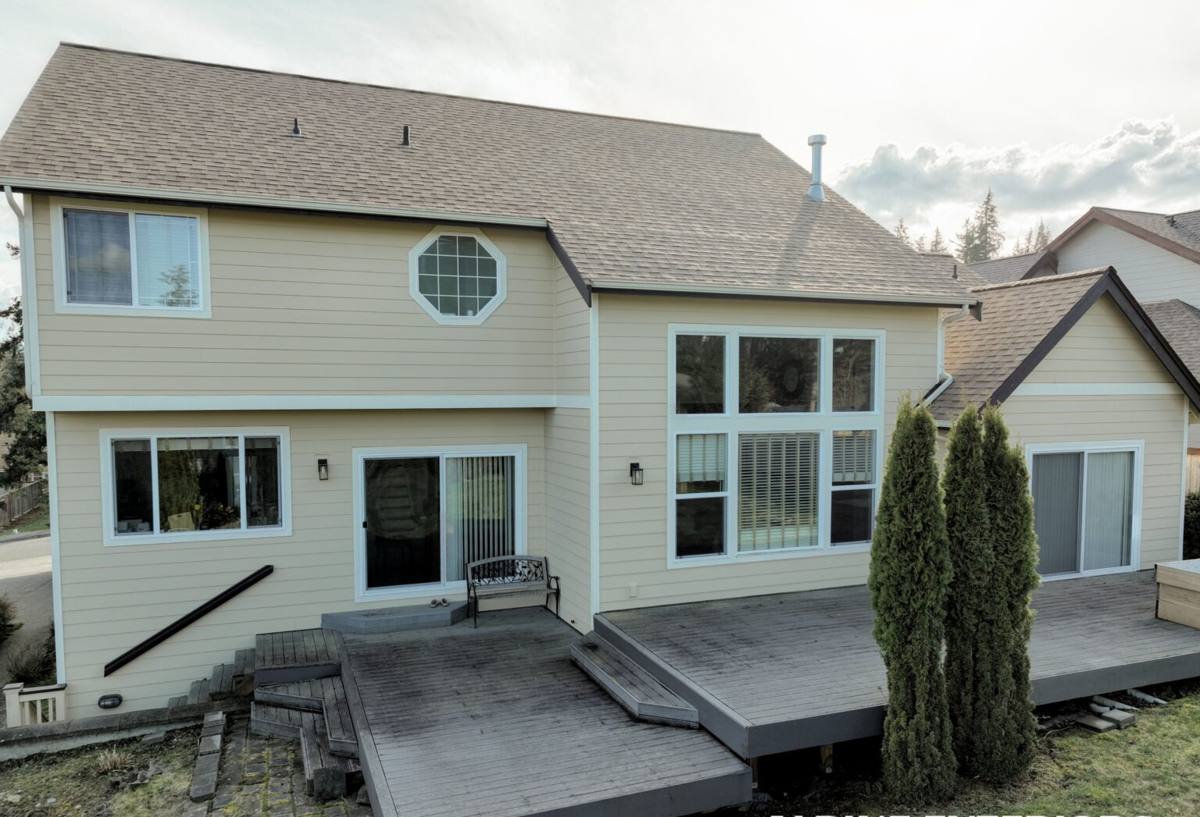
What King County's Climate Actually Does to Windows
Moisture Is the Real Enemy
Rain that comes in sideways during a windstorm, condensation from indoor humidity meeting cold glass, and moss or algae holding water against sills and trim — all of it adds up to slow water intrusion. Left unchecked, that moisture gets behind trim, into framing, and eventually shows up as soft wood, peeling paint, or a musty smell nobody can quite locate.
Temperature Swings Stress the Seals
Insulated glass units rely on a sealed gas-filled space between panes. Repeated expansion and contraction from cold mornings and warm afternoons — common with lake-reflected light — is exactly the kind of cycling that eventually breaks down edge seals on lower-quality units, leading to the fogged or hazy glass you see on older double-panes.
Moss and Organic Growth
A long moss season means more organic debris sitting in window tracks, weep holes, and sill corners. That debris holds moisture and can clog the small drainage paths that are supposed to let water escape a window assembly, which turns a well-designed window into one that traps water instead of shedding it.
Signs Your Current Windows Are Costing You Money
- Visible fog, haze, or moisture between the panes of a double- or triple-pane window
- Cold drafts near the window frame even when it's fully closed and locked
- Sills or corners that feel soft, look discolored, or show peeling paint
- Condensation forming on the inside of the glass regularly, especially in bathrooms and kitchens
- Windows that are hard to open, close, or lock — a sign the frame has shifted or swollen
- A noticeable temperature difference standing near the window versus the middle of the room
- Visible gaps or failed caulk/sealant around the exterior trim
Any one of these is worth a look. Several together usually mean the windows are past the point where caulk and weatherstripping will fix the problem.
What a Correct Window Job Actually Involves
Replacing a window is more than swapping glass in a frame. Done right, the work includes several steps that are easy to skip if a crew is moving fast:
- Removal without damage — taking out the old unit without tearing up siding, trim, or interior finish more than necessary.
- Inspecting the rough opening — checking the framing and sheathing underneath for rot or moisture damage before anything new goes in. This is the step that gets skipped most often, and it's the one that matters most in a wet climate.
- Flashing and water management — installing flashing tape and drainage paths so any water that does get past the exterior finish has somewhere to go besides your wall cavity.
- Air sealing — using low-expansion foam or backer rod and sealant around the frame, not just caulk on the outside trim.
- Level, plumb, and square set — a window that's slightly out of square will bind, won't seal evenly, and will wear unevenly over time.
- Exterior finish work — trim, caulking, and paint or stain matched to the surrounding siding so the house looks finished, not patched.
- Cleanup and disposal — old glass and frames hauled off, not left leaning against the garage.
Skipping the framing inspection or the flashing detail is how a "new window" ends up with a rot problem behind it five years later that costs far more to fix than the window did.
Choosing Frame Material and Glass
There's no single "best" window for every house — it depends on your budget, your home's age and style, and how much upkeep you want to take on. Here's how the common options compare for a King County home:
| Frame Material | Energy Performance | Maintenance | Typical Lifespan | Best For |
|---|---|---|---|---|
| Vinyl | Good; multi-chamber designs insulate well | Low — no painting, occasional cleaning | 20–30 years | Budget-conscious replacements, rental properties |
| Fiberglass | Very good; stable in temperature swings | Low | 30–40+ years | Homes wanting long-term durability without wood upkeep |
| Wood-clad | Good, depends on glass package | Moderate — exterior clad protects wood, interior wood needs care | 20–30 years, cladding-dependent | Traditional or historic-style homes wanting a wood interior look |
| Aluminum | Weakest without thermal breaks | Low | 20–30 years | Large commercial-style openings, generally not our first recommendation for residential energy performance |
On the glass side, look at the U-factor (lower is better for insulation) and the Solar Heat Gain Coefficient (lower helps with west- and south-facing rooms that pick up strong lake glare). Double-pane with a good low-E coating and argon fill covers most homes here well; triple-pane adds cost and weight but can be worth it on north- or water-facing walls that take the brunt of wind and rain.
How We Approach a Mercer Island Project
Every home and every window opening is a little different, but our process stays consistent:
- On-site assessment — we look at each window individually, not just from a price-per-unit spreadsheet, and flag any openings that show signs of moisture or framing issues.
- Straightforward proposal — options at a few price and performance points, explained in plain terms, with no pressure to upgrade past what your house actually needs.
- Scheduling around access — Mercer Island properties often have tighter driveways, water-side decks, or bridge-dependent delivery timing; we plan material drop-off and crew access accordingly so a job doesn't stall waiting on a truck.
- Careful installation — the framing check, flashing, and air-sealing steps described above, done the same way whether it's one window or a whole house.
- Final walkthrough — checking operation, seals, and exterior finish with you before we call it done.
Why Local Experience on Mercer Island Matters
A contractor who already works this area understands things that don't show up in a generic estimate: how King County's permitting and inspection process works for window replacement, what HOA or design-review expectations look like in some Mercer Island neighborhoods, and how to plan logistics around an island with limited bridge access rather than showing up with the wrong materials and losing a day. That familiarity translates into fewer surprises, fewer delays, and a job that accounts for the site conditions from the start instead of discovering them mid-project.
It also matters for accountability. A crew that plans to keep working in this community has every reason to do the flashing and sealing correctly the first time, because a callback for a leak is a conversation with a neighbor, not an anonymous complaint.
Keeping New Windows Performing for the Long Haul
Even a well-installed window needs some basic upkeep in this climate:
- Clear moss, leaves, and debris from tracks, sills, and weep holes a couple of times a year
- Check exterior caulking annually for cracks or gaps, especially after a hard winter
- Wipe down tracks and hardware periodically so moving parts don't bind
- Watch for early condensation or fogging between panes and address it before it spreads to other units
- Keep gutters and downspouts clear so overflow doesn't run down onto window heads
None of this is complicated, but skipping it is how small problems turn into sill rot or a failed seal a few years earlier than they should.
Let's Look at Your Windows
If your windows are drafty, foggy, hard to operate, or just old enough that you're wondering whether they're still doing their job, it's worth having someone look at them before winter rain and moss season put more strain on them. We're happy to walk through your home, point out what's working and what isn't, and give you a clear, no-pressure estimate — use the form below to get started.