 King County
 Building Decks for Mercer Island's Particular Conditions
Mercer Island sits in a spot most decks weren't designed for. It's an island community wrapped in mature tree canopy, surrounded by Lake Washington, and tucked into the broader Puget Sound weather pattern that keeps King County damp for most of the year. That combination — shade, standing moisture, and long stretches without direct sun to dry a deck surface — is harder on outdoor structures than most manufacturers' warranty language assumes. A deck built the way it would be built in a drier, sunnier part of the country tends to show problems here within a few seasons: soft spots, cupped boards, black-green streaking, and fasteners that back out as wood moves with the moisture cycle.
A deck built for Mercer Island has to account for shade cover that keeps decking wet for hours after rain stops, drainage that has to move water off the structure and away from the house rather than just off the surface, and a maintenance reality where moss and algae are a normal seasonal event, not an occasional nuisance. None of that is exotic engineering — it's just building to the conditions that are actually here, instead of the conditions a generic deck spec assumes.
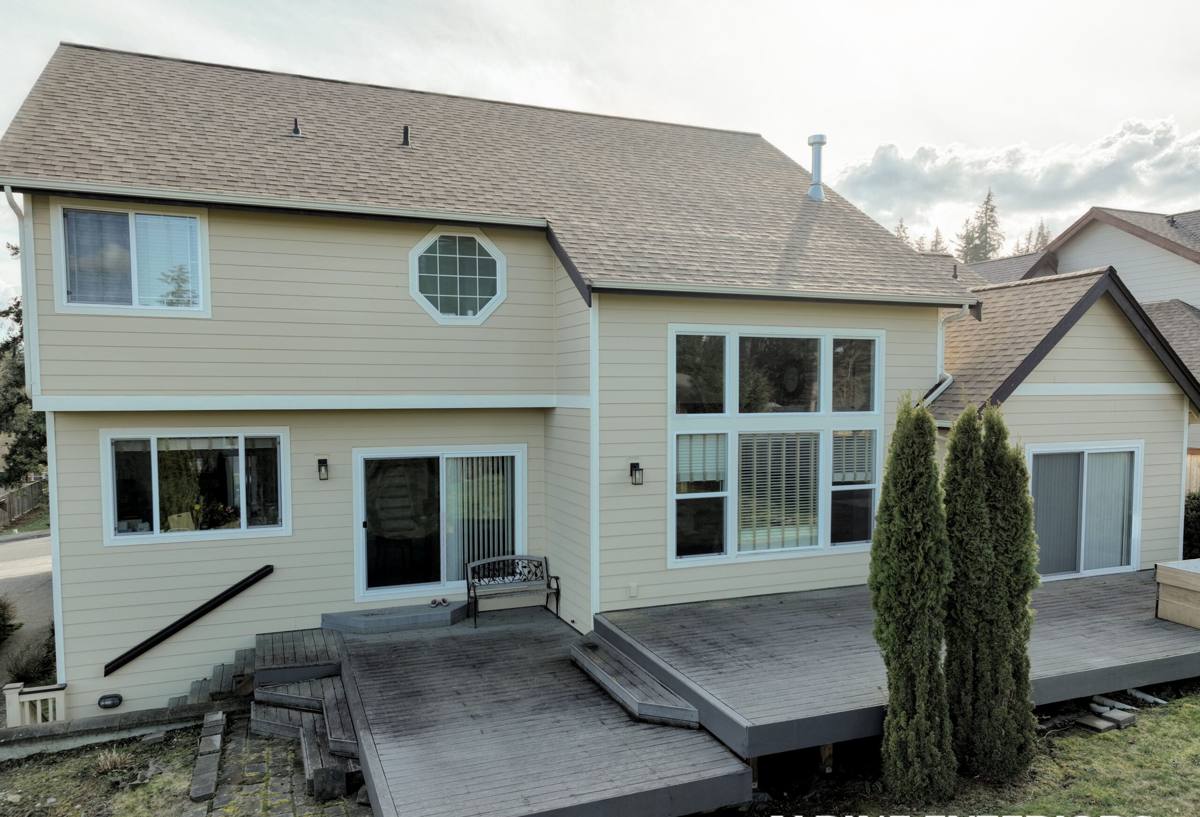
What Actually Wears Out a Deck Here
Shade and Moss
Mercer Island's tree cover is one of its defining features, and it's also the single biggest factor in how fast a deck surface goes green. Moss and algae need moisture and lack of direct sun to establish — a shaded deck under overhanging branches can hold dampness long after an open, sun-exposed deck elsewhere in the county has already dried out. Moss on a walking surface isn't just cosmetic; it holds water against the board and turns a dry surface into a slip hazard after almost any rain.
Driving Rain and Standing Moisture
King County's rain doesn't always fall straight down — wind-driven rain gets pushed under rail caps, into ledger connections, and along the underside of boards where it doesn't evaporate quickly. Over years, that's what causes ledger rot at the house connection, corroded fasteners, and joists that fail from the inside out while the top of the board still looks fine.
Freeze-Thaw and Wood Movement
King County doesn't get brutal winters, but it does get repeated cycles of wet, cold, and mild that make wood swell and shrink. Boards installed without the right gapping cup, crown, or pull away from fasteners over a few seasons — a detail that matters more here than in drier climates because the wood never fully dries out between cycles.
What a Correctly Built Custom Deck Involves
A deck is only as good as what's underneath it. The visible decking gets all the attention, but the structure below it is what determines whether the deck is still solid in fifteen years or needs major rework in five.
- Ledger attachment: Properly flashed and lagged into the house framing, with a water-diverting flashing detail so rain can't get behind the ledger board — the single most common point of hidden rot on older decks.
- Footings sized for the soil: Mercer Island's soil varies by lot — some areas hold water more than others — so footing depth and bearing need to match actual conditions, not a generic minimum.
- Joist spacing matched to the decking: Composite and PVC boards often need tighter joist spacing than traditional wood to avoid flex and long-term sagging — a spec detail that's easy to skip and expensive to fix later.
- Proper board gapping: Correct spacing lets water and debris pass through instead of collecting, and gives the boards room to move with seasonal humidity.
- Fasteners rated for exterior, wet-climate use: Coated or stainless fasteners appropriate to the board material, not whatever's cheapest at the yard.
- Drainage below the deck: Especially on lower decks or ones over living space, water needs a planned path off the structure and away from the foundation, not just down through the gaps.
Choosing a Decking Material for This Climate
There's no single "best" decking material — the right choice depends on how much maintenance a homeowner actually wants to do, and how much shade the deck sits under. On a Mercer Island lot with significant tree cover, moisture resistance and moss behavior often matter more than upfront cost.
| Material | Upfront Cost | Maintenance | Moisture / Moss Behavior | Typical Lifespan |
|---|---|---|---|---|
| Cedar / Wood | Lowest to moderate | Annual cleaning and re-staining or sealing | Absorbs moisture; needs regular sealing to resist moss and rot in shaded areas | 10-15 years with upkeep |
| Capped Composite | Moderate to high | Periodic washing, no staining or sealing | Resists rot; can still hold surface algae in deep shade if not cleaned | 25-30 years |
| PVC / Cellular Decking | Highest | Lowest — occasional washing | Doesn't absorb moisture; best performance in heavily shaded, damp spots | 30+ years |
We don't push one material as universally right. A sunnier deck with an open lake view can do well with a well-maintained wood or standard composite. A deck tucked under fir and cedar canopy — common on interior lots here — usually holds up better long-term with a capped composite or PVC product, simply because it doesn't give moss and algae the organic material they need to take hold.
Why We're Careful About Certain Wood Species and Uncapped Composites in Deep Shade
Untreated or uncapped products can perform fine in open sun, but in a shaded, moisture-retentive spot they need more attention to stay ahead of surface growth and moisture uptake than most homeowners want to commit to. That's a maintenance-burden and moisture-behavior tradeoff we'll walk through honestly for your specific lot, rather than defaulting to whatever's easiest to install.
Permits, Setbacks, and Working Within Mercer Island's Rules
Mercer Island, like other King County cities, has its own permitting process for new deck construction and significant rebuilds, along with setback requirements from property lines and, in many cases, tree protection considerations given how much of the island's character comes from its tree canopy. We handle the permit submission and inspection scheduling as part of the project rather than leaving it to the homeowner to navigate — it's part of doing the job right, not an upsell.
Our Process, Start to Finish
- On-site walkthrough: We look at sun exposure, tree cover, existing structure (if any), and how the deck ties into the house before recommending anything.
- Material and layout discussion: We go over the tradeoffs in the table above against your specific lot conditions and budget — no pressure toward the highest-margin product.
- Permit handling: We prepare and submit what's needed for the city and schedule required inspections.
- Demo (if replacing an existing deck): Old structure removed, framing and ledger inspected for hidden rot before anything new goes up.
- Framing and structural work: Footings, ledger flashing, joists, and drainage detailing done to spec before decking goes down.
- Decking installation: Boards, railing, and stairs installed with correct gapping and fastening for the material chosen.
- Final walkthrough: We go over care and cleaning specific to the material and the amount of shade your deck sits in.
Keeping a Mercer Island Deck in Good Shape Year-Round
- Sweep leaves and needles off the deck regularly in fall — trapped organic debris is what feeds moss and algae growth.
- Rinse the surface every few months, more often on heavily shaded sections, to keep spores from establishing.
- Check and clear gaps between boards so water keeps draining through rather than pooling.
- Inspect railing posts and stair stringers annually for movement or soft wood, especially where they meet the ground or a ledger.
- Re-seal or re-stain wood decking on the schedule the product calls for — skipping a cycle in this climate compounds fast.
- Trim back overhanging branches where practical to give the deck surface more light and airflow.
- Have fastener heads and flashing points checked every couple of years, since that's where hidden moisture damage starts.
Why a Local Crew Matters for This Job
A deck built by a crew that doesn't regularly work in King County's wet, shaded conditions will often build to a generic spec — one that looks fine on paper but doesn't account for how much moisture this region actually holds against a structure over a full year. A crew that already works on Mercer Island and the surrounding area knows which framing and drainage details matter here, has already worked through the local permitting process, and isn't guessing at how a given material will hold up under this specific mix of shade, rain, and lake-driven humidity. That familiarity shows up in fewer callbacks and a deck that's still solid a decade or two out, not just at the final walkthrough.
If you're planning a new custom deck or need an honest opinion on whether an existing one is still sound, we're glad to take a look. Fill out the form below for a free, no-pressure estimate — we'll walk your specific lot, talk through material options that make sense for your sun and shade conditions, and give you a straight answer on what the job actually involves.