 King County
 Mercer Island's Water-Surrounded Climate Is Hard on Siding
Mercer Island sits entirely surrounded by Lake Washington, connected to Seattle and Bellevue by the I-90 corridor, and that setting changes what your siding deals with day to day. It isn't the direct salt spray you'd get living right on Puget Sound's shoreline, but the steady humidity coming off the lake, combined with the driving rain that moves through King County for much of the year, keeps exterior walls damp longer than they'd stay a few miles inland. Add in a long moss season under the mature tree canopy that shades much of the island, and you have conditions that will find every weak point in a siding system over time.
None of that means siding is doomed here. It means siding has to be installed and repaired correctly the first time, with materials that were engineered to handle sustained moisture rather than materials that merely tolerate it. When a repair is done right, it should hold up under exactly these conditions for decades. When it's done as a quick patch, the same conditions will expose it again within a season or two.
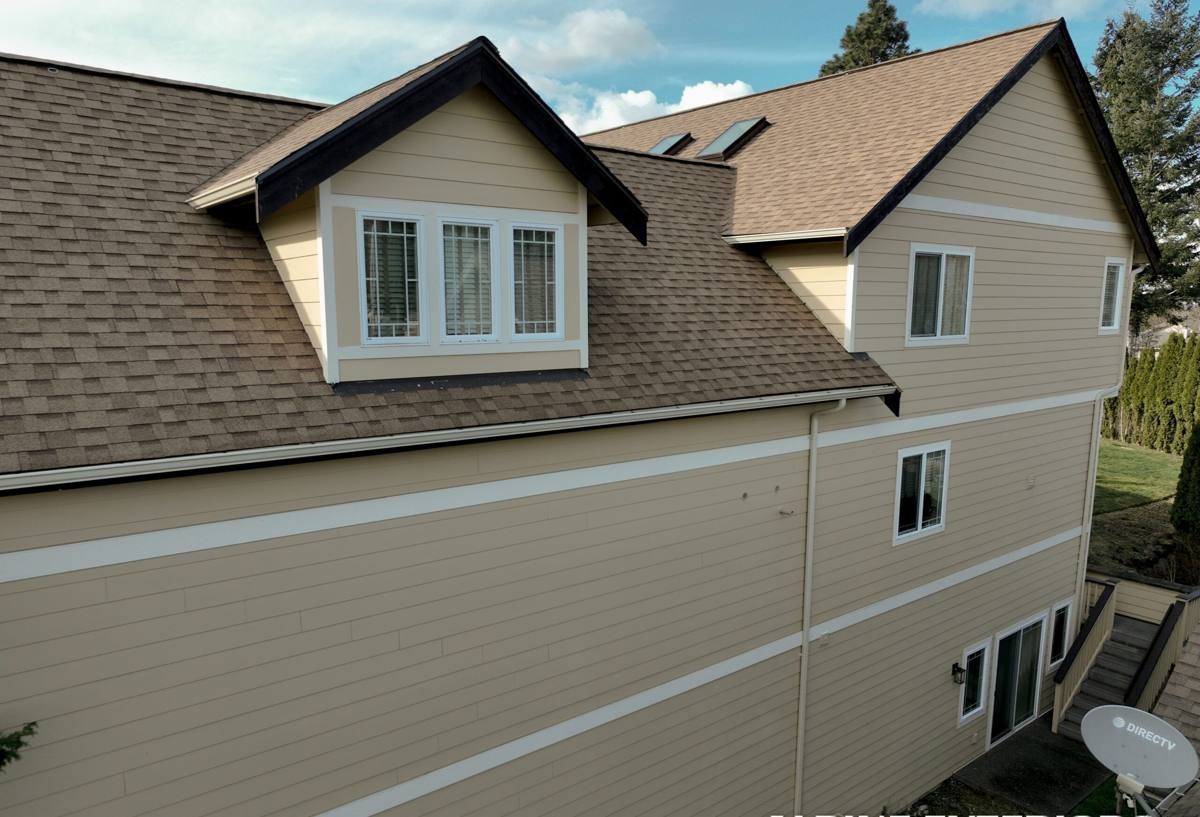
What Repair-Worthy Damage Looks Like on Mercer Island Homes
Most siding problems don't announce themselves as a hole in the wall. They show up as small, easy-to-dismiss signs that indicate moisture is already working its way into the assembly. On shaded, north-facing walls and anywhere tree cover keeps a wall from drying out between rains, the signs tend to show up earlier and more persistently than on sun-exposed elevations.
- Soft or spongy spots when you press on a board, especially near the bottom courses or below windows
- Paint that's bubbling, peeling, or alligatoring in patches rather than evenly across a wall
- Visible moss, algae, or black streaking that keeps returning after cleaning
- Boards that are cracked, cupped, bowed, or pulling away from the wall at the edges
- Gaps or separation at corner boards, trim, and butt joints where caulking has failed
- Water stains or discoloration on the interior side of an exterior wall
- A musty smell near an exterior wall that doesn't go away with ventilation
Any one of these on its own might be minor. Several showing up in the same area of the house usually means water has been getting behind the siding for a while, and the repair needs to start with finding out how it got in — not just replacing what's visibly damaged.
Repair or Replace? How We Make That Call
Not every damaged section needs a full re-side, and we're not going to tell a homeowner they need whole-house replacement when a targeted repair will hold. The decision comes down to a handful of factors we walk through during an assessment.
| Factor | Favors Repair | Favors Replacement |
|---|---|---|
| Extent of damage | Isolated to a wall section or a handful of boards | Spread across multiple elevations |
| Age of existing siding | Still well within its expected service life | Near or past the end of its practical lifespan |
| Underlying sheathing | Dry and structurally sound once opened up | Soft, rotted, or showing long-term water damage |
| Material match | Product is still available or a close match can be sourced | Discontinued color, profile, or product line |
| Root cause | A single, correctable issue like a flashing or caulking failure | Systemic issues — poor original installation, chronic drainage problems |
If the framing behind the siding has stayed dry, a well-executed repair can genuinely extend the life of a wall for years. If water has already reached the sheathing or framing, patching the surface without addressing what's underneath just buries the problem under new material.
What a Correct Siding Repair Actually Involves
A repair that's going to last on Mercer Island has to treat the cause of the damage, not just the symptom. That means the process looks the same whether we're replacing three boards or a whole wall section.
Diagnose before you touch a board
Before anything comes off the wall, we figure out how water got in — failed caulking, a flashing gap above a window or door, siding installed too close to grade or a deck surface, or a nail pattern that let moisture track behind the boards. Replacing damaged siding without fixing the entry point just means a repeat visit.
Protect the water-resistive barrier and flashing
The house wrap and flashing behind your siding are doing more work than the siding itself in a lot of ways — they're the layer that actually keeps bulk water out of the wall assembly. Removing damaged boards has to be done carefully so that layer isn't torn, and any flashing that's cracked, rusted, or improperly lapped gets corrected as part of the repair, not left in place.
Check the sheathing
Once boards are off, we inspect the sheathing underneath for softness or rot. Damaged sheathing gets replaced before new siding goes back up — it's the difference between a repair that lasts and one that fails again from the inside out.
Install and finish to spec
New boards get properly primed on cut edges, fastened per manufacturer spacing, and caulked at the joints that call for it — not everywhere, since over-caulking a fiber cement wall can trap moisture rather than shed it. Where color matching is part of the job, we work to get the new sections as close to invisible as the existing material allows.
Why Patch Jobs on the Wrong Material Don't Hold Up Here
We only install and repair with James Hardie fiber cement siding, and Mercer Island's climate is a big part of why. A lot of the repair calls we see involve other materials that were never particularly forgiving of sustained moisture, and patching them doesn't change that underlying weakness.
Vinyl siding flexes and gaps at the seams over time, and once water finds its way behind a panel, there's no drying it out from the outside — the panel just sits over damp sheathing until someone pulls it off. Cedar looks right for this region but demands ongoing refinishing to keep water out, and a missed maintenance cycle in a shaded, damp spot is exactly how rot gets started. Engineered wood products like LP SmartSide are more moisture-resistant than raw wood but are still wood-based at the core, meaning a compromised edge or a gap in the factory coating can lead to swelling that a surface patch won't reverse.
None of that is a knock on those products in every setting. It's why, on a wet, tree-shaded island where a wall can stay damp for days after a storm, we standardized on a material that doesn't rely on a coating or a paint film to keep moisture out of its core.
Repairing With — and Matching To — James Hardie Fiber Cement
James Hardie's fiber cement is engineered from cement, sand, and cellulose fibers, which means it doesn't absorb and swell the way wood-based products can, and it won't warp, delaminate, or feed rot the way an already-compromised wood product can once water gets behind it. The HZ5 product line is formulated for regions like ours that see sustained wet weather, and the factory-applied ColorPlus finish is baked on under controlled conditions rather than field-painted, which is part of why it holds color and resists cracking longer than a job-site paint job.
That factory finish is also why matching matters on a repair. Because ColorPlus colors are proprietary and consistent from the factory, sourcing the correct matching boards and touch-up product gives a repaired section a far closer match than trying to hand-mix and brush-match a field-painted product. It's one more reason repairs on Hardie siding tend to look intentional rather than patched.
Signs a Repair Was Done Correctly
- The cause of the original damage — flashing, caulking, grade clearance — was addressed, not just the visible boards
- Sheathing was inspected and any damaged material replaced before new siding went up
- Fasteners and joint spacing follow manufacturer installation specs, not a shortcut pattern
- Color and profile match closely enough that the repair isn't an eyesore from the curb
- Caulking is used at transitions and joints that call for it, not smeared over the whole repair as a catch-all
Our Process for a Mercer Island Repair Call
Because so much of Mercer Island is waterfront or view property with mature landscaping, access and site conditions are part of nearly every job here, not an afterthought. Our process accounts for that from the first visit.
- On-site assessment. We look at the damaged area, check surrounding walls for related issues, and identify the likely water entry point rather than just quoting the visible repair.
- Straightforward estimate. You get a clear scope — what's being replaced, what's being repaired, and why — before any work starts.
- Access and site planning. Tight side yards, sloped waterfront lots, retaining walls, and tree canopy all affect how a job gets staged, and we plan for that up front instead of discovering it mid-job.
- Weather-aware scheduling. Board and sheathing replacement needs a dry work window; we schedule around the rain rather than rushing a repair into wet conditions.
- Cleanup and walk-through. We remove debris and walk the repair with you so you know exactly what was done and why.
Why It Matters to Hire a Crew That Already Works Mercer Island
Siding repair on Mercer Island isn't identical to a repair job a few miles away in a drier, more open neighborhood. A crew that regularly works the island already understands how the lake-effect humidity and heavy tree canopy tend to concentrate damage on certain elevations, knows what King County permitting involves for exterior work, and is used to the tighter access and grading challenges that come with a lot of Mercer Island's waterfront and hillside lots. That familiarity shows up in fewer surprises once a wall is opened up and in a repair that's planned around your property instead of a generic checklist.
It also matters for how the finished work looks. Mercer Island homeowners tend to care about curb appeal and long-term value, and a repair that's mismatched in color or profile stands out on a house that's otherwise well maintained. A crew that treats the repair as a real extension of the existing siding — not just a functional patch — is doing the job the way it should be done.
Get an Honest Look at Your Siding
If you're seeing soft spots, peeling paint, persistent moss, or water staining on your Mercer Island home, it's worth getting it looked at before the next wet season makes the problem bigger. We'll give you a straightforward read on whether you're looking at a repair or something more, with no pressure either way — request a free estimate using the form below.