 King County
 Redmond's Climate Is Harder on Siding Than It Looks
Redmond doesn't get hurricanes or hailstorms, so it's easy to assume siding here just quietly ages out. In practice, the wear is slower but more relentless. King County's long wet season pushes moisture into siding for months at a stretch, driving rain off the Cascades and Puget Sound frequently hits west- and south-facing walls at an angle, not just straight down, and the tree cover that makes Redmond neighborhoods so pleasant also keeps siding shaded and damp longer after every storm. Add in the moss and algae growth that thrives in that shade, and you get a climate that specifically targets whatever weak points exist in a home's exterior envelope.
None of this is dramatic on its own. It's cumulative. A caulk joint that opens a hair, a piece of trim that wasn't back-primed, a butt joint that wasn't flashed correctly — in a drier climate those might last decades before causing a problem. In Redmond's climate, they become entry points for moisture within a few wet seasons, and once water gets behind siding it doesn't dry out quickly with our overcast, humid winters.
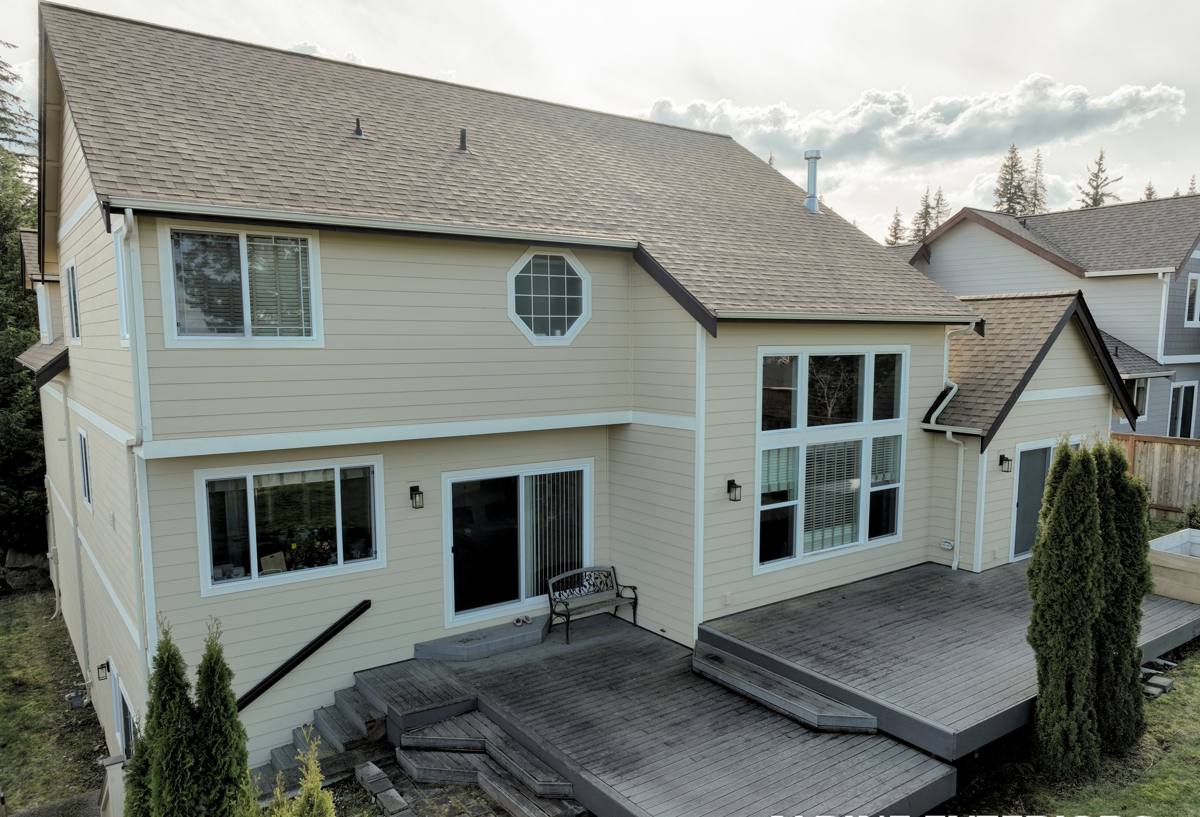
Signs a Redmond Home Actually Needs Siding Replacement
Not every issue means full replacement — some are legitimately repair-level. But there's a point where patching stops making sense and a full siding replacement is the more honest answer. Look for:
- Soft or spongy spots when you press on siding, especially near the bottom courses and around window trim
- Persistent moss or dark streaking that comes back within weeks of cleaning, especially on north- and shaded-side walls
- Visible warping, cupping, or bowing in panels or lap boards
- Paint that's failing repeatedly in the same spots no matter how often it's repainted
- Cracking or splitting at butt joints, corners, or around penetrations like hose bibs and light fixtures
- A musty smell or interior wall staining that suggests moisture is already getting past the siding
If you're seeing two or more of these on the same wall, that's usually a sign the water resistive barrier underneath has already been compromised, not just the visible siding.
Why We Install James Hardie and Nothing Else
We only install James Hardie fiber cement siding. We don't install vinyl, LP SmartSide, Cemplank, Allura, primed spruce, or cedar, and we're upfront with Redmond homeowners about why.
Vinyl is affordable and low-maintenance in mild climates, but in a wet, temperature-swinging climate like ours it expands and contracts more visibly, can warp under direct afternoon sun on south-facing walls, and its seams and J-channels give moisture more places to work behind the panel over time. Wood-based composite sidings like LP SmartSide use engineered wood strand technology that resists moisture better than raw wood, but any wood-based product is still more sensitive to sustained damp conditions than fiber cement, and repeated wet-dry cycles are exactly what Redmond winters deliver. Natural cedar looks great on day one but demands an ongoing maintenance commitment — sealing, staining, and moisture monitoring — that most homeowners underestimate until the siding is already showing rot.
James Hardie fiber cement is non-combustible, dimensionally stable across our wet-to-dry swings, and comes from the factory with a baked-on ColorPlus finish that holds color far longer than field-applied paint. Hardie also engineers specific product formulations for different climate zones — the HZ5 line is built for regions like ours with real moisture exposure. That combination of moisture resistance, stability, and a strong transferable warranty is why we standardized on one product line instead of offering several. We'd rather install one thing correctly and stand behind it than sell homeowners a menu of products with different failure modes.
What a Correct Siding Replacement Actually Involves
Siding replacement done right is mostly about what happens before the new siding ever goes up. The visible product is only part of the system.
Full Tear-Off and Inspection
We remove the old siding completely rather than installing over it. That's the only way to actually see the sheathing underneath — soft spots, old water damage, or rot that's been hidden for years often only shows up once the old siding is off. Any damaged sheathing gets repaired or replaced before anything new goes on; covering it up just hides the problem for the next owner to discover.
Water-Resistive Barrier
A new, continuous water-resistive barrier goes over the sheathing before siding installation. This is the layer that actually keeps bulk water out of the wall assembly — the siding itself is the first line of defense, but the barrier underneath is what protects the structure if water ever gets past it.
Flashing at Every Penetration
Windows, doors, hose bibs, vents, and any other wall penetration need proper flashing integrated with the water-resistive barrier, not just caulked over. Caulk fails; correctly lapped flashing doesn't depend on a bead of sealant staying intact for 30 years.
Manufacturer-Spec Installation
James Hardie publishes specific installation requirements — fastener spacing and type, minimum clearance from grade and roof lines, gapping at butt joints, and field-cutting and painting requirements. Installing to spec isn't optional if you want the manufacturer's warranty to actually hold up; it's also what keeps the finished product performing the way it's designed to in a wet climate.
Our Redmond Siding Replacement Process
- On-site assessment. We walk the exterior with you, check for soft spots and moisture damage, and give you an honest read on whether you're looking at repair or full replacement.
- Scope and product selection. We help you choose the right Hardie panel or lap profile and ColorPlus color for your home, and put together a clear, itemized estimate.
- Tear-off and sheathing repair. Old siding and trim come off, sheathing gets inspected, and any damaged areas are repaired before we move forward.
- Barrier and flashing installation. New water-resistive barrier and flashing go in at every window, door, and penetration.
- Hardie installation to manufacturer spec. Panels or lap siding go up with correct fastening, gapping, and clearances.
- Trim, caulking, and final detail work. Corners, trim boards, and joints get finished and sealed correctly.
- Final walkthrough. We go over the finished job with you before calling it done.
Choosing the Right Hardie Line and Finish for Redmond
James Hardie makes several product lines and profiles, and the right choice depends on your home's style and exposure, not just personal taste. HardiePlank lap siding is the most common choice for traditional Redmond home styles and comes in multiple exposure widths and textures. HardiePanel vertical siding works well for modern designs or as an accent alongside lap siding. HardieShingle gives a cedar-shake look without the maintenance burden of real cedar shakes.
Because King County falls within Hardie's HZ5 climate zone, the products specified for our region are engineered with moisture exposure in mind rather than a generic national formulation. ColorPlus finishes are factory-applied and cured under controlled conditions, which is a meaningfully more durable result than field-painted siding, and it means touch-up paint is formulated to match rather than guessed at on-site.
What Drives the Cost of a Siding Replacement
Every Redmond home is different, so we don't quote off square footage alone. These are the factors that actually move the number:
| Factor | Why It Matters |
|---|---|
| Sheathing condition | Rot or moisture damage found during tear-off adds repair scope that can't be known until the old siding is off |
| Home size and wall complexity | More corners, dormers, and roof lines mean more cutting, flashing, and labor time |
| Siding profile and texture | Lap width, shingle-style siding, and vertical panel accents vary in material and labor cost |
| Trim scope | Full trim replacement alongside siding costs more than reusing sound existing trim |
| Access and site conditions | Steep lots, tight side yards, or multi-story walls affect staging and labor time |
| Color and finish selection | Standard ColorPlus colors versus premium or custom options can shift material pricing |
We won't give you a real number until we've actually looked at your home, but these are the honest drivers behind why two houses of similar size can land in very different price ranges.
Why a Crew That Already Works Redmond Matters
Siding installation quality depends a lot on details that are specific to where a home is, not just how it's built. A crew that regularly works Redmond and the broader King County area already understands the moisture patterns typical of shaded, tree-covered lots, knows what local permitting and inspection expects for exterior work, and has seen firsthand how different wall orientations hold up over multiple wet seasons here. That's different from a crew that installs siding all over the region without much repeat presence in any one community — there's real value in a contractor who can reference how a job they did nearby has actually performed over time, not just how it looked the day it was finished.
It also matters for the boring-but-important logistics: knowing local disposal and permitting processes, being reachable if a warranty question comes up years later, and having a reputation in the area that's tied to work still standing, not just work recently completed.
Maintenance and Warranty After Installation
One advantage of fiber cement done correctly is how little ongoing maintenance it actually needs compared to wood or vinyl. That said, "low-maintenance" isn't "no-maintenance":
- Rinse siding periodically to keep moss and algae from establishing, especially on shaded north-facing walls
- Keep gutters clear so overflow doesn't run down siding repeatedly in the same spot
- Trim back vegetation that keeps siding shaded and damp longer than the rest of the house
- Have caulking at trim and penetrations checked periodically, since caulk is a maintenance item even on a low-maintenance siding system
- Keep a copy of your product and installation documentation in case a warranty question ever comes up
James Hardie backs its products with a strong transferable warranty when installed to spec, which is one more reason correct installation isn't optional — it's what makes that warranty actually mean something if you ever need it.
If your Redmond home is showing any of the signs above, or you just want an honest opinion on whether you're looking at repair or replacement, we're happy to take a look. Fill out the form below for a free, no-pressure estimate.