 King County
 Why Siding Choice Matters More in Renton Than It Looks
Renton sits in a part of King County where homes take a steady beating from moisture almost year-round. The city's position near Lake Washington and the Cedar River, combined with its proximity to Puget Sound's marine air, means siding here deals with a mix of driving rain, humid air carrying salt and mineral content, and long stretches of gray, damp weather that never really gives wood or wood-composite products a chance to fully dry out. Add in the deep shade found under mature Douglas fir and cedar trees in many older Renton neighborhoods, and you get conditions that are almost purpose-built to grow moss, algae, and mildew on anything that holds moisture.
None of that is unusual for the Pacific Northwest. But it does mean that siding installed in Renton has a harder job than siding installed in a dry climate, and the margin for error — in material choice and in workmanship — is smaller. A siding job that looks fine on day one can fail quietly over a few winters if the wrong product went up, or if the right product went up the wrong way.
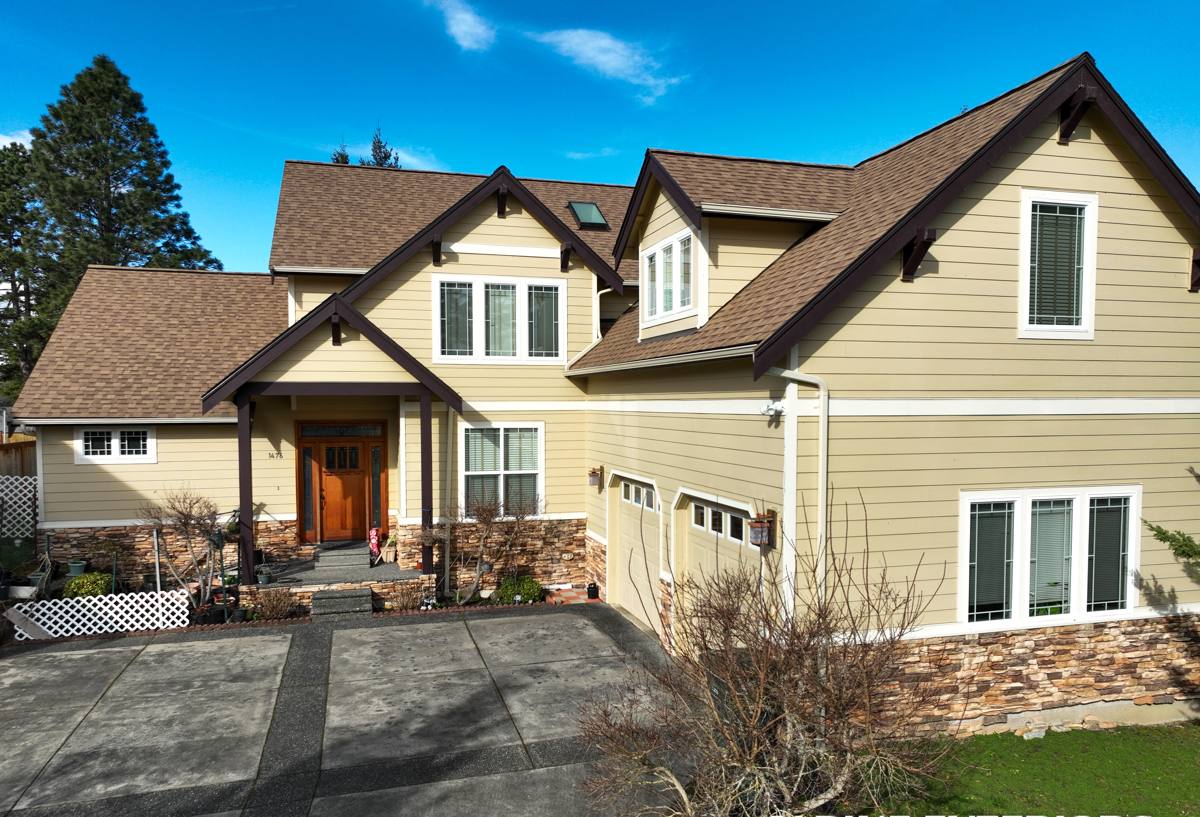
What Renton's Climate Actually Does to Siding
Salt Air and Slow Corrosion
Homes closer to the water pick up airborne salt and moisture that accelerates corrosion on fasteners, trim, and any exposed metal flashing. Over years, this can undermine even well-built siding systems if the underlying materials and hardware weren't chosen with that exposure in mind.
Driving Rain and Wind-Driven Moisture
Rain in this region rarely falls straight down. Wind pushes it sideways into wall assemblies, which means seams, laps, and penetrations around windows and doors are under constant pressure to shed water rather than trap it. A siding system with a weak water-management design will eventually let moisture behind the cladding, even if the surface looks dry.
Moss, Algae, and the Long Wet Season
King County's wet season stretches from fall through spring, and shaded or north-facing walls in Renton often stay damp for days after a storm. Porous or absorbent siding materials give moss and algae a foothold, and once established, that growth holds even more moisture against the wall — a cycle that speeds up rot, paint failure, and structural damage on the wrong products.
What Renton Homes Actually Need From Their Siding
Given all of that, a siding product installed in Renton needs to do a few things well, not just look good on installation day:
- Resist water absorption so it doesn't swell, cup, or trap moisture against the wall sheathing
- Hold paint and factory finish without repeated repainting cycles
- Stand up to freeze-thaw cycling during the occasional hard winter snap
- Resist moss and algae growth on shaded, damp exposures
- Handle wind-driven rain at seams, corners, and penetrations without failing
- Be non-combustible, which matters more each year as wildfire smoke and ember exposure becomes a regional concern even west of the Cascades
This is the list we measure every siding product against before we'll put it on a Renton home. It's also the reason our answer, every time, is James Hardie fiber cement.
Why We Only Install James Hardie in Renton
King County Exterior installs James Hardie fiber cement siding exclusively. We don't offer vinyl, LP SmartSide, Cemplank, Allura, primed spruce, or cedar as alternatives — not because those products have no merit anywhere, but because after years of working on homes throughout King County, we've standardized on the one product line that consistently holds up to this specific climate without the maintenance headaches and moisture risk we've seen with the alternatives.
Fiber Cement's Moisture Behavior
James Hardie siding is made from cement, sand, and cellulose fibers, engineered specifically for moisture-heavy climates through Hardie's HZ5 product line, which is built for the Pacific Northwest's wet, temperate conditions. Fiber cement doesn't absorb and swell the way wood-based products can, and it doesn't provide the same organic material for moss and mildew to feed on. That matters directly for the shaded, damp walls common on Renton lots.
ColorPlus Factory Finish
Rather than relying on field-applied paint that has to cure correctly in unpredictable weather, Hardie's ColorPlus finish is baked on at the factory under controlled conditions, giving it better adhesion and UV resistance than most site-applied paint jobs. In a climate where you often only get a narrow dry window each year to paint exteriors, that's a real practical advantage, not just a marketing point.
Non-Combustible Construction
Fiber cement doesn't burn, which is a meaningful difference from wood-based sidings during ember-exposure events, and it's increasingly a factor insurers and homeowners are paying attention to even in western Washington.
Warranty Backing
James Hardie backs its siding with a transferable limited warranty that reflects the manufacturer's confidence in the product when it's installed to spec — which is the operative phrase. A great product installed incorrectly doesn't perform like a great product, which is why installation quality matters as much as material choice.
What a Correct Siding Installation Involves
Fiber cement siding is only as good as the assembly behind it. A rushed or corner-cutting installation can undermine even the best material. Here's what we consider non-negotiable on every Renton project.
Water-Resistive Barrier and Flashing First
Before a single piece of siding goes up, the wall needs a properly lapped water-resistive barrier and correctly integrated flashing at every window, door, and penetration. Given how much wind-driven rain Renton sees, this layer is what actually keeps water out of the wall assembly — the siding itself is the second line of defense, not the only one.
Proper Clearances and Fastening
Hardie siding has specific installation requirements around ground clearance, roof-line clearance, fastener spacing, and butt-joint treatment. Skipping these — for example, installing siding too close to grade or a lower roof — invites moisture wicking and premature failure regardless of how good the material is.
Caulking and Joint Treatment Done Right
Manufacturer-specified sealants at joints and transitions, applied correctly and in the right locations, keep water from tracking behind the panels. Over-caulking or under-caulking both cause problems down the line.
Our Installation Process
- Site assessment: We inspect existing siding, sheathing, and trim condition, checking for hidden moisture damage before we quote anything.
- Product and profile selection: We help you choose the right Hardie plank, shingle, or panel profile and color for your home's style and exposure.
- Tear-off and sheathing repair: Old siding comes off, and any compromised sheathing or framing is repaired before new material goes on — this step gets skipped by corner-cutting crews and it's where problems hide.
- Water-resistive barrier and flashing installation: Installed and lapped per manufacturer and code requirements at every penetration.
- Hardie siding installation: Installed to James Hardie's fastening, clearance, and joint specifications, which is what keeps the warranty valid.
- Trim, caulking, and touch-up: Final detailing at corners, window and door surrounds, and any factory-finish touch-up.
- Final walkthrough: We review the completed work with you before calling the job done.
Cost Factors for a Renton Siding Project
Every home is different, but the factors below are what typically move the price of a fiber cement siding installation up or down. We'll give you a firm, itemized quote after an on-site assessment.
| Factor | Why It Affects Cost |
|---|---|
| Home size and wall complexity | More square footage, more corners, dormers, and gables mean more material and labor |
| Existing siding condition | Rotted sheathing or hidden moisture damage found during tear-off requires repair before new siding goes on |
| Siding profile and finish | Lap, shingle, and panel profiles, plus color and texture choices, carry different material costs |
| Trim and detail work | Window surrounds, corner boards, and fascia detailing add labor time |
| Access and site conditions | Steep lots, tight setbacks, or limited equipment access can affect labor time |
| Tear-off vs. re-side over existing | Full tear-off costs more upfront but avoids covering up hidden problems |
Signs a Renton Home Needs New Siding Soon
Because moisture damage in this climate often develops behind the siding before it's visible on the surface, it helps to know what to watch for:
- Bubbling, peeling, or chalky paint that keeps coming back after repainting
- Soft or spongy spots when you press on the siding, especially near the bottom edges
- Persistent moss or algae staining on shaded or north-facing walls
- Visible warping, cupping, or gaps opening up at seams and corners
- Rising energy bills that suggest the wall assembly is no longer performing as it should
- Interior signs like musty smells or staining on walls that share an exterior wall
If any of these sound familiar, it's worth having someone take a closer look before small problems turn into sheathing or framing repairs.
Why a Crew That Already Works in Renton Matters
Siding installation isn't just about product knowledge — it's about knowing how a specific area's conditions play out on real houses. A crew that regularly works King County homes has already seen how Renton's damp, shaded lots behave differently from a drier neighborhood a few miles away, knows which details of flashing and clearance matter most in this climate, and isn't guessing at how James Hardie products perform locally versus reading it off a spec sheet. That familiarity shows up in the small decisions made on the job — where extra flashing attention goes, how joints are staggered, how ventilation is handled — that don't show up on a proposal but matter for how the siding performs ten years from now.
Living With Hardie Siding After Installation
One of the practical advantages of fiber cement is how little it asks of you afterward. There's no annual staining or sealing schedule to keep up with. Periodic gentle washing to keep moss and grime from building up in shaded areas is the main maintenance task, along with the normal practice of keeping gutters clear and vegetation trimmed back from exterior walls — both of which matter more in a climate where things stay damp for long stretches. Compared to the recurring painting and moisture-watching that wood-based sidings demand in this region, it's a meaningfully lower-maintenance way to own a home here.
If your Renton home's siding is showing its age, or you're planning ahead for a replacement, we're happy to walk the property with you, look at what's actually going on, and put together a straightforward, no-pressure estimate — just use the form below to get started.