 King County
 Board & Batten Siding, Built for Sammamish Weather
Board & batten has become one of the most requested siding profiles in Sammamish, and it's easy to see why. The vertical lines read as clean and modern on newer builds, but they also suit the more traditional farmhouse and craftsman styles common throughout King County. What most homeowners don't realize is that the look is only half the story — the material behind that profile determines whether it still looks sharp in ten years or becomes a maintenance headache by year three.
Sammamish sits far enough inland from Puget Sound that homeowners sometimes assume salt air isn't a factor. It still is, especially on homes with exposure toward the lake or open western faces that catch wind-driven rain off the water. Combine that with our long, low-sun moss season and the near-constant damp shoulder seasons, and you have a climate that is genuinely hard on the wrong siding material — even when the workmanship is good.
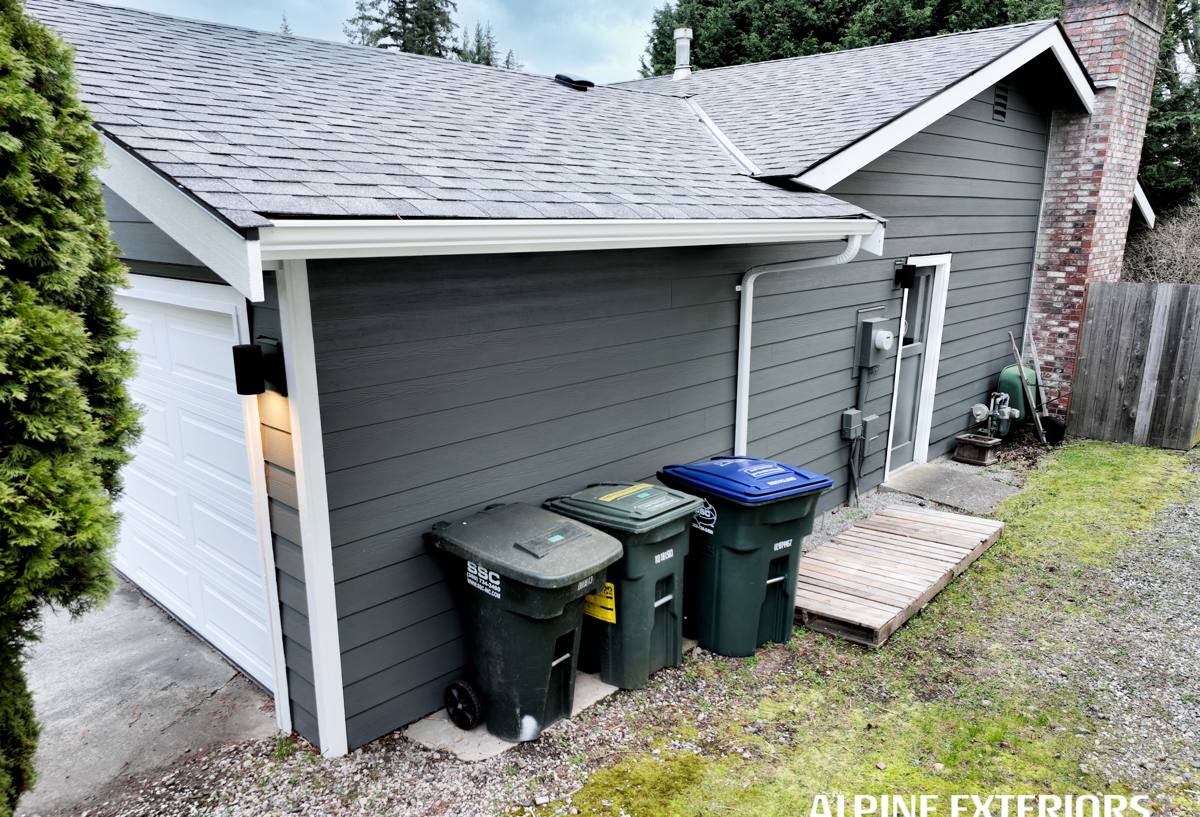
Why Board & Batten Fails When the Material Is Wrong
Board & batten is a design choice, but the material underneath it is the actual performance factor. The profile creates a series of vertical seams and butted joints, and every one of those seams is a potential water entry point if the material behind it swells, cups, or rots. This is where cheaper substrates struggle in our climate specifically:
- Engineered wood and OEM composite battens can absorb moisture at cut ends and seams, leading to swelling and edge softness within a few wet seasons.
- Vinyl board & batten is installed with expansion gaps by design, which means it flexes in temperature swings and can gap or warp — and it doesn't hold paint if you ever want to change the color.
- Primed wood battens look great on day one but require diligent repainting and caulk maintenance to keep water out of end grain, which is exactly where moss and algae like to start.
None of these materials are "bad" in every climate. But Sammamish's combination of sustained damp, moss pressure, and occasional wind-driven rain off the lake is a tough proving ground, and it's why we don't install them.
What We Install Instead
We install James Hardie fiber cement board & batten exclusively. It's a non-combustible, cement-based material engineered specifically for climates like ours through Hardie's HZ10 product line, which is formulated for the wetter, milder weather patterns found in the Pacific Northwest. The battens and panels don't absorb water the way wood-based products do, they hold a factory-applied ColorPlus finish instead of field paint, and the seams are detailed to shed water rather than trap it.
What a Correct Board & Batten Job Actually Involves
The board & batten look is simple, but getting it right on a real house is not just nailing boards to a wall. A correct installation accounts for:
- Weather-resistive barrier and rainscreen detailing — the vertical battens create shadow lines but also channels; there needs to be a drainage plane behind the siding so any incidental moisture can escape instead of sitting against the wall sheathing.
- Proper batten spacing and fastening — Hardie specifies exact nailing patterns and batten reveals; spacing that's "close enough" by eye leads to uneven shadow lines and can stress the fastener points over time.
- Flashing at every horizontal transition — window heads, water tables, and roof-to-wall intersections are where board & batten jobs actually fail if flashing is skipped or improvised.
- Correct caulking and sealant at butt joints — even with fiber cement's low absorption, joint sealant matters at penetrations and terminations.
- Ventilation behind the cladding — critical in a climate where the wall assembly rarely gets a long, hot dry-out period the way it might in a drier region.
Skipping any one of these doesn't usually show up as an obvious failure right away. It shows up two or three winters later as staining, soft spots at the base of battens, or moss establishing itself in a seam that should have been sealed.
Moss, Rain, and Salt Air: The Three Things That Wear Down Sammamish Siding
Moss Season
King County's moss season runs long — shaded north and east elevations, tree-lined lots, and roofs that stay damp for months all contribute to moss and algae establishing on siding surfaces. Board & batten's vertical seams and horizontal batten caps give organic growth more edges to grip than a flat lap profile does. Fiber cement's dense composition resists the surface degradation that lets moss root into softer materials, and ColorPlus finishes are formulated to resist mildew growth on the surface.
Driving Rain
Homes with more open exposure, particularly toward the lake or on elevated lots that catch wind, deal with rain that doesn't just fall straight down — it drives sideways into vertical seams. This is precisely the scenario rainscreen detailing and correct flashing are built to handle, and it's why installation quality matters as much as the product choice.
Salt Air
Sammamish isn't coastal, but Puget Sound's marine air influence reaches well inland, and homes closer to the lake see some of that same slow corrosive effect on fasteners and lesser building materials. Fiber cement doesn't corrode, and we use fasteners rated for the exposure.
Our Process for Sammamish Board & Batten Projects
| Step | What Happens |
|---|---|
| 1. On-site assessment | We evaluate current siding condition, wall assembly, existing moisture damage, and sun/shade exposure on each elevation. |
| 2. Product and reveal selection | We confirm Hardie board & batten panel width, batten spacing, and color to match the home's style and HOA requirements where applicable. |
| 3. Removal and sheathing check | Old siding comes off and we inspect sheathing for hidden rot or moisture damage before anything new goes up — this step gets skipped by crews trying to move fast, and it's where problems get missed. |
| 4. Weather barrier and rainscreen install | A proper drainage plane goes in before a single batten is hung. |
| 5. Siding and batten installation | Installed to Hardie's fastening and spacing specifications, with flashing at every transition. |
| 6. Final inspection and cleanup | We walk the job with the homeowner before calling it done. |
Cost Factors for Board & Batten in Sammamish
Every home is different, but the real cost drivers on a board & batten project are usually the same few things:
| Factor | Why It Matters |
|---|---|
| Existing siding removal | Tear-off complexity and any sheathing repair needed underneath adds time and material. |
| Wall height and elevation count | Two-story and multi-gable homes have more flashing detail and more linear footage of seams. |
| Batten reveal and panel width | Narrower reveals mean more battens, more fasteners, and more labor per square foot. |
| Trim and accent detailing | Corner boards, window trim, and transitions to other siding profiles add finish work. |
| Access and site conditions | Sloped lots, mature landscaping, and tight lake-facing setbacks common in Sammamish can affect scaffolding and staging. |
We give homeowners a real number after walking the actual house, not a phone-quoted range that changes once the crew shows up.
Why Local Experience with Board & Batten Matters Here
A crew that's only worked drier climates will often underestimate how much attention Sammamish's damp season and moss pressure demand. Reveal spacing that looks fine on paper, flashing shortcuts that "usually" work — these are the details that separate a board & batten job that ages well from one that needs siding repairs in five years. We work this area regularly, which means we already know which elevations tend to hold moisture longest, where moss pressure is worst, and how to detail a job so it doesn't come back to bite the homeowner.
Before you commit to a siding contractor for a board & batten project, a short checklist worth going through:
- Ask what siding material they install and why — and whether they'll install alternatives you request.
- Confirm they include rainscreen/drainage plane detailing, not just a weather barrier.
- Ask how they handle flashing at window heads and roof transitions specifically.
- Get manufacturer and workmanship warranty terms in writing, not verbally.
- Ask how many board & batten jobs they've done in King County specifically, not just siding jobs generally.
Get a Free Estimate for Your Sammamish Home
If you're considering board & batten siding for a home in Sammamish, we're happy to come take a look, walk the exterior with you, and give you a straightforward assessment of what your home needs — no pressure, no inflated urgency. Use the form below to request a free estimate.