 King County
 What Seattle's Climate Actually Does to a Deck
Seattle sits in a climate that's hard on any outdoor structure, and decks take the worst of it because they're horizontal, exposed on top, and often shaded by trees or the house itself. Homeowners in King County deal with three specific stressors that shape how a deck should be built and what it should be built from: near-constant moisture, salt-laden air off Puget Sound, and a moss season that runs longer here than almost anywhere else in the country.
Rain and moisture load
It's not the volume of rain that's hardest on a deck here, it's the duration. Seattle gets long stretches of steady, low-intensity rain from fall through spring, which means deck surfaces, fasteners, and framing stay damp for days at a time instead of getting a quick soak and a dry-out. That extended wet period is what causes rot in untreated wood, corrosion in the wrong hardware, and swelling or cupping in boards that weren't rated for it.
Salt air and marine exposure
Homes closer to Puget Sound and the Sound-facing neighborhoods deal with a steady low-level salt content in the air, even well inland from the actual shoreline on breezy days. Salt air accelerates corrosion on fasteners, railing hardware, and any exposed metal connectors. It doesn't ruin composite boards the way it can degrade some metals, but it absolutely dictates what hardware and fasteners belong in the build.
Moss and algae season
Because Seattle stays damp and mild rather than hot and dry, moss and algae have a long growing window on shaded or north-facing decks, sometimes nearly year-round on decks that don't get much sun. Moss holds moisture against whatever it's growing on, and on a deck surface that means the material underneath needs to tolerate being damp and shaded for long stretches without breaking down.
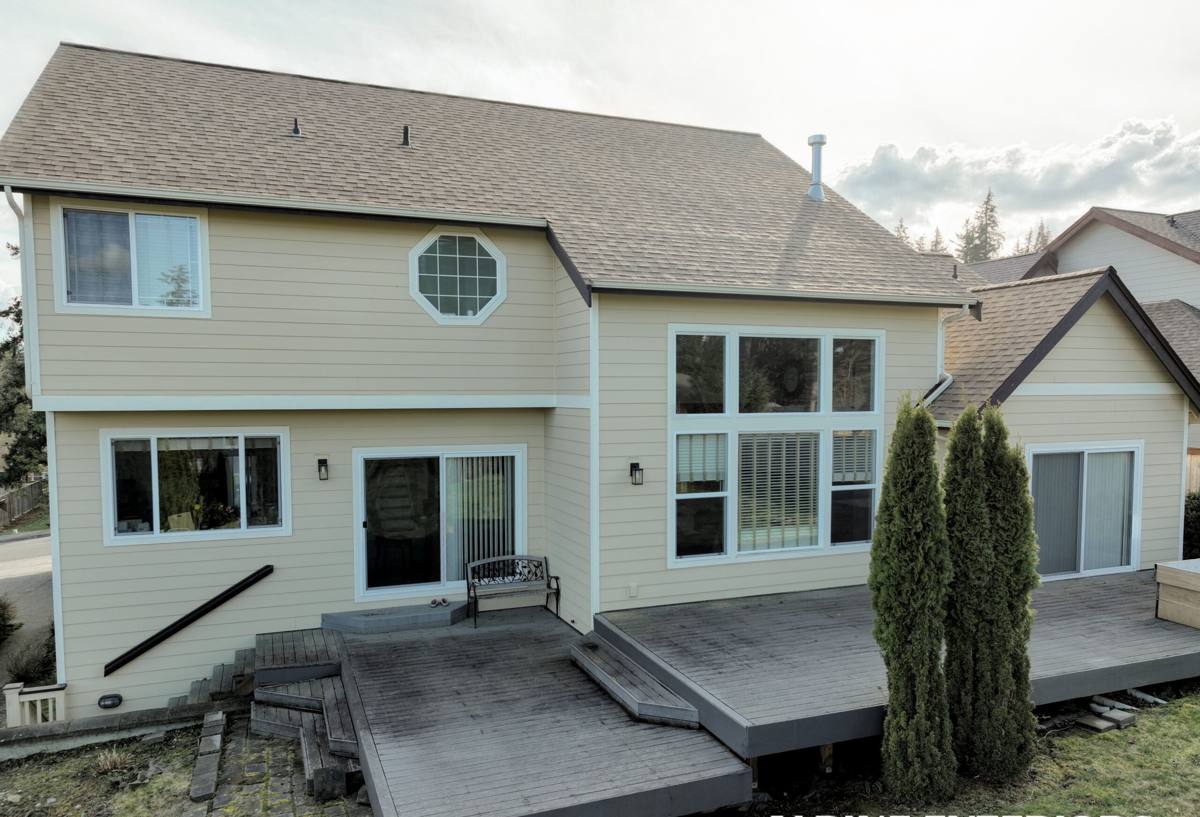
Why Composite Decking Fits This Climate
Composite decking was built to solve exactly this kind of problem: a wood-fiber and polymer blend, usually with a protective cap layer, that doesn't absorb water the way solid wood does and doesn't need annual staining or sealing to hold up. For a Seattle deck that spends a good chunk of the year wet, that's the main advantage — the board itself isn't feeding on moisture the way untreated or even pressure-treated wood can.
How composite differs from wood in wet climates
Solid wood decking, even cedar or pressure-treated lumber, will take on moisture, swell, dry, and shrink in cycles through a Seattle winter. Over years that cycle opens up checking and cracks where water sits, which is exactly where rot and moss take hold. Composite boards, particularly capped composite, resist that moisture uptake at the surface, so the freeze-thaw and wet-dry cycling that breaks wood down has far less to work with.
What composite doesn't solve on its own
Composite decking is not a substitute for a properly built substructure. The boards can handle moisture better than wood, but the joists, beams, ledger board, and fasteners underneath are still wood and metal, and they still need to be protected and detailed correctly. We've seen composite deck surfaces installed over framing that was never properly flashed or ventilated — the top looks fine for a few years while the structure underneath is quietly failing. The material is only as good as what it's built on.
What a Correct Composite Deck Install Involves Here
Substructure and joist protection
Every joist and beam should get a moisture barrier tape or joist protection strip before boards go down, not just at the ledger connection. In a climate where the deck surface sheds water down through board gaps for most of the year, an unprotected joist top is sitting under a slow drip for months at a stretch. This is one of the most common corners cut on lower-bid decking jobs, because it's invisible once the boards are on.
Ledger flashing and house connection
Where the deck attaches to the house, flashing has to be detailed to shed water away from the wall assembly, not just caulked and hoped for. Seattle's rain volume makes a poorly flashed ledger one of the more common sources of hidden water damage behind siding, and it's not something you can inspect after the fact without pulling boards.
Board spacing, ventilation, and drainage
Composite boards need consistent gapping for water to drain through and for the material to expand and contract with temperature, which it does more than most homeowners expect. Under-deck ventilation also matters more here than in drier climates — a low-clearance deck with poor airflow underneath stays damp longer after every rain, which is exactly the environment moss and mildew prefer.
Fasteners and hardware
Given the salt air and sustained moisture, hardware should be rated for coastal or marine-grade exposure — stainless steel or coated fasteners rated for ACQ-treated lumber contact, and structural connectors that won't corrode and stain the decking or weaken over time. This is a small cost difference on a job and a real difference in how the deck holds up ten and fifteen years out.
Choosing the Right Composite Board for a Seattle Home
Not all composite decking is built the same way, and the differences matter more in a wet, shaded climate than they would somewhere dry. The table below breaks down the general categories homeowners choose between.
| Board Type | Moisture Resistance | Moss/Algae Resistance | Maintenance | General Cost Position |
|---|---|---|---|---|
| Uncapped composite | Moderate — core can absorb some moisture at cut ends | Lower — more porous surface | Occasional cleaning, cut ends need sealing | Lower |
| Capped composite | High — polymer shell sheds water at the surface | Higher, especially with textured or streaked finishes | Periodic washing, minimal upkeep | Mid |
| PVC/all-polymer decking | Very high — no wood fiber content | High | Low, mainly surface cleaning | Higher |
For most Seattle homes, especially decks with any shade or north exposure, we steer people toward fully capped composite as the baseline, and discuss all-polymer PVC decking for decks that stay damp and shaded most of the year, like ones tucked under trees or on the north side of a house. It's a conversation about trade-offs — upfront cost against long-term maintenance — not a one-size answer.
Our Process for a Seattle Composite Decking Project
Assessment and planning
We start by looking at sun exposure, drainage slope, proximity to the ground, and the condition of any existing structure if this is a replacement. A deck on the shaded north side of a King County home gets different recommendations on board finish and ventilation than one that sees full sun most of the day.
Tear-out and structural check
If we're replacing an existing wood deck, we check the ledger, posts, footings, and joists before assuming they're reusable. A composite deck surface is only worth installing on a structure that's sound; we won't put new boards over framing that's already showing rot or undersized for current code.
Permits and code
Deck work in Seattle and unincorporated King County generally requires a permit once you're past minor repair-level work, particularly for anything attached to the house, elevated, or involving structural changes. Guard height, baluster spacing, and footing depth are all governed by code that we build to regardless of whether a permit is pulled, because it's the standard that keeps the deck safe.
Install sequence
- Confirm or install proper footings and ledger flashing
- Frame and protect joists with moisture barrier tape
- Install hidden or face fasteners rated for the board manufacturer's specs
- Set boards with correct gapping for drainage and expansion
- Install railing and fascia with corrosion-resistant hardware
- Final walkthrough for level, drainage, and finish detail
Living With Composite Decking Through a Long Moss Season
Composite decking is low-maintenance compared to wood, but "low-maintenance" doesn't mean "no maintenance" in a climate like this. A little seasonal attention keeps a composite deck looking and performing the way it should for the long haul.
- Sweep off fallen leaves and debris regularly in fall — trapped organic matter under leaves is where moss gets its start
- Rinse the deck surface a few times a year, more often on shaded sections, to keep pollen and organic buildup from taking hold
- Keep gutters and downspouts clear so runoff isn't dumping directly onto or near the deck
- Trim back overhanging branches where possible to cut down on shade and leaf litter
- Check under-deck ventilation isn't blocked by storage, planters, or overgrown landscaping
- Inspect railing hardware annually for any early corrosion, especially on decks closer to the water
Why Hire a Crew That Already Works in Seattle
A composite deck built to a spec sheet written for a dry climate doesn't automatically hold up here. The framing details, fastener choices, and ventilation approach that matter in King County aren't always what a crew from a drier region defaults to. Working decks throughout this area day in and day out means we've seen which corners get cut on cheaper jobs, where water actually collects on a real Seattle roofline and yard, and which hardware holds up after a decade of Puget Sound weather instead of just the first couple of dry summers.
It also means we're not guessing at local permit requirements or code specifics — we build to them as a matter of course, not as an afterthought when an inspector flags something.
Common Mistakes We See on Composite Deck Installs in This Area
A few issues come up often enough on decks we're asked to inspect or repair that they're worth naming directly:
- No joist protection tape, leading to hidden rot under boards that look fine on the surface
- Standard fasteners instead of corrosion-resistant hardware, causing staining and eventual hardware failure
- Boards installed too tight, blocking drainage and trapping moisture between boards
- Poor or missing ledger flashing, allowing water intrusion into the house wall assembly
- Low ground clearance with no ventilation plan, creating a permanently damp under-deck environment
Every one of these is avoidable with correct detailing at install time, and every one of them is expensive and disruptive to fix after the fact.
Get an Honest Look at Your Deck
If you're planning a new composite deck or replacing an aging wood deck anywhere in Seattle or the surrounding King County area, we're happy to come take a look, walk through what your specific site needs given its sun exposure and drainage, and give you a straightforward, no-pressure estimate. There's no cost and no obligation — just an honest assessment from a crew that already knows what this climate does to a deck.