 King County
 Shoreline's Siding Takes a Different Kind of Beating
Shoreline sits right where Puget Sound weather hits hardest — close enough to the water that salt-laden air reaches the siding on most homes, combined with the driving, wind-pushed rain that comes off the Sound during fall and winter storms. Add in a moss season that can run eight months out of the year under the tree canopy common in this part of King County, and you get a set of siding problems that look different from what a contractor sees working a drier, inland neighborhood.
Salt air accelerates corrosion on fasteners, flashing, and any exposed metal trim. Driving rain finds its way into every gap, seam, and nail hole that isn't sealed correctly, and once moisture gets behind siding it doesn't dry out quickly in our climate — it sits, and that's when rot and mold start. Moss and algae hold moisture against the siding surface even longer, which is why north-facing walls and shaded sections of a Shoreline home often show damage years before the sunnier sides do.
None of this means Shoreline homes need exotic solutions. It means the repair work has to account for how water actually moves and lingers in this specific environment, not just patch what's visible on the surface.
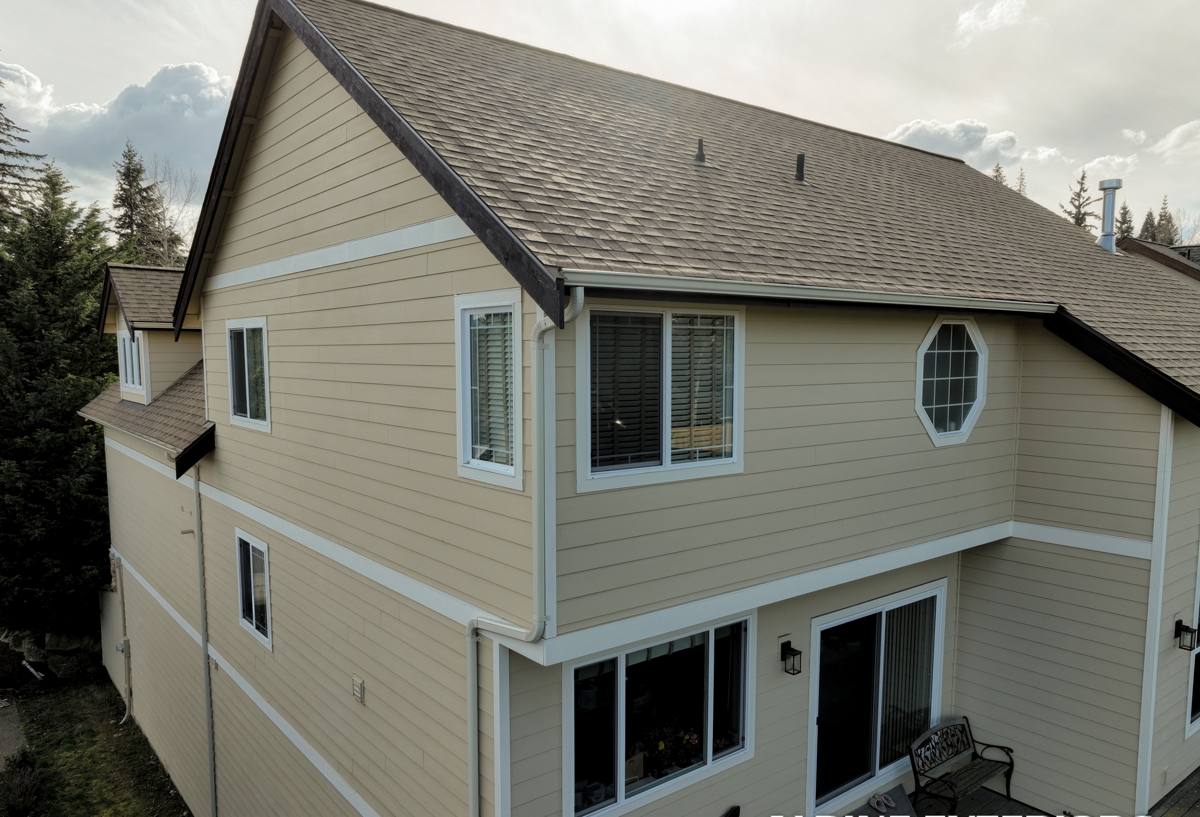
What "Siding Repair" Actually Means Here
A lot of siding repair calls start as a homeowner noticing a stain, a soft spot, or a section that looks discolored. The real question is always the same: is this cosmetic, or is water getting behind the siding into the wall assembly? In a marine climate like ours, that distinction matters more than it would somewhere drier, because trapped moisture has more time between dry spells to do damage.
Cosmetic Issues
Surface staining, moss growth, chalking paint, and minor caulk cracking are cosmetic problems. They're worth addressing because they're often an early warning sign, but they don't necessarily mean water has breached the siding.
Moisture Intrusion Issues
Soft or spongy siding, visible rot at butt joints or corners, bubbling paint, warping panels, or interior signs like peeling paint or musty smells near exterior walls point to actual water intrusion. This is where repair has to go beyond the visible siding and into what's happening behind it — the weather-resistive barrier, the sheathing, and the framing.
Common Repair Calls We See in This Area
- Moss and algae staining on shaded, north-facing, or tree-covered walls that holds moisture against the siding surface
- Failed caulk joints around trim, windows, and butt joints — UV and constant damp-dry cycling break down sealant faster near the water
- Corroded fasteners and trim from salt air, especially on homes with direct sightlines to the Sound
- Rot at the bottom courses of siding near grade, decks, and patios where splashback and poor drainage keep wood-based products wet
- Delamination and swelling on engineered wood products where edges weren't sealed or field-cut edges were left exposed
- Vinyl siding warping or cracking from temperature swings and impact, with visible gaps at seams
- Water staining on interior walls that traces back to a failed flashing detail or penetration point on the exterior
What a Correct Repair Involves
A repair that just covers the damaged spot with new material and calls it done is a temporary fix. A correct repair starts with figuring out why the damage happened in the first place — otherwise you're repeating the same repair in a few years.
1. Find the Moisture Source
Before removing anything, we look at the whole picture: grading and drainage around the foundation, gutter and downspout performance, flashing at windows, doors, and roof-to-wall intersections, and the condition of caulking and trim. Damaged siding is usually a symptom, not the root cause.
2. Remove and Inspect
Damaged siding comes off in a way that lets us see the sheathing and weather-resistive barrier underneath. If there's rot in the sheathing or framing, that has to be repaired or replaced before any new siding goes back on — covering rotten wood with new siding just hides the problem for the next owner to find.
3. Correct the Detail That Failed
If a flashing detail was missing or installed wrong, or if a penetration wasn't properly sealed, that gets fixed as part of the repair. Matching the new siding without correcting the underlying detail means the same failure happens again.
4. Match and Finish
New siding is fitted to match the existing profile, properly fastened, caulked at the right joints (and left open where it should drain), and finished to match the existing color and texture as closely as the material allows.
Repair or Replace? What Determines the Right Call
Not every siding problem needs a full replacement, and not every repair is worth doing if the underlying material is failing broadly. Here's how we think through it:
| Factor | Leans Toward Repair | Leans Toward Replacement |
|---|---|---|
| Extent of damage | Isolated to one wall, corner, or a few boards | Recurring across multiple walls or elevations |
| Cause | One-time event: impact, isolated flashing failure | Systemic: material breakdown, chronic moisture path |
| Siding material | James Hardie fiber cement, matched and available | Discontinued vinyl, or engineered wood showing widespread swelling |
| Age of siding | Newer install, still well within its service life | Original siding decades old, nearing end of life anyway |
| Sheathing/framing condition | Dry, sound wood behind the damaged section | Rot found in sheathing or framing during inspection |
When damage is isolated and the framing underneath is dry, a well-executed repair is the honest recommendation — there's no reason to replace a whole wall of good siding. When we're finding rot, moisture, or material failure in more than one spot, patch repairs stop making financial sense and it's time to talk about a section or full replacement.
Why We Repair and Install James Hardie — and Not the Alternatives
We install and repair James Hardie fiber cement siding, and we don't install vinyl, LP SmartSide, or other engineered wood products. That's a standard we hold to on every job, including repair work, because we've seen how those materials perform over time in exactly the kind of climate Shoreline sits in.
Engineered wood siding relies on factory sealing to keep moisture out of its wood-fiber core, and any breach — an unsealed cut edge, a failed caulk joint, a missed touch-up — lets water into the material itself, which is much harder to repair cleanly than fiber cement. Vinyl doesn't rot, but it warps and becomes brittle with temperature swings, its seams are a constant maintenance point, and repaired sections rarely blend seamlessly since vinyl fades and colors are hard to match years later.
James Hardie fiber cement is non-combustible, doesn't absorb moisture the way wood-based products do, and its ColorPlus factory finish holds color without the frequent repainting cycle other materials need. When we're called to repair a home sided in something other than Hardie, we'll do honest, correct repair work on the existing material — but we'll also be straight with you about what you're maintaining and what your options look like going forward.
Our Repair Process
- On-site inspection of the damaged area and a check of the broader exterior for related issues
- Diagnosis of the moisture source or failure point, not just the visible symptom
- A written scope and estimate explaining what's being repaired and why
- Removal of damaged material and inspection of sheathing and framing
- Repair of any underlying structural or moisture-barrier issues found
- Installation of matched siding, correct fastening, and proper sealing details
- Final walkthrough so you know exactly what was done and why
Why a Crew That Already Works Shoreline Matters
Siding repair in a coastal King County community isn't quite the same trade as siding repair fifteen miles inland. A crew that regularly works Shoreline knows which wall orientations take the worst of the driving rain, how quickly moss reestablishes itself under the tree cover common in the area, and how salt exposure differs block by block depending on proximity to the water. That familiarity shows up in small but real ways — scheduling around wet-season windows, knowing which flashing details tend to fail first on homes of a certain era, and not needing to relearn the local building department's requirements on every job.
It also matters for something more basic: accountability. A crew that works this area regularly has a reputation to protect with neighbors who talk to each other, which is a different incentive than a contractor passing through for a one-off job.
Signs It's Time to Call a Professional
- Soft, spongy, or visibly warped siding anywhere on the exterior
- Paint that's bubbling, peeling, or cracking in a pattern rather than just aging evenly
- Visible gaps, cracks, or separation at siding seams and butt joints
- Persistent moss or algae buildup that returns quickly after cleaning
- Musty smells, discoloration, or peeling paint on interior walls near the exterior
- Rust streaks or corrosion around fasteners and metal trim
- Any area where you can see or feel movement when you press on the siding
If you're noticing any of these on a Shoreline home, it's worth having someone look before the next wet season adds to the damage. We're happy to come take a look, walk you through what we're seeing, and put together a straightforward, no-pressure estimate — use the form below to get started.