 King County
 Siding Installation in Bellevue: What the Climate Actually Demands
Bellevue sits close enough to Lake Washington and the broader Puget Sound air mass that homes here deal with a specific combination of stressors: salt-tinged moisture carried in on marine air, driving rain that comes in sideways during fall and winter storms, and long stretches of overcast, damp weather that keep exterior surfaces wet for days at a time. Add in the shade from mature tree canopy common in many Bellevue neighborhoods, and you get an extended moss and algae season that runs longer here than in drier parts of the country.
None of that is exotic — it's just King County weather. But it matters enormously for siding, because siding is the single largest continuous surface protecting your home's structure. A product or installation that's marginal in a dry climate becomes a real liability in a wet one. Water that gets behind siding and can't dry out doesn't evaporate on its own here; it sits, and it works on whatever it's touching.
Why This Isn't Just "Any Siding Job"
A correct siding installation in Bellevue has to account for three things at once: keeping bulk water out, letting incidental moisture escape, and standing up to years of freeze-thaw cycling combined with UV exposure during the drier summer stretch. Get any one of those wrong and you're looking at problems within a few years rather than a few decades.
Why We Install James Hardie Fiber Cement — and Nothing Else
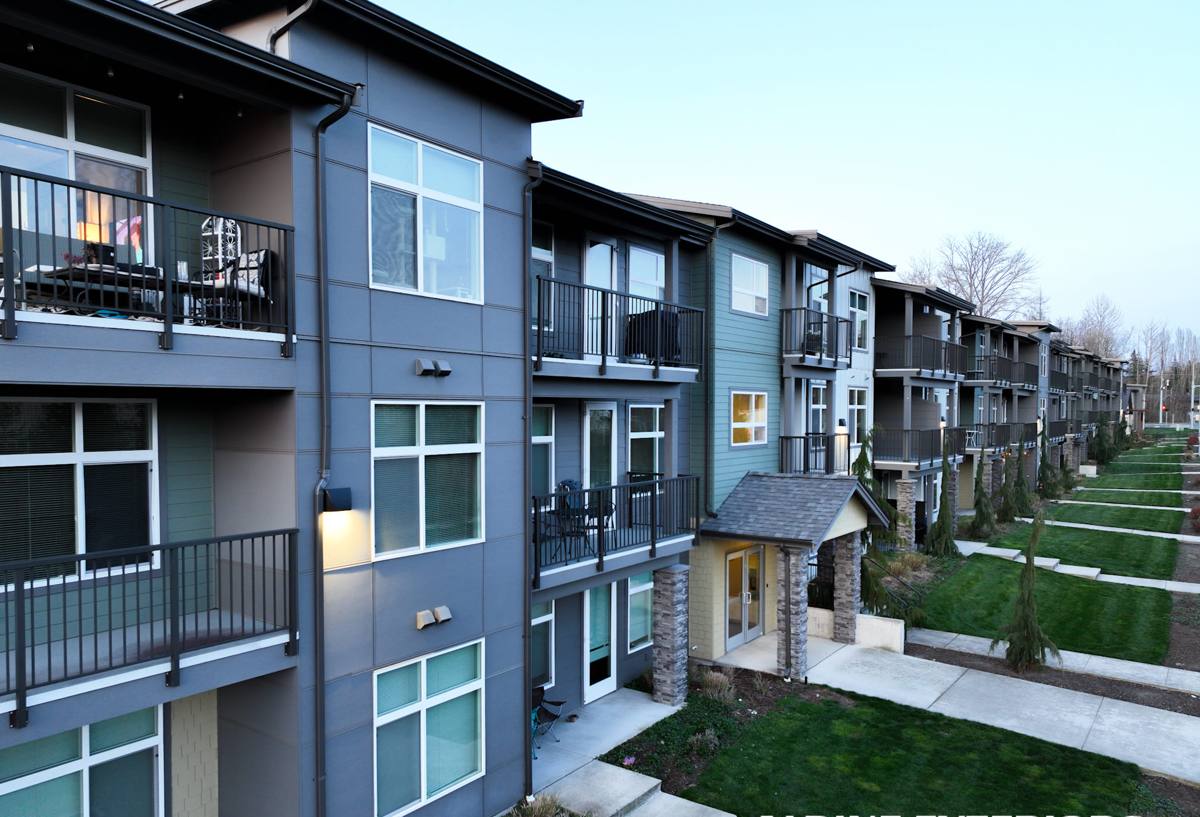
We made a decision as a company to install James Hardie fiber cement siding exclusively. We don't install vinyl, LP SmartSide, Cemplank, Allura, primed spruce, or cedar. That's not a marketing position — it's a professional standard we hold ourselves to because we've seen what each of those alternatives does over time in exactly the climate Bellevue sits in.
Fiber cement is non-combustible, which matters both for insurance considerations and for the wildfire smoke and ember exposure that has become a more regular part of Pacific Northwest summers. It doesn't rot, it doesn't provide a food source for the moss and mildew that thrive in our damp shoulder seasons, and it holds paint and factory finish far longer than wood-based or vinyl alternatives because it doesn't expand and contract with moisture the way those products do.
James Hardie's ColorPlus factory-applied finish is baked on and cured under controlled conditions, which gives it better fade and chip resistance than field-applied paint. And their HZ5 product line is specifically engineered for climates that see the freeze-thaw and moisture cycling that King County gets — it isn't a generic product they market everywhere with a regional label slapped on.
What We're Not Saying About Other Products
We're not going to tell you vinyl or LP SmartSide are junk — they're not, and plenty of contractors do good work with them. Vinyl is inexpensive and low-maintenance in the sense that it never needs paint, but it's also a petroleum-based product that becomes brittle in cold and can warp or buckle in ways that are hard to repair invisibly. LP SmartSide and other engineered wood products have improved a lot, but they're still wood-based, meaning moisture intrusion at a poorly sealed joint or fastener point can lead to swelling and delamination — and repairs on those failures aren't always cosmetic quick fixes. Cedar is beautiful but requires an ongoing maintenance commitment most homeowners don't sign up for realistically. We simply decided that for the climate we work in, fiber cement's trade-offs made the most sense to standardize on, and we didn't want to be in the business of installing products we'd hesitate to put on our own homes.
What a Correct Siding Installation Involves
The siding itself is only part of the system. Most of the siding failures we get called out to inspect in the greater King County area aren't failures of the siding material — they're failures of what's underneath it or how it was fastened.
The Layers That Actually Keep Water Out
- Weather-resistive barrier (WRB): A properly lapped and taped house wrap or building paper that sheds water down and out, not one that's stapled up haphazardly with gaps at seams.
- Flashing at every penetration: Windows, doors, hose bibs, light fixtures, and vents all need correctly integrated flashing so water is directed out and over the WRB, never trapped behind it.
- Rainscreen or drainage gap: A small air gap behind the siding lets any moisture that does get in dry out through ventilation instead of sitting against the sheathing — this is increasingly standard practice in wet climates like ours and something we build in as part of the assembly.
- Correct fastening: James Hardie has specific fastener patterns, spacing, and penetration depth requirements. Under-driven or over-driven nails, or fasteners in the wrong location on the plank, are one of the most common installation defects we find on other contractors' work.
- Proper clearances: Siding needs a minimum gap above roof lines, decks, and grade so it isn't sitting in standing water or snow.
Skip any one of these and you can install the best siding material available and still end up with rot, mold, or paint failure within a handful of years — the material gets blamed, but the installation was the actual problem.
Our Process for Bellevue Homes
We approach every siding installation the same structured way, whether it's a full re-side or a single-elevation replacement.
1. On-Site Assessment
We look at the existing siding, sheathing condition, and any visible signs of moisture intrusion — soft spots, staining, or bubbling paint. In older Bellevue homes this is also when we check for hidden rot around window and door openings, which is common enough in this climate that we build time for it into the estimate.
2. Tear-Off and Sheathing Inspection
Once old siding comes off, we inspect the sheathing itself. Any water-damaged sheathing gets replaced before anything new goes up — covering damaged sheathing with new siding just hides the problem for a few more years.
3. WRB, Flashing, and Rainscreen Installation
This is the step that determines whether the siding lasts 10 years or 40. We install the weather barrier, integrate flashing at every penetration, and set up the drainage gap before a single piece of Hardie plank goes up.
4. James Hardie Installation to Manufacturer Spec
Fastener spacing, gapping for expansion, and joint treatment all follow James Hardie's published installation guidelines — not shortcuts that speed up the job but compromise the warranty.
5. Final Walkthrough
We walk the finished job with the homeowner, checking caulking, trim, and paint lines before calling it done.
Comparing Siding Options for a Bellevue Climate
| Factor | James Hardie Fiber Cement | Vinyl | Engineered Wood (LP SmartSide) | Cedar |
|---|---|---|---|---|
| Moisture resistance | Excellent — cement-based, doesn't absorb or swell | Good on its face, but seams can trap moisture | Moderate — vulnerable at unsealed cuts and fastener points | Requires diligent sealing and maintenance |
| Combustibility | Non-combustible | Combustible, can melt/warp near heat | Wood-based, combustible | Combustible |
| Moss/algae resistance | Strong with factory finish | Moderate | Moderate | Low without regular treatment |
| Maintenance | Low — occasional wash and caulk check | Very low but limited repair options | Moderate — watch for edge swelling | High — regular staining/sealing |
| Typical service life (installed to spec) | Decades, factory finish warrantied | Decades but can become brittle/fade | Variable, moisture-dependent | Variable, maintenance-dependent |
Why Hiring a Crew That Already Works Bellevue Matters
Siding installation isn't just about following a manufacturer's manual — it's about applying that manual correctly to the specific conditions of a job site. A crew that regularly works Bellevue and the surrounding King County area already understands things like how much drainage detail a shaded, tree-covered lot needs versus an open one, how to sequence a tear-off around our wetter months so sheathing isn't exposed to rain for days, and what clearance and flashing details tend to get missed on the area's older housing stock.
That local familiarity also shows up in smaller ways: knowing which inspectors in the area focus on which details, having a real sense of realistic timelines given how often weather can push a schedule, and being available for a warranty callback without a long drive across the region. None of that replaces sound installation practice, but it removes a lot of the guesswork that shows up when a crew is working somewhere unfamiliar.
What to Ask Before Hiring Anyone for This Job
- Are they James Hardie certified or specifically experienced installing fiber cement, not just "familiar with it"?
- Will they inspect and replace damaged sheathing before installing new siding, and is that spelled out in the estimate?
- Does their quote include a rainscreen/drainage gap, or just siding-over-wrap?
- How do they handle flashing at windows, doors, and other penetrations — can they explain their approach, not just point at the product?
- What does the warranty actually cover — material only, or labor too, and for how long?
- Do they have a real local presence, or are they traveling in from outside the area for the job?
Signs Your Bellevue Home May Need Siding Attention Now
Not every siding problem waits for a full failure to show itself. Watch for paint that's bubbling or peeling in patches rather than evenly, soft or spongy spots when you press on siding near the ground or under windows, visible warping or buckling panels, persistent moss or algae growth that comes back quickly after cleaning, and gaps or separation at seams and corners. Any of these can mean moisture is already working on the layers behind the siding, and the sooner it's addressed, the less likely you are to be dealing with sheathing or framing repair on top of the siding itself.
Get a Straight Answer on Your Bellevue Siding Project
If your home's siding is showing its age, or you're planning ahead of a larger exterior project, we're glad to come take a look and give you a straightforward, no-pressure estimate — what your home actually needs, what correct installation involves, and what it would cost to do it right the first time. Fill out the form below to get started.