 King County
 Queen Anne's Hilltop Position Puts Extra Demands on Siding
Queen Anne sits higher and more exposed than most of the surrounding city, and that position changes what a siding system has to deal with year-round. Homes near the top of the hill catch wind off Puget Sound with little to break it up, which means driving rain hits walls at an angle instead of falling straight down. That angled, wind-driven rain is harder on siding than a calm downpour because it gets pushed into laps, corners, and trim joints that a system installed for a sheltered lot might never have to handle.
Add in the salt-laden air that rolls in off the Sound, and you've got a combination that speeds up corrosion on fasteners and trim, and accelerates the breakdown of paint films that aren't built to shed water repeatedly. None of this means Queen Anne is a hostile place to own a house — it's a beautiful place to live — but it does mean the siding on these homes works harder than siding on a similar house twenty miles inland, and it should be chosen and installed with that in mind.
What a Long Moss Season Does to a Building Envelope
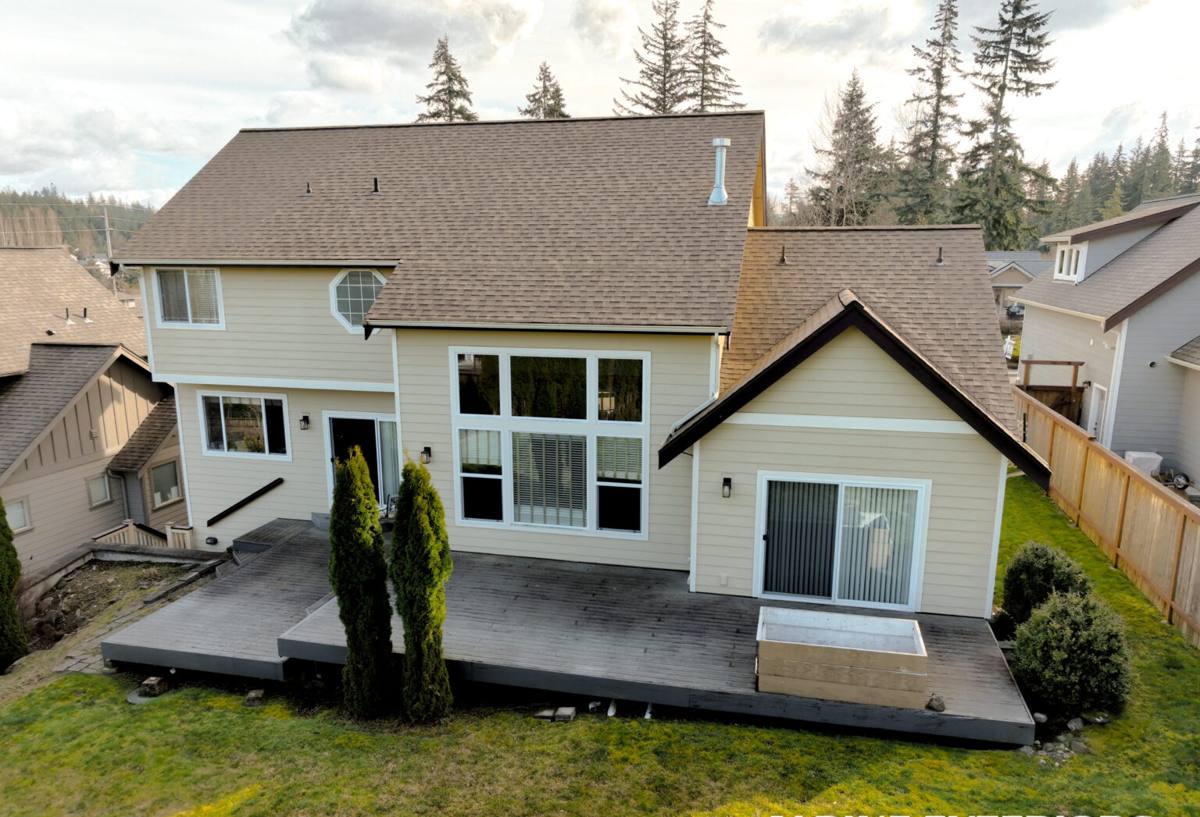
King County's wet season stretches long, and on a shaded, north-facing wall or under mature tree cover — common on older Queen Anne lots — moss and algae can hold moisture against siding for months at a stretch. Wood-based products absorb that moisture and start to soften or rot from the inside out, often before any staining is visible from the ground. Even products that resist rot outright can still look bad if moss gets a foothold in caulk lines, butt joints, or anywhere water sits instead of draining.
The practical takeaway for homeowners is that siding choice and installation detail matter more here than in a drier climate. A siding system that manages water well — sheds it, doesn't trap it, and doesn't feed mold or moss — holds its appearance and its structure far longer than one that merely looks good on install day.
What We Typically Find on Older Queen Anne Homes
Queen Anne has a lot of older housing stock, including craftsman and early-20th-century homes that have been re-sided once or twice already. When we pull old siding off a house like this, a few things show up often enough that they're worth mentioning:
- Original wood sheathing that's still sound but has taken on moisture damage right behind old, poorly lapped siding joints
- Window and door flashing that was never properly integrated with the water-resistive barrier, letting water track behind the cladding
- Multiple layers of old paint or a prior siding product installed directly over failing material instead of a proper tear-off
- Trim and corner details that were caulked instead of flashed, which fails quietly over years rather than all at once
These aren't unusual problems for a home's age — they're the kind of thing any 60- or 80-year-old house in a wet climate accumulates. But they matter because siding installation is only as good as what's underneath it. A new product installed over an unaddressed moisture problem just hides that problem for a while.
Why We Install Only James Hardie Fiber Cement
We made a decision as a company to install James Hardie fiber cement siding exclusively, and we don't install vinyl, LP SmartSide, cedar, primed spruce, or other fiber cement brands. That's not a marketing position — it's a standard we hold ourselves to because of what we've seen these products do over time in exactly this kind of climate.
Wood-based and wood-composite sidings can perform well when detailed and maintained carefully, but they depend on an unbroken paint film and consistent upkeep to keep moisture out — a tall order on a hill that gets driving rain and long stretches of damp shade. Vinyl is inexpensive and low-maintenance, but it can warp in direct sun exposure on west-facing walls and it isn't rated as a non-combustible material. James Hardie fiber cement is engineered specifically to resist moisture, hold paint far longer through its factory-applied ColorPlus finish, and stand up to fire as a non-combustible product — all real advantages in a marine climate with a long wet season.
Hardie's HZ5 product line in particular is engineered for climates with more moisture exposure, which fits Queen Anne's conditions better than a generic siding spec pulled off a shelf.
What Correct Installation Actually Involves
Fiber cement only performs the way it's designed to if it's installed to Hardie's specifications, and the details that get skipped on a rushed job are exactly the details that cause problems in a wind-and-rain climate. A correct installation includes:
- Proper water-resistive barrier and flashing integration at every window, door, and penetration — not caulk substituting for flashing
- Correct fastener type, spacing, and embedment so panels stay secure under wind load without over-driving fasteners
- Minimum clearances from grade, roof lines, and decks so siding never sits in standing water or gets buried in mulch or soil
- Proper lap and joint treatment, including factory-primed or ColorPlus-matched caulking at joints designed to move
- Ventilation behind the cladding where the wall assembly calls for it, so incidental moisture can dry out instead of getting trapped
Skipping any one of these doesn't usually cause an immediate, visible failure — it shows up two, five, or ten years later as a soft spot at a corner, a stain under a window, or paint that's failing years ahead of when it should.
Our Process for a Queen Anne Siding Installation
- On-site assessment. We look at the whole envelope, not just the siding — sheathing condition, existing flashing, drainage at grade, and exposure on each elevation of the house.
- Tear-off and inspection. Old siding comes off so we can actually see the sheathing and framing underneath, rather than installing over hidden damage.
- Repair and prep. Any rot or damaged sheathing gets repaired, and the water-resistive barrier and flashing get installed or corrected before a single piece of new siding goes up.
- Hardie installation to spec. Panels, fasteners, laps, and joints are installed per James Hardie's published specifications, adjusted for each elevation's actual wind and rain exposure.
- Final detailing and walkthrough. Caulking, touch-up, and trim details get finished, and we walk the house with the homeowner before calling the job done.
Cost Factors for a Queen Anne Siding Project
Every home is different, but the factors that most often move the price on a Queen Anne siding job are consistent enough to lay out plainly:
| Factor | Why it affects cost |
|---|---|
| Extent of tear-off and sheathing repair | Older homes often need more substrate repair before new siding can go on |
| House access and lot slope | Steep or narrow Queen Anne lots can require more setup time for scaffolding and material staging |
| Number of stories and roof lines | Taller walls and complex rooflines increase labor and add more flashing detail work |
| Trim and architectural detail | Craftsman and older homes often have more trim, corner boards, and detail work than a simple modern facade |
| Hardie product line selected | Panel style, plank width, and ColorPlus color selection affect material cost |
We provide a written, itemized estimate after the on-site assessment so homeowners can see exactly where the cost is coming from rather than a single lump number.
Signs Your Current Siding Is Telling You Something
Homeowners often wait longer than they should to address siding issues because the early signs are easy to write off as cosmetic. Worth a closer look if you're seeing:
- Paint that's peeling, bubbling, or chalking well ahead of its expected repaint interval
- Soft or spongy spots when you press on siding, especially near the bottom courses or under windows
- Persistent moss or algae growth that comes back quickly after cleaning
- Visible gaps, warping, or buckling at joints and corners
- A musty smell or visible staining on interior walls that back up to exterior siding
Any one of these on its own might be minor. Several together, especially on a home that's had the same siding for a couple of decades, usually means it's worth having someone look at what's happening behind the surface.
Why Hiring a Crew That Already Works Queen Anne Matters
Siding installation isn't identical from neighborhood to neighborhood, even within the same county. A crew that regularly works Queen Anne's steep lots, older homes, and hill exposure already knows what to check for before they start — where flashing tends to have failed on homes of a certain age, which elevations take the worst of the wind-driven rain, and how to stage a job safely on a sloped site. That familiarity shows up in fewer surprises mid-project and a finished job that's actually built for the conditions the house faces, not a generic installation dropped onto a challenging site.
If you're weighing a siding project for a Queen Anne home, we're happy to take a look and walk you through what we see — no pressure, no obligation. Fill out the form below to schedule a free estimate.