 King County
 Why Woodinville Decks Take a Different Kind of Beating
A deck in Woodinville doesn't fail the way a deck fails in a dry climate. It doesn't crack from sun exposure first — it rots from the inside out, starting at the joints, the fasteners, and the spots where water has nowhere to go. King County's long wet season, the driving rain that comes sideways off a storm front, and the moisture-laden marine air that settles into this part of the Puget Sound region all work on wood, metal, and even composite decking in slow, steady ways that homeowners often don't notice until a board feels soft underfoot or a railing post starts to wobble.
The moss season here is real and it's long. Anything horizontal — a deck surface, a stair tread, the ledge where a rail meets a post — collects moisture and organic debris for months at a stretch. That combination of standing moisture and organic growth is what breaks down wood fiber and corrodes fasteners years before they should fail. A deck built without that reality in mind will look fine for a season or two and then start giving you problems every single year after.
Building for Woodinville means building for drainage first, material selection second, and appearance third — not because looks don't matter, but because a deck that traps water will never look good for long no matter what it's made of.
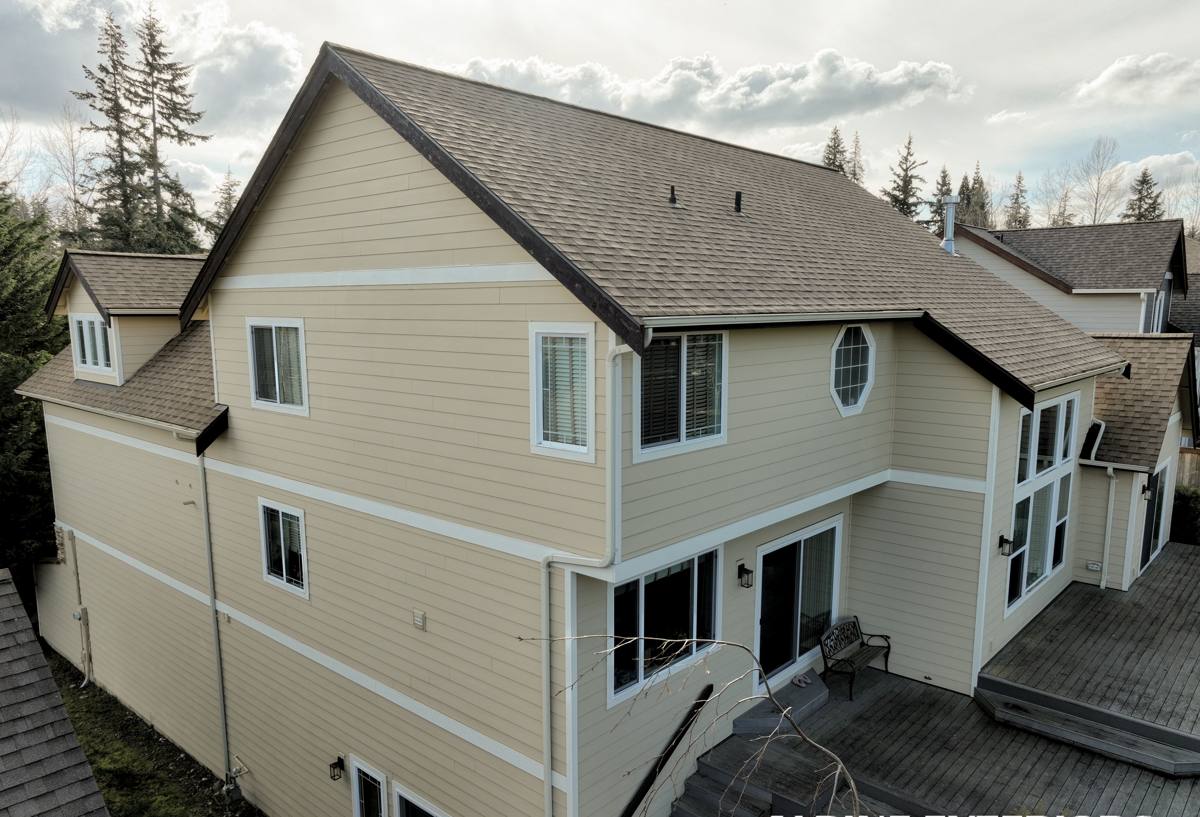
What a Correctly Built Deck Looks Like Here
There's a lot more to a deck than boards and rails. The parts you can't see are usually the parts that determine whether it lasts fifteen years or forty.
Ledger Attachment and Flashing
The ledger board — the piece that bolts the deck to your house — is the single most common failure point on decks in wet climates, and it's almost always a flashing problem, not a structural one. Water gets behind the ledger, sits against the house sheathing, and starts rot that spreads before anyone sees it. Correct flashing detail (proper layering with the house's weather-resistive barrier, not just a bead of caulk) is non-negotiable on every deck we attach to a home.
Footings and Framing for Wet Ground
King County soils hold water, and a footing that isn't set to the right depth and bearing conditions can shift over a few wet winters. We size and set footings to the load they'll actually carry and to local frost and soil conditions, not to a generic minimum. Framing lumber gets treated for ground contact where it's called for, and every joist hanger and structural fastener is coated or stainless rated for exterior, wet-climate use — standard interior-grade hardware corrodes and weakens faster than most homeowners expect.
Joist Protection
Joist tape or an equivalent protective barrier over the top of each joist keeps rain from sitting in the screw holes and wicking down into the wood grain. It's a small material cost that adds real years to the framing's life, and it's the kind of detail that's easy to skip and impossible to fix later without tearing up the decking.
Choosing the Right Decking Material for This Climate
There's no single "best" decking material — there's a best material for your budget, your maintenance appetite, and how much sun versus shade your yard actually gets. Here's how the common options hold up under King County's wet, low-light winters and moss pressure.
| Material | How It Handles Moisture & Moss | Maintenance | Typical Lifespan |
|---|---|---|---|
| Pressure-treated wood | Resists rot chemically but surface still grows moss/algae if shaded | Annual cleaning, periodic sealing | 10–15 years with upkeep |
| Cedar | Naturally rot-resistant, but soft surface can hold moisture in shaded areas | Regular cleaning, sealing every 1–2 years | 15–20 years with upkeep |
| Composite decking | Doesn't rot, but can grow surface algae/moss film in shady, damp spots | Periodic washing, no sealing needed | 25–30+ years |
| PVC decking | Fully moisture-proof surface, least prone to organic growth | Occasional washing | 25–30+ years |
We don't push one product over another as a default — it's a real trade-off. Wood costs less up front and looks natural, but it demands yearly attention to stay ahead of moss and moisture. Composite and PVC cost more initially and can still develop a slippery film in a heavily shaded, low-airflow spot if it's never cleaned, but they remove the rot risk entirely and hold up with far less work over the deck's life. We'll walk your specific site — sun exposure, tree cover, how the yard drains — and give you a straight answer on what fits.
Drainage, Moss, and the Space Under Your Deck
What happens under and around a deck matters as much as what happens on top of it. A deck built low to grade over poorly draining soil creates a damp, shaded pocket that stays wet for weeks after a storm — ideal conditions for moss, mold, and slow wood decay in the framing above it. Grading the ground under and around a deck so water moves away from the structure, keeping soil from piling up against posts and footings, and leaving enough clearance for airflow underneath all reduce how long moisture sits in contact with the wood.
On the surface, proper board spacing lets water shed through rather than pool on top, and boards run in a direction that matches the deck's natural drainage path shed faster than boards fighting against it. None of this eliminates the need for occasional cleaning, but it dramatically cuts how often moss and algae get a foothold in the first place.
Our Process, From First Call to Final Walkthrough
- Site visit and assessment — we look at grading, sun/shade exposure, existing structure (if it's a rebuild), and how the space actually gets used.
- Design and material selection — we talk through layout, railing style, and decking material trade-offs based on your budget and how much maintenance you want to do.
- Permitting — most jurisdictions in King County require a permit for decks above a certain height or attached to the home; we handle that process rather than leaving it on you.
- Build — footings, framing, flashing, and joist protection go in first and get inspected before decking, rails, and stairs are installed.
- Final walkthrough — we go over the finished deck with you, including what upkeep it needs and when, before we consider the job done.
What a New Deck Typically Costs
Deck pricing varies more than almost any other exterior project because so much depends on size, height off the ground, material, and how complicated the framing and footing work is. Broadly, homeowners should expect a range from a modest single-level wood deck on simple, accessible ground up to a significantly higher figure for a large multi-level composite or PVC deck with custom railing and stairs. The factors below drive most of that swing.
| Cost Factor | Why It Matters |
|---|---|
| Decking material | Pressure-treated wood costs least up front; composite and PVC cost more but need less upkeep over time |
| Height off grade | A deck more than a few feet off the ground needs stronger footings, guardrails, and often more code review |
| Ground conditions | Sloped or poorly draining sites need more excavation, drainage work, and footing depth |
| Attachment vs. freestanding | Ledger-attached decks need house flashing work; freestanding decks avoid that but need more posts/footings |
| Railing and stairs | Custom railing styles and multi-flight stairs add labor and material cost beyond a basic run |
We give straight, itemized estimates rather than a single vague number, so you can see exactly what's driving the cost and where you have room to adjust the scope.
Keeping Your Deck in Shape Year After Year
A well-built deck still needs regular attention in this climate. The good news is that most of it is simple and cheap compared to the cost of replacing rotted framing later.
- Sweep leaves and debris off the surface regularly through fall, especially in shaded corners where moss takes hold fastest
- Rinse or wash the deck surface at least once or twice a year to clear algae and moss film before it gets slick
- Check the ledger board area and any spot where the deck meets the house for staining, soft wood, or gaps in flashing
- Keep gutters and downspouts near the deck clear so runoff isn't dumping extra water onto or under the structure
- Inspect railing posts and stair stringers for movement or soft spots each spring
- Reseal wood decking on the schedule appropriate to the product — skipping a cycle lets moisture back into the grain
- Trim back overhanging branches and shrubs that keep the deck surface shaded and slow to dry
Why Hire a Crew That Already Works Woodinville
A deck built to a generic national spec sheet isn't necessarily built for this ground, this rainfall, and this moss season. Crews who work King County regularly know which footing depths and flashing details actually hold up here, which decking products perform well in shaded Pacific Northwest yards versus how they're marketed, and which permitting steps apply locally. That local pattern recognition is the difference between a deck that needs attention in year three and one that's still solid at year twenty.
It also matters for accountability. A crew that plans to keep working in this area has every reason to build something that holds up, stands behind the work, and is easy to reach if a question comes up two winters down the road.
If you're weighing a new deck or a rebuild for your Woodinville home, we're happy to walk the site, talk through material options honestly, and put together a clear, no-pressure estimate using the form below.