 King County
 Woodinville's Climate and What It Does to Siding
Woodinville sits in a part of King County where tree cover, valley humidity, and a long wet season combine to put real, sustained pressure on exterior siding. Rain here isn't just frequent — it's often a slow, driving soak that lasts for days, and it arrives on top of landscaping and mature tree canopy that keeps moisture close to the house long after a storm passes. Add in the broader Puget Sound region's damp, mild winters and you get conditions that are almost engineered to grow moss, feed mildew, and find any weak seam in a home's exterior.
Homes in Woodinville's wooded, semi-rural neighborhoods deal with this differently than a home on an open lot closer to Seattle. Shade slows drying time after rain. Overhanging branches drop debris into siding laps and trim. Sprinkler systems and irrigated landscaping — common around the area's wineries and larger residential lots — add another source of near-constant moisture at the base of exterior walls. None of this is exotic weather. It's just persistent, and persistent is what wears out the wrong siding material years before it should fail.
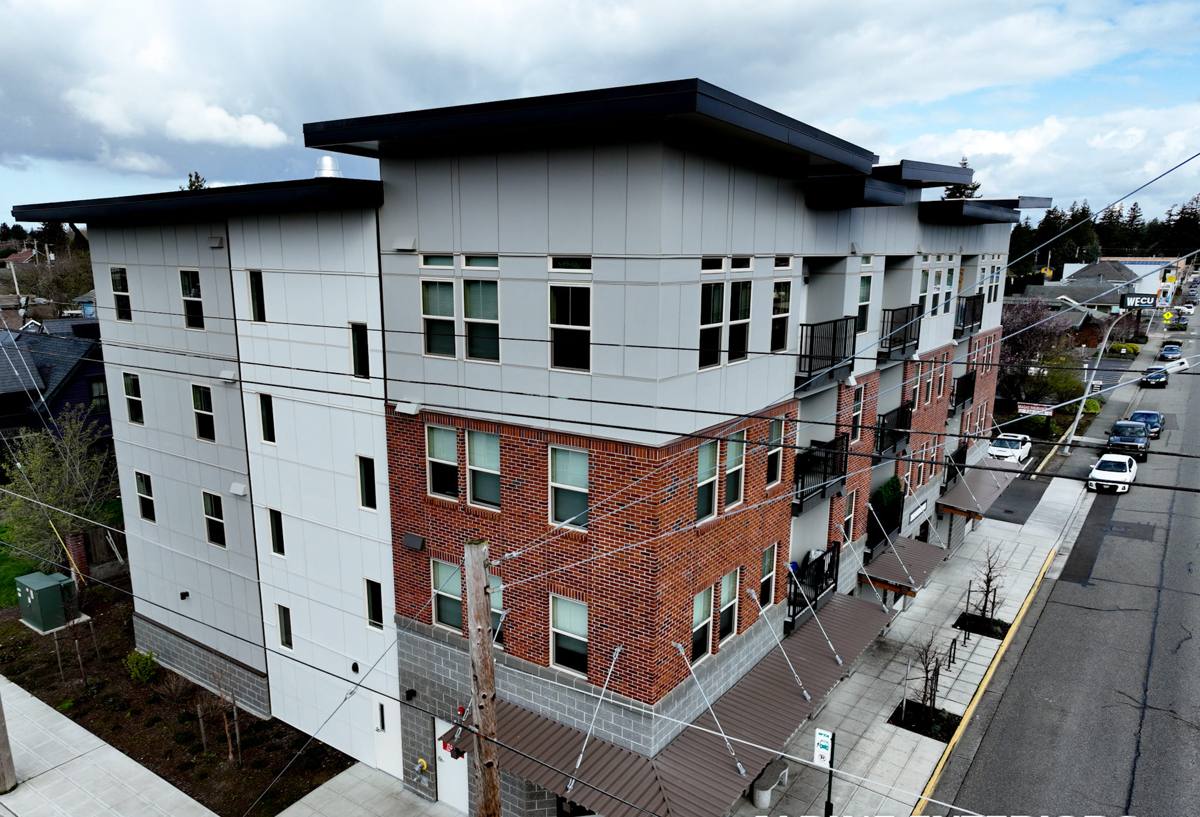
Why We Only Install James Hardie in Woodinville
We install James Hardie fiber cement siding exclusively. Not because it's the only product on the market, but because after years of working on homes throughout this climate, it's the one material that consistently holds up to what King County actually throws at a house. We don't install vinyl, LP SmartSide, Cemplank, Allura, or bare cedar or primed spruce — each of those has genuine strengths, but each also has a real-world weak point that shows up faster in a wet, shaded, moss-prone environment like Woodinville than it would in a drier climate.
Moisture Management in a High-Rainfall Valley
Fiber cement is dimensionally stable — it doesn't swell, cup, or warp the way wood-based products can when they take on repeated moisture cycles. Vinyl, by contrast, can distort with temperature swings and gaps at seams over time, giving water a path behind the panel. In an area where siding might stay damp for days at a stretch during a wet spell, that stability matters more than it would somewhere with a shorter, drier rainy season.
Standing Up to Moss and Mildew
Moss and mildew need two things to take hold: moisture and something to grow on. Wood-based siding products give organic growth a foothold that's hard to fully eliminate no matter how well the product is sealed and maintained. James Hardie's fiber cement composition doesn't feed mold and mildew the way wood fiber does, which is a meaningful advantage in a shaded, tree-heavy setting where a home's north-facing wall might rarely see direct sun.
The Right Hardie Product Line for This Climate
James Hardie engineers its siding in different formulations for different climate zones, and the Pacific Northwest falls under the company's HZ5 category — built for regions with damp, temperate conditions and freeze-thaw cycles. That's the line we spec for Woodinville homes. It's a different formulation than what Hardie recommends for hot, dry, or humid-Southeast climates, and using the right one isn't a marketing detail — it affects how the product performs against moisture over its service life.
ColorPlus Factory Finish
Most of the Hardie siding we install carries the ColorPlus finish — baked on at the factory under controlled conditions rather than field-painted on site. That matters in a climate like this one because field-applied paint has to cure properly to perform, and King County's damp weather window makes that harder to guarantee than a factory process does. ColorPlus finishes also carry a longer finish warranty than standard field painting, which is a real difference when a homeowner is comparing long-term value, not just install-day cost.
What Correct Installation Actually Involves
James Hardie siding is only as good as the installation behind it. The product itself is engineered to perform, but water management, fastening, and clearances are what actually determine whether a home stays dry and the siding lasts. This is where a lot of installation quality gaps show up — often invisibly, until a problem surfaces years later.
| Installation Detail | Why It Matters in Woodinville |
|---|---|
| Weather-resistive barrier and flashing at every penetration | Directs incidental moisture back out instead of behind the siding, critical given how long walls stay damp here |
| Proper ground and hardscape clearance | Wooded, landscaped lots often have soil, mulch, or irrigation right up against the foundation — clearance keeps splash-back and standing moisture off the siding's bottom edge |
| Correct fastener type, spacing, and depth | Under- or over-driven fasteners create gaps or cracking that let water in over repeated wet-dry cycles |
| Caulking and sealant at joints, not gaps | Poorly sealed joints are a direct entry point for the driving rain typical of Puget Sound storms |
| Ventilation behind the cladding | Lets any moisture that does get in dry out instead of sitting against sheathing, especially important on shaded walls |
Every one of these details is spelled out in James Hardie's installation manual, and every one of them is also a place where a rushed or inexperienced crew can cut a corner that isn't visible until the siding is finished and painted over.
Our Process for Woodinville Homes
We approach every Woodinville siding project the same methodical way, adjusted for the specific lot's shade, drainage, and exposure.
- On-site assessment: we walk the property, note tree cover, drainage patterns, existing moisture damage, and any areas where landscaping or irrigation sits close to the walls.
- Tear-off and sheathing inspection: we remove the old siding and check the sheathing underneath for rot or hidden moisture damage before anything new goes up — this step catches problems that would otherwise get sealed behind new siding.
- Water-resistive barrier and flashing installation: this is the layer that actually keeps a house dry, and we install it to spec before a single piece of siding goes on.
- Hardie panel or plank installation: fastened, spaced, and sealed to James Hardie's published specifications for the HZ5 climate zone.
- Trim, caulking, and detail work: the seams, corners, and penetrations where most long-term failures start.
- Final walkthrough: we review the finished job with the homeowner and flag any maintenance items specific to the property, like nearby sprinkler heads or tree limbs that should be kept trimmed back.
Cost Factors for a Woodinville Siding Project
Every home is different, and we don't publish blanket per-square-foot pricing because it misleads more than it informs. What we can do is walk through the variables that actually move the number.
| Factor | How It Affects Cost |
|---|---|
| Home size and wall complexity | More corners, dormers, and trim detail mean more labor and material waste to account for |
| Extent of tear-off and repair | Rot or moisture damage found under old siding adds sheathing repair before new siding can go on |
| Siding profile chosen | Lap siding, panel systems, and shingle-style Hardie products differ in material and labor cost |
| Trim and accent work | Board-and-batten accents, window trim upgrades, and color-matched details add scope |
| Site access | Wooded or sloped lots common around Woodinville can add setup time and equipment needs |
The only way to get an accurate number is a walk-through of the actual house, which is what we offer with our free estimate.
Maintenance: What Hardie Siding Still Needs From You
James Hardie siding is low-maintenance, not no-maintenance. In a climate like Woodinville's, a little seasonal attention goes a long way toward protecting the investment.
- Rinse siding with a garden hose once or twice a year to clear pollen, dust, and the early stages of moss or algae film
- Keep tree branches and shrubs trimmed back so air can circulate and shaded areas get some sun exposure
- Check and clear gutters each fall so overflow doesn't run down the siding face
- Inspect caulking at trim and joints every year or two and have any cracked or missing sealant addressed
- Watch for and address any irrigation spray hitting the siding directly, especially on ground-level walls
- Repaint is optional with ColorPlus finishes for many years, but if it's ever needed, use a paint compatible with fiber cement
Why a Crew That Already Works Woodinville Matters
Siding installation manuals read the same everywhere, but the conditions a crew is actually working in do not. A crew that regularly works in Woodinville and the surrounding King County area already knows what a shaded, tree-covered lot does to drying time, how local moisture and moss patterns behave through the wet season, and where homeowners in this area tend to run into trouble with irrigation, drainage, or overhanging vegetation. That's not something you learn from a spec sheet — it's something you learn from doing the work here, on homes with the same climate exposure as yours.
It also means faster response if something needs a follow-up look after installation, and a crew that isn't guessing at how James Hardie's HZ5 product line should be flashed and sealed for this specific region. Correct installation is what makes the difference between siding that lives up to its warranty and siding that causes problems five or ten years down the road.
If you're considering new siding for a Woodinville home, we're happy to walk the property, look at what your current siding is telling us, and put together a straightforward estimate — no pressure, no upsell, just a clear look at what the job actually involves.