 King County
 Why Bellevue Siding Has to Work Harder Than People Expect
Bellevue sits close enough to the water and low enough in the Puget Sound trough that homes here deal with a specific combination of stresses: salt-tinged marine air drifting in off the Sound, long stretches of driving rain that push moisture sideways into wall assemblies, and a moss and algae season that can run most of the year on shaded, north-facing walls. None of that is dramatic on its own. The problem is that it never really stops. A siding product that's fine in a dry climate, or one that only sees occasional storms, gets tested here month after month, year after year.
That's the lens we use when we talk to Bellevue homeowners about siding. It's not about finding something that looks good on install day — it's about what the wall assembly is doing five, ten, twenty years in, after hundreds of soak-and-dry cycles and constant low-grade moisture pressure. That's why we install James Hardie fiber cement siding exclusively, and it's why a page about siding in Tampa or Phoenix would read completely differently than this one.
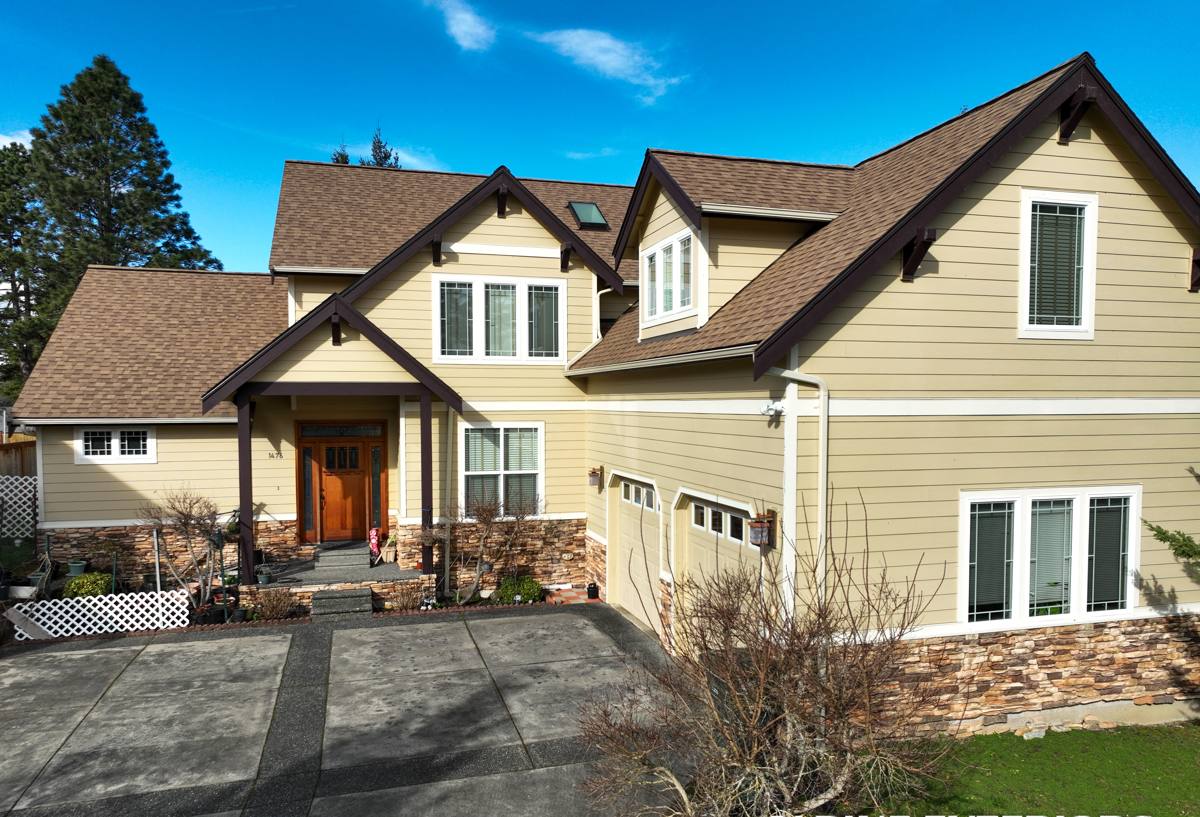
What King County's Climate Actually Does to Siding
Moisture, Not Just Rain Volume
The Seattle-Bellevue area doesn't get the heaviest rainfall totals in the country, but it gets some of the most persistent. Long, low-intensity rain events soak siding, trim, and the water-resistive barrier behind it for days at a time. Materials that absorb moisture and are slow to dry — or that swell and shrink with each cycle — take on cumulative damage that shows up as cupping, delamination, or rot at the most vulnerable points: butt joints, corners, and anywhere flashing was cut short.
Salt Air From the Sound and Lake
Bellevue isn't oceanfront, but proximity to Lake Washington and the broader Puget Sound marine environment means airborne salt and moisture are part of the picture, especially on homes with more open exposure. Salt-laden air accelerates corrosion on fasteners and trim hardware and speeds up the breakdown of finishes that aren't engineered to resist it.
Moss, Algae, and Shade
King County's tree canopy is part of what makes the area desirable, but it also means a lot of homes have walls that rarely get direct sun. Shaded, damp surfaces are exactly where moss and algae take hold. On some siding materials that's a cosmetic nuisance you pressure-wash off. On others, sustained organic growth traps moisture against the surface and works its way into seams and edges over time.
Why We Standardized on James Hardie for Homes Like Yours
We made a deliberate decision to install James Hardie fiber cement and nothing else — not vinyl, not LP SmartSide, not Cemplank or Allura, not primed spruce or cedar. That's not a marketing position, it's a practical one built around what actually holds up in this specific climate.
James Hardie's siding is fiber cement: a mix of cellulose fiber, sand, and Portland cement pressed and cured into planks and panels. It doesn't absorb and swell the way wood-based products can, it's non-combustible, and James Hardie engineers specific product lines for different climate zones, including an HZ5 formulation built for regions like ours that see sustained moisture and freeze-thaw cycling. That climate-specific engineering is a big part of why we don't treat every siding product as interchangeable.
We're not going to tell you every alternative is unusable — plenty of them have real strengths. But each one comes with a trade-off that matters more here than it would somewhere drier: vinyl can warp and doesn't stand up to impact the way fiber cement does; engineered wood products rely heavily on maintaining an intact factory coating, and any gap in that coating becomes a moisture entry point; and bare or primed wood siding demands a repainting and caulking schedule that's hard to keep up with in a climate that gives you a short paint-drying window most of the year. Fiber cement, installed correctly, removes most of that maintenance burden.
ColorPlus Finish: Why Factory-Applied Color Matters Here
One of the most underrated parts of the James Hardie system is the ColorPlus finish — a multi-coat color baked onto the plank at the factory under controlled conditions, rather than sprayed or brushed on site after installation. In a climate with as much humidity and rain as King County, field-applied paint has a much harder time curing evenly and bonding as well as a factory finish does. That translates directly into how long the color holds up and how soon a home needs repainting.
ColorPlus siding comes with a separate finish warranty from the substrate warranty, and Hardie's touch-up and caulk systems are formulated to match, so repairs and trim work don't turn into a visible patchwork. For a wall that's going to see near-constant moisture exposure, starting with a finish that was cured properly in a factory rather than on a ladder in variable weather is a meaningful advantage, not a cosmetic upsell.
What a Correct James Hardie Installation Involves
Fiber cement siding is only as good as the installation behind it. Hardie engineers the product, but the water management system — the parts you don't see once the job is done — is what determines whether a wall stays dry for the next thirty years or starts failing in five. A correct job includes:
- A properly lapped and sealed water-resistive barrier behind the siding, with all penetrations flashed before a single plank goes up
- Rigid or engineered flashing at every horizontal transition — window heads, roof-to-wall intersections, deck ledgers — not just caulk bridging the gap
- Correct fastener type, spacing, and embedment depth per the Hardie installation manual for our climate zone, not a generic nailing pattern
- A minimum clearance gap between the bottom of the siding and grade, decks, patios, or roof lines so splashback and standing water can't wick into the plank
- Butt joints back-flashed or sealed with a Hardie-approved joint treatment, not just caulked and painted over
- Field cuts sealed on all edges before installation, since a raw, unsealed cut edge is the single most common point of moisture intrusion on fiber cement jobs
Skip any one of these and you can end up with a wall that looks right for a few years and then fails quietly behind the surface — which is often worse than an obvious problem, because it's not caught until there's visible damage or rot in the sheathing.
Comparing Siding Options for a Bellevue Home
Homeowners often ask us to lay out, plainly, how the common siding options actually compare once you factor in what King County's climate does to a wall over time. Here's the honest breakdown we give people during an estimate.
| Factor | James Hardie Fiber Cement | Vinyl | Engineered Wood / LP-Style | Cedar / Primed Wood |
|---|---|---|---|---|
| Moisture resistance | Non-combustible, doesn't swell with water absorption | Won't rot, but can warp and gap over time | Depends entirely on intact factory coating | Absorbs moisture; needs consistent sealing |
| Performance in salt air | Cement substrate is not affected by salt corrosion | Generally stable, fasteners can corrode | Coating can degrade faster near salt exposure | No inherent resistance |
| Moss/algae exposure | Surface can be cleaned without damaging substrate | Cleanable, but seams can trap growth | Cleaning risks breaking the coating | Prone to sustained growth and staining |
| Repainting cycle | ColorPlus finish rated well beyond 10-15 years | Doesn't repaint easily; color fades in place | Repaint needed once coating wears, often 7-10 years | Typically every 3-7 years in this climate |
| Fire resistance | Non-combustible | Can melt/deform under heat exposure | Combustible wood-based core | Combustible |
No product wins on every line item for every homeowner, and cost, style preference, and the condition of the existing wall assembly all factor into a real recommendation. But this is the framework, not a sales pitch, and it's why fiber cement is what ends up on the homes we build.
Our Process for a Bellevue Siding Project
Every home we side goes through the same core process, adjusted for the specific house:
- On-site assessment. We look at the existing siding, sheathing condition, moisture history, roofline intersections, and shaded/exposed areas that will need extra attention.
- Product and color planning. We help you choose the right Hardie product line and ColorPlus color for the home's exposure and your style preference.
- Tear-off and sheathing check. Old siding comes off and we inspect the sheathing underneath for rot or moisture damage before anything new goes up — this is where hidden problems from a previous installation usually surface.
- Water-resistive barrier and flashing. This step is the foundation of the whole job and gets done to Hardie's specification, not shortcuts.
- Installation. Panels and planks go up with correct fastening, spacing, and joint treatment throughout.
- Trim, caulk, and touch-up. Matched Hardie products finish the details so the color and texture stay consistent.
- Final walkthrough. We go over the finished job with you before calling it complete.
Why It Matters That We Already Work in Bellevue
Bellevue and the surrounding King County communities have their own permitting requirements, and many neighborhoods have HOA guidelines around exterior color, material, and appearance that a crew unfamiliar with the area can easily run afoul of. Beyond paperwork, a crew that's worked here consistently knows how the local weather patterns affect scheduling — when to push a start date back for a stretch of rain versus when a shorter dry window is workable, and how to sequence a job so vulnerable, uncovered wall sections aren't left exposed overnight during an unpredictable forecast.
That local familiarity also shows up in smaller ways: knowing which parts of a given neighborhood tend to see heavier moss growth because of tree cover, or which older homes in the area were originally sided with materials that are more likely to have hidden sheathing damage once removed. None of that replaces a proper on-site assessment, but it means fewer surprises and a smoother project overall.
What to Ask Before You Hire Anyone for Siding Work
Whether you go with us or get multiple estimates, these are the questions worth asking any contractor bidding a Bellevue siding job:
- Are you a certified or factory-trained installer for the specific product you're proposing?
- What's your plan for the water-resistive barrier and flashing at windows, doors, and roof intersections?
- Will you inspect and address sheathing condition before installing new siding, not just cover it up?
- What clearance will the siding have from grade, decks, and roof lines?
- What warranty covers the material, the finish, and your labor separately, and what voids each one?
If a contractor can't answer those clearly, that's worth taking seriously before you sign anything.
Ready to Talk About Your Home
If your Bellevue home's siding is showing its age, or you're planning ahead before winter's rain sets in, we're happy to take a look and give you a straightforward assessment. There's no pressure and no obligation — just an honest read on what your home needs and what a correct James Hardie installation would involve. Use the form below to request a free estimate.