 King County
 Why Bellevue Homes Wear Out Siding Faster Than the Brochures Suggest
Bellevue sits close enough to Puget Sound and Lake Washington that homes here deal with a version of King County's climate that's a little more aggressive than what you'd find further inland. Salt-tinged marine air moves through the region, driving rain hits siding sideways during fall and winter storms, and a long, damp moss season keeps north-facing walls and shaded siding runs wet for weeks at a stretch. None of that is dramatic on any single day. It's the accumulation — year after year of moisture cycling in and out of the siding material — that eventually separates a good siding job from one that's quietly failing behind the paint.
Siding replacement in Bellevue isn't just a cosmetic upgrade. It's the point where you get to fix whatever the original siding got wrong, address moisture damage that's been building for years, and choose a material that's actually built for this specific climate instead of one that just looked good in a showroom somewhere drier.
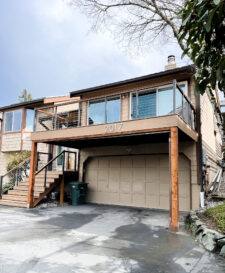
What Bellevue's Climate Actually Does to Siding
Salt Air and Marine Moisture
Bellevue isn't a beach town, but its proximity to Lake Washington and the broader Puget Sound airmass means homes get more airborne moisture and mineral content than a house in eastern Washington ever sees. Over time, that moisture works into seams, fastener holes, and any spot where paint film has thinned or cracked. Materials that swell, wick, or hold water against their core don't handle that kind of chronic exposure well.
Driving Rain
Storms coming off the Sound or funneling through the lowlands don't just fall straight down — they hit siding at an angle, driving water up under laps, into corner trim, and behind poorly flashed windows and doors. A siding system's water-shedding detail (how the laps overlap, how trim is flashed, how the bottom edge is finished) matters as much as the material itself. Bad detailing turns ordinary rain into a slow leak.
Moss and Sustained Dampness
Shaded siding — north walls, areas under overhangs, anything near mature trees — stays damp far longer than sun-exposed walls. That's exactly the environment moss and algae need to take hold. Once organic growth establishes on a wall, it holds even more moisture against the surface, and on materials sensitive to sustained wet conditions, that's where rot, delamination, or paint failure tends to start.
Signs Bellevue Homeowners Should Watch For
- Soft or spongy spots when you press on siding, especially near the bottom courses or below windows
- Paint that's bubbling, peeling, or chalking heavily in patches rather than evenly across the wall
- Visible moss or algae staining on north- or shade-facing walls that keeps returning after cleaning
- Gaps, warping, or buckling where siding boards meet trim, corners, or window frames
- A musty smell in rooms along an exterior wall, which can mean moisture has already reached the sheathing
- Siding that was caulked repeatedly at the same joints — a sign someone's been chasing a leak instead of fixing it
Any one of these on its own might be minor. Several at once, especially on a home that's 15-20+ years past its original siding install, usually means it's time to look at full replacement rather than another round of patching.
What a Correct Siding Replacement Actually Involves
Replacing siding well is mostly about what happens before the new siding ever goes up. Skipping these steps is how a siding job looks fine for two or three years and then starts failing.
1. Full Tear-Off and Inspection
Old siding comes off entirely so the sheathing underneath can be inspected. This is the only real chance to find rot, soft framing, or moisture damage that's been hidden for years. Anywhere driving rain or moss-related dampness has been working on a wall, this step matters more, not less.
2. Repair the Substrate
Any damaged sheathing or framing gets cut out and replaced before new siding goes on. Installing new siding over compromised substrate just hides the problem again — it doesn't fix it.
3. Weather-Resistive Barrier and Flashing
A correctly installed water-resistive barrier, properly lapped and taped, along with flashing at every window, door, and horizontal transition, is what actually stops driving rain from reaching the wall assembly. This detailing work is arguably more important to long-term performance than the siding brand on top of it.
4. Rainscreen Consideration
In a climate with Bellevue's rain and humidity profile, a ventilated gap between the siding and the weather barrier helps any moisture that does get past the surface dry out instead of sitting against the wall. It's a detail worth discussing for any full replacement, particularly on shaded or north-facing elevations.
5. Correct Fastening and Fitment
Fiber cement siding has manufacturer-specified nailing patterns, clearances, and gaps that have to be followed for the warranty to hold and for the material to perform as designed. This is where installer experience shows — rushed or improperly fastened siding is one of the most common causes of early failure, regardless of what material was used.
6. Caulking, Trim, and Final Finish
Joints get sealed with the right products, trim is finished cleanly, and factory-finished panels are touched up only where the manufacturer's system allows, preserving the factory coating's performance rather than compromising it with field-applied paint everywhere.
Why We Only Install James Hardie Fiber Cement
We get asked why we don't offer vinyl, LP SmartSide, or other fiber cement brands as alternatives. It's a fair question, and the honest answer is that we've made a professional standard out of installing one product system because it holds up to King County's climate better than the alternatives, and we'd rather stand behind one thing we trust completely than offer a menu of options with different risk profiles.
Non-Combustible Core
James Hardie siding is fiber cement — it doesn't burn. In a region where wildfire smoke and occasional dry-season fire risk are a real concern even west of the Cascades, that's a meaningful safety difference compared to vinyl or wood-based products.
Built for Wet, Marine-Influenced Climates
Hardie's HZ5 product line is engineered specifically for climates with freeze-thaw cycling and sustained moisture exposure, which describes the Pacific Northwest well. The material resists the swelling, warping, and moisture-driven damage that wood and engineered wood products are more prone to under chronic dampness.
ColorPlus Factory Finish
Hardie's ColorPlus finish is baked on at the factory under controlled conditions, which gives it better fade and moisture resistance than field-applied paint and dramatically extends the time before repainting is needed. On a home in Bellevue's marine air and long wet season, that factory finish is doing real work.
Strong, Transferable Warranty
James Hardie backs its siding with a substantial product warranty that's transferable to a future homeowner — a real factor if you sell the home before you'd otherwise need to replace siding again.
We're not going to tell you vinyl or engineered wood siding is garbage — plenty of it is manufactured well and installed correctly on homes across the country. But vinyl can warp or crack in temperature swings and doesn't offer fire resistance, and engineered wood products depend heavily on maintaining an intact factory seal to resist moisture — a seal that's easy to compromise during cutting, fastening, or minor damage over the years. Given what Bellevue's climate does to siding over a couple of decades, we decided fiber cement was the material we were willing to install and warranty our workmanship on.
Comparing Siding Options for Bellevue's Climate
| Factor | James Hardie Fiber Cement | Vinyl | Engineered Wood (LP-type) |
|---|---|---|---|
| Moisture resistance | Strong — cement-based core | Good if installed correctly, but seams can trap moisture | Depends heavily on intact factory sealant |
| Fire resistance | Non-combustible | Combustible, can melt/warp near heat | Combustible |
| Performance in driving rain | Strong with correct flashing detail | Moderate — seams and laps are vulnerable points | Moderate — edges are the weak point |
| Finish longevity | 15+ years before repaint typical (ColorPlus) | Color is through-body but can fade/chalk | Field paint or factory finish, shorter repaint cycle |
| Typical lifespan installed to spec | 30-50 years | 20-40 years | 20-30 years |
These are general industry ranges, not guarantees — actual performance depends heavily on installation quality, maintenance, and site conditions regardless of material.
What Drives the Cost of Siding Replacement
Every siding job is priced around the same handful of variables. Understanding them helps you evaluate a quote rather than just compare a bottom-line number.
- Home size and wall complexity — more square footage, more corners, dormers, and roof lines all add labor time
- Substrate condition — how much rot or damaged sheathing gets found once old siding comes off
- Siding profile and trim selection — lap width, trim boards, and accent details all affect material and labor cost
- Access and site conditions — steep lots, limited access, or landscaping that requires extra care
- Rainscreen and upgraded weather barrier — adds labor and material but improves long-term moisture performance
- Height and stories — multi-story homes require more scaffolding, staging, and safety setup
We won't quote a number here without seeing the home — anyone who does is guessing. What we can tell you is that the cheapest bid usually gets there by skipping one of the steps described above, most often the substrate repair or the flashing detail, and those are exactly the steps that determine whether the job lasts.
Why Local Experience in Bellevue Matters
A crew that already works throughout King County knows what Bellevue's microclimates actually do to a house — which elevations hold moss longest, how driving rain off the lake behaves differently than a storm coming through a more sheltered inland neighborhood, and what permitting and inspection expectations look like locally. That's different from a crew that installs siding wherever the next job happens to be and treats every region the same. Correct siding installation isn't just about following a manufacturer's manual — it's about applying that manual with judgment shaped by what actually happens to homes in this specific area.
Our Process for a Bellevue Siding Replacement
- On-site assessment — we look at existing siding, moisture signs, trim, and flashing details, and talk through what we find
- Written estimate — a clear scope covering tear-off, substrate repair allowances, siding profile, trim, and finish
- Tear-off and inspection — old siding comes off, sheathing gets inspected, and we flag anything that changes scope before proceeding
- Weather barrier and flashing installation — the part of the job that determines long-term performance
- James Hardie installation — fastened and fitted to manufacturer spec, with proper clearances and gaps
- Final trim, caulking, and cleanup — including site cleanup and a final walkthrough
If your Bellevue home is showing signs of wear from years of marine air, driving rain, or moss, we're happy to take a look and give you a straightforward, no-pressure assessment of what's going on and what it would take to fix it right. Use the form below to request a free estimate.