 King County
 Bothell's Climate Is Harder on Siding Than It Looks
Bothell doesn't get the dramatic weather that makes headlines, and that's exactly why so much siding damage here goes unnoticed until it's expensive. What Bothell gets instead is months of low-grade moisture: driving rain that comes in sideways off the marine air moving through the Puget Sound region, long stretches of overcast days that never quite dry a wall out, and a moss season that can run from fall through spring under the tree cover that defines so many King County neighborhoods. None of that is dramatic on its own. Stacked year after year, it's what breaks down the wrong siding material long before a homeowner expects it.
Add in Bothell's mix of mature, tree-shaded older neighborhoods and newer construction on tighter lots, and you get siding conditions that vary block to block — some homes fighting shade and standing moisture, others catching more wind-driven rain with less canopy to slow it down. A siding material and installation approach that works fine on a dry-climate spec sheet doesn't always hold up to that combination.
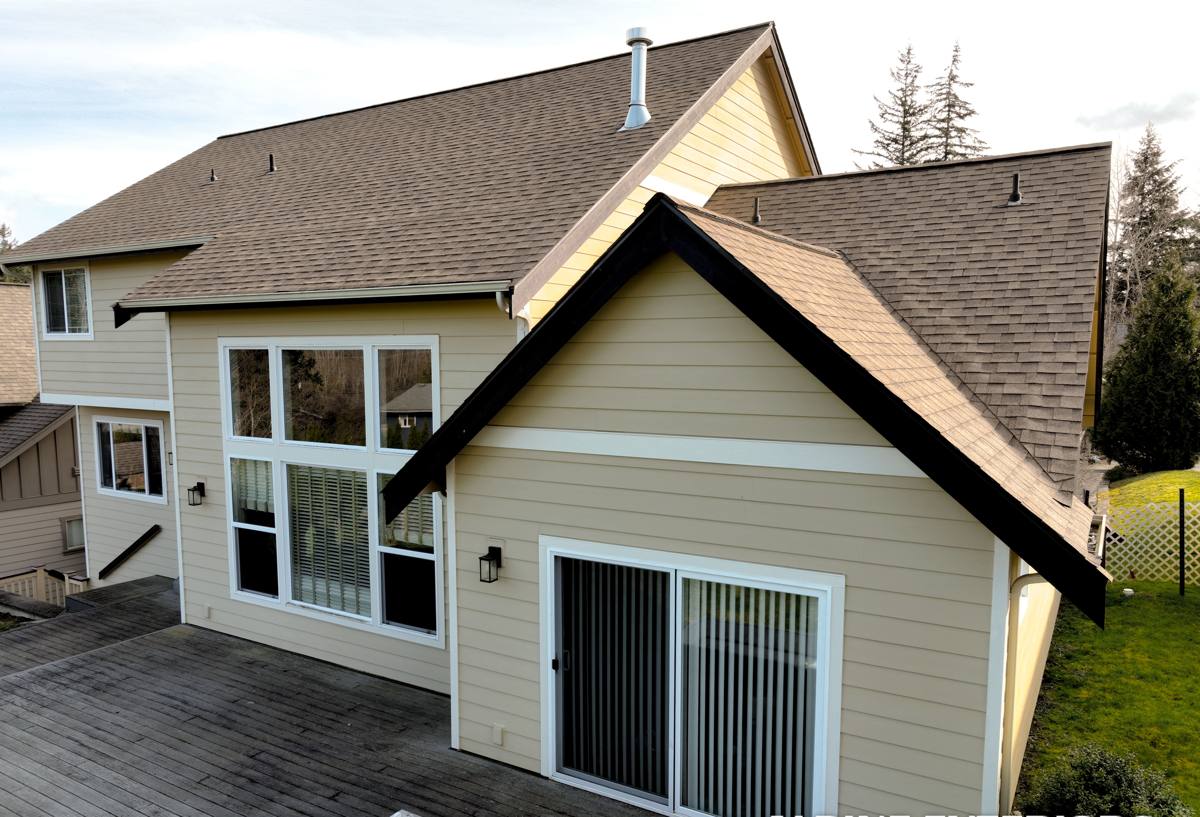
What Moss, Rain, and Marine Air Actually Do to a Wall
Moss and Organic Growth
Moss needs shade and sustained moisture, and Bothell's tree canopy provides plenty of both. Moss itself doesn't eat through siding, but it holds water against the surface far longer than open air would, and it traps debris and organic matter in seams and laps. On materials that swell, delaminate, or absorb water at the edges, that constant dampness is what starts the failure — not the moss itself, but everything it keeps pinned against the wall.
Driving, Wind-Driven Rain
Rain that falls straight down is easy to shed. Rain pushed sideways by wind — common through King County's wetter months — gets forced up under laps, into fastener holes, and behind trim if the flashing and gapping weren't done correctly. This is almost never a material failure. It's an installation failure, and it's the single most common problem we find when we're called out to look at siding that's failing early.
The Wet-Dry Cycle
Bothell doesn't freeze hard or often, but it does swing between soaked and dry constantly through fall, winter, and spring. Materials that expand and contract with moisture — or that absorb water into their core — go through that stress dozens of times a season. Over years, that's what causes swelling, cupping, and paint failure on siding that wasn't built to handle it.
Why We Install Only James Hardie Fiber Cement
We don't install vinyl, LP SmartSide, cedar, primed spruce, Cemplank, or Allura, and Bothell's climate is a big part of why. Fiber cement from James Hardie is engineered specifically to resist the failure modes above:
- Moisture resistance: Hardie board doesn't have an organic wood core to swell, rot, or feed fungal growth the way wood-based products can when moss and moisture sit against them season after season.
- Dimensional stability: It doesn't expand and contract with humidity the way vinyl does, which means laps and seams stay tight instead of gapping over time and giving wind-driven rain a path in.
- Factory-baked ColorPlus finish: The finish is cured onto the board at the factory rather than field-painted, which holds up better against the UV exposure and moisture cycling typical of a Pacific Northwest exterior.
- Non-combustible core: Not a Bothell-specific climate issue, but a real advantage for homeowners near wooded lots and greenbelt areas common throughout King County.
James Hardie also makes HZ5-rated product for this region specifically, engineered for higher-moisture climate zones. That's not marketing — it's a formulation difference that matters when the siding is going to sit wet more often than it sits dry.
Choosing the Right Hardie Profile for a Bothell Home
Bothell's housing stock ranges from older single-story homes on wooded lots to newer two-story construction with less canopy and more direct wind exposure. The right Hardie profile depends on the house, not just the homeowner's taste.
| Profile | Best Fit | Bothell Consideration |
|---|---|---|
| HardiePlank Lap Siding | Traditional and craftsman-style homes | Most common choice; sheds driving rain well when laps and flashing are correctly detailed |
| HardiePanel Vertical Siding | Modern builds, accent walls | Clean look on newer construction; needs correct battens and drainage plane to perform in wet-shade areas |
| HardieShingle | Craftsman and cottage-style homes | More seams than lap siding, so flashing detail matters even more under tree cover |
| HardieTrim | Corners, window and door surrounds | Pairs with any profile; keeps moisture from tracking behind trim boards |
What a Correct Installation Actually Involves
The material is only half the equation. Most of the siding failures we get called to inspect in King County trace back to installation shortcuts, not product defects. A correct Hardie install includes:
- A properly lapped weather-resistant barrier behind the siding, with seams taped and integrated with window and door flashing — not just stapled up and covered.
- Flashing at every horizontal transition, window head, and roofline intersection, directing water out and away from the wall assembly.
- Correct minimum gaps at butt joints, corners, and trim, per James Hardie's published installation specs — tight-fit installs look good for a season and trap moisture for years.
- Fasteners driven to the manufacturer's specified depth and pattern, not overdriven or underdriven, which affects both water resistance and wind performance.
- Starter strips and kick-out flashing set correctly at the base of walls, a detail that's easy to skip and one of the most common causes of rot at the bottom course.
- Caulking and sealant used only where Hardie's install guide calls for it — over-caulking every seam actually traps water rather than keeping it out.
Skipping any one of these doesn't show up on day one. It shows up two, five, or eight years later as staining, soft trim, or paint failure — usually right around the areas that stay shaded and damp the longest.
Our Process
1. On-Site Assessment
We walk the exterior, check the current siding and sheathing condition, note shade patterns and drainage issues specific to the lot, and identify any moisture damage that needs to be addressed before new siding goes on.
2. Tear-Off and Sheathing Check
Old siding comes off and we inspect the sheathing underneath. Any soft, rotted, or water-damaged sheathing gets repaired or replaced before anything new goes up — covering damaged sheathing with new siding just hides a problem that will resurface.
3. Weather Barrier and Flashing
A new weather-resistant barrier goes on with correctly lapped seams, integrated flashing at every penetration and transition, and kick-out flashing where rooflines meet walls.
4. Hardie Installation to Spec
Siding, trim, and corners go on following James Hardie's published fastening and gapping requirements — not shortcuts, not "close enough."
5. Final Inspection
We walk the finished job checking laps, seams, caulking, and trim before calling it complete.
Why a Local King County Crew Matters
Siding installation isn't one-size-fits-all, and a crew that already works Bothell and the surrounding King County area brings something a traveling or out-of-area installer doesn't: direct, repeated experience with how local conditions actually behave on a wall. That means knowing which sides of a house typically hold moisture longest based on tree cover and orientation, understanding how local permitting and inspection processes work, and having already handled the flashing and drainage detailing that this specific climate demands — not learning it on your project.
It also means being reachable. If a question comes up two years after installation, you're calling a crew that's still working in your area, not chasing down a company that did one job in the region and moved on.
What Drives Cost on a Bothell Siding Project
| Factor | Why It Matters |
|---|---|
| Sheathing condition | Rotted or water-damaged sheathing found during tear-off requires repair before new siding goes on |
| Home size and complexity | More corners, gables, and trim detail means more labor and material |
| Profile choice | Lap, panel, and shingle siding differ in material and installation labor |
| Access and lot conditions | Tree cover, tight side yards, and slope can affect setup and staging time |
| Trim and accent work | Board-and-batten accents, custom trim, and multiple colors add labor |
We give honest, project-specific numbers after seeing the house — broad estimates without an on-site look tend to be wrong in one direction or the other.
Maintaining Hardie Siding in Bothell's Climate
James Hardie siding is low-maintenance compared to wood or vinyl, but "low-maintenance" isn't "no-maintenance" in a climate like this one. A simple annual routine keeps it performing as designed:
- Rinse siding annually to clear pollen, moss spores, and grime buildup before they take hold, especially on shaded walls.
- Trim back tree branches and shrubs that keep siding in constant shade and reduce airflow along the wall.
- Check caulking around windows, doors, and trim yearly and have any cracked or missing sections redone.
- Watch for soft spots, staining, or bubbling paint near the bottom courses — early signs of a flashing or drainage issue, not a reason to panic, but a reason to have it looked at.
- Keep gutters clear so overflow isn't running directly down the siding face during heavy rain events.
Get a Straight Answer for Your Home
Every home in Bothell sits a little differently — more shade here, more wind exposure there, older sheathing on one, newer construction on another. If you're weighing a siding replacement or want a second opinion on a quote you've already gotten, we're happy to take a look and give you a straightforward, no-pressure estimate based on what your specific house actually needs.