 King County
 Why Sammamish Puts Different Demands on Siding Than Other King County Neighborhoods
Sammamish sits on a wooded plateau between Lake Sammamish and the foothills, and that geography changes how siding ages here compared to more open parts of King County. Mature tree canopy over a lot of Sammamish properties means large sections of a home's exterior stay shaded for much of the day, even in summer. Shade slows evaporation. Siding that would dry out in an afternoon on an open lot in Redmond or Issaquah can stay damp for days under a stand of Douglas firs in Sammamish, and that difference is exactly what shortens the life of the wrong siding material.
Add in the region's long wet season — the driving rain that blows in off Puget Sound weather systems, months of low clouds, and the marine moisture that carries inland across the county — and you get a climate that rewards materials engineered for water resistance and punishes anything that isn't. Moss doesn't need standing water to take hold; it needs shade, organic debris, and sustained dampness, and a heavily treed Sammamish lot checks every one of those boxes for a good part of the year.
What This Means in Practical Terms
For siding, that combination of shade and prolonged moisture translates into a few very specific failure patterns we see repeatedly on Sammamish homes:
- North- and west-facing walls under tree cover holding moisture longer than south-facing walls, aging unevenly
- Moss and algae staining building up on shaded siding faster than owners expect, even on newer homes
- Wood-based and wood-look products (cedar, primed spruce, some engineered wood siding) showing swelling, delamination, or rot at butt joints and lower courses within a handful of years
- Caulk and paint film failing early on materials that rely on a surface coating rather than a factory-cured finish
None of this means Sammamish is an unusually harsh place to build. It means the material and the installation details matter more here than they would in a drier climate, because the margin for error is smaller.
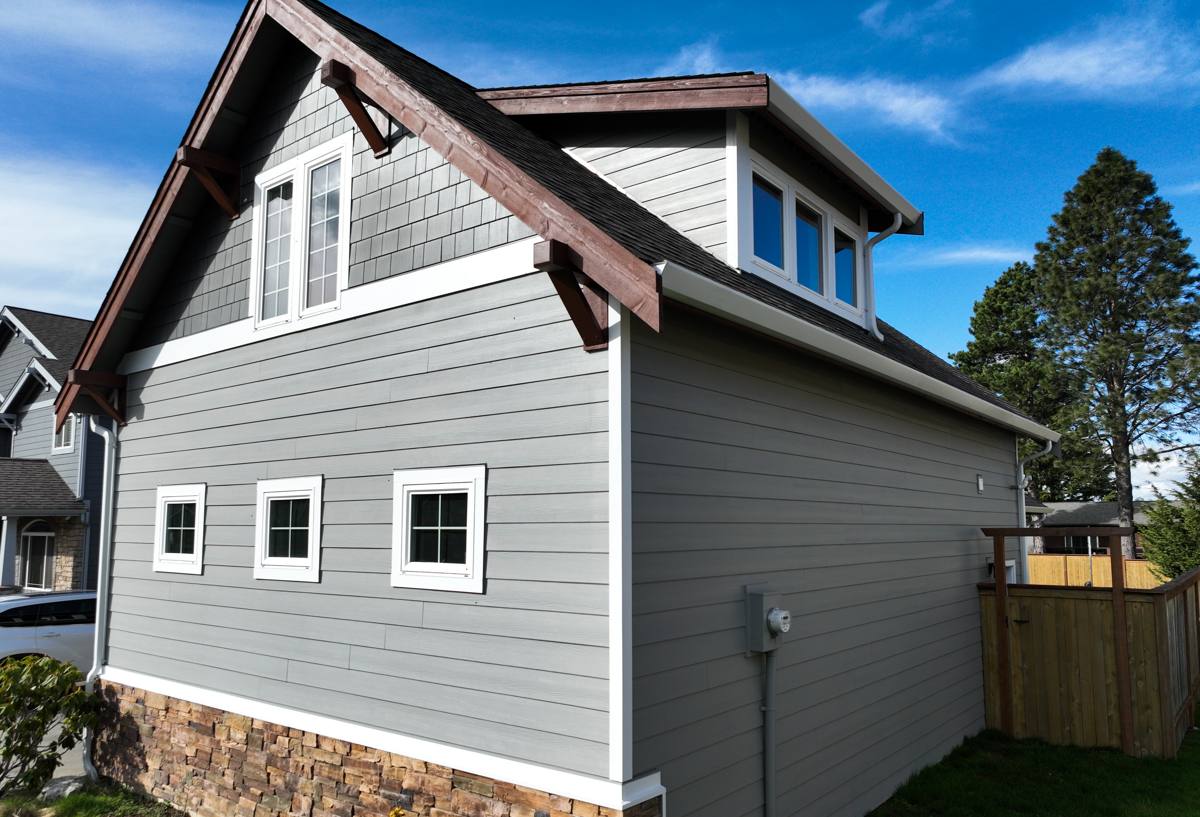
Why We Install Only James Hardie Fiber Cement
We standardized on James Hardie fiber cement siding for every home we side in King County, including Sammamish, and we don't install vinyl, LP SmartSide, Cemplank, Allura, or unprimed or primed wood siding. That's not a marketing position — it's a decision based on what actually holds up under repeated wet-dry cycling in a shaded, moisture-heavy climate.
Fiber cement is a mix of cement, sand, and cellulose fibers, cured into a dense, stable board. It doesn't absorb water the way wood-based siding does, it won't warp or delaminate in humid shade, and it's non-combustible, which matters as wildfire smoke and dry-season fire risk have become a bigger part of Pacific Northwest summers. James Hardie's ColorPlus finish is baked on in a factory process rather than field-painted, which means the color layer is more consistent and better bonded than a job-site paint job, and it comes with its own finish warranty separate from the product warranty.
Where Hardie Earns Its Keep in a Climate Like This
| Condition in Sammamish | How Hardie Fiber Cement Responds |
|---|---|
| Shaded, slow-drying walls under tree canopy | Dimensionally stable when damp; doesn't swell, cup, or delaminate the way wood-based products can |
| Driving wind-driven rain | Engineered rainscreen-compatible profiles and lap design shed water when installed to spec |
| Long moss and algae season | Dense, non-porous surface resists moss anchoring better than porous wood substrates; still needs periodic cleaning |
| Wildfire smoke / ember exposure in dry months | Non-combustible core, unlike vinyl or wood siding |
| UV and repainting cycles | Factory ColorPlus finish outlasts field-applied paint on wood siding |
What a Correct Fiber Cement Installation Actually Involves
The board itself is only part of the story. Most of the siding failures we get called out to inspect in King County aren't a product failure — they're an installation shortcut that let water get behind the siding and stay there. In a shaded, wet climate like Sammamish's, those shortcuts show up faster than they would somewhere drier.
The Details That Matter
- Weather-resistive barrier and flashing installed and lapped correctly at every window, door, and penetration before a single board goes up
- Proper clearance between the bottom of the siding and roofing, decks, and grade, so splashback and standing water don't wick into the board
- Rainscreen or drainage gap where the wall assembly calls for it, so any moisture that does get behind the siding can drain and dry instead of sitting against the sheathing
- Correct fastener type, spacing, and placement per James Hardie's published installation instructions — not shortcuts that void the warranty
- Caulked and sealed joints at trim, corners, and butt joints, using products compatible with fiber cement
- Field-cut edges primed or sealed before installation, since a raw cut edge is the one place factory protection doesn't reach
Skip any one of these on a shaded Sammamish wall that stays damp for days at a time, and you're setting up exactly the kind of trapped-moisture problem that fiber cement siding is supposed to prevent in the first place.
Our Process, Start to Finish
We keep the process straightforward because the value is in the details, not in complexity.
1. On-Site Assessment
We walk the property, look at existing siding condition (if there is any), check for moisture damage or rot at trim and penetrations, and evaluate sun exposure and shade patterns wall by wall — because a Sammamish home's north wall and south wall are often facing genuinely different climate conditions.
2. Product and Line Selection
We recommend the James Hardie line, profile, and finish that fits the home's exposure, style, and the owner's budget. We'll explain the trade-offs plainly rather than upselling.
3. Written Estimate
A clear scope, timeline, and price before any work starts. No surprise change orders for things we should have caught during assessment.
4. Tear-Off and Substrate Check
When we remove old siding, we inspect the sheathing and framing underneath. If there's hidden rot or moisture damage — which we find more often on shaded walls — we address it before new siding goes on, not after.
5. Installation to Manufacturer Spec
Weather barrier, flashing, drainage, fastening, and caulking done to James Hardie's published requirements, so the manufacturer's warranty is actually valid if it's ever needed.
6. Final Walkthrough
We go through the finished job with the homeowner and answer questions about care and maintenance specific to their property's sun and shade exposure.
Choosing the Right Hardie Line and Profile for a Sammamish Property
James Hardie makes several siding profiles and a climate-engineered HZ product line, and the right choice depends on the home's exposure, style, and how much of the lot sits under tree cover.
| Feature | Best Fit For |
|---|---|
| HardiePlank lap siding | Traditional and most common choice; wide range of exposures and colors, works well on most Sammamish home styles |
| HardiePanel vertical siding | Modern facades, accent walls, gable ends; often paired with lap siding for visual contrast |
| HardieShingle | Craftsman and cottage-style homes wanting a shingled look without wood's moisture sensitivity |
| HZ5 climate-engineered formulation | Standard for the Pacific Northwest's freeze-thaw and high-moisture conditions; what we install by default in King County |
What Fiber Cement Siding Costs to Install
Exact pricing depends on the size of the home, the number of stories, tear-off complexity, trim and detail work, and how much hidden repair a tear-off uncovers. In general terms, expect fiber cement to cost more upfront than vinyl and be roughly comparable to or somewhat above quality wood siding installed correctly — but with a much longer service life and lower long-term maintenance cost, which is the real comparison that matters.
| Cost Factor | Why It Moves the Price |
|---|---|
| Tear-off and disposal | Multiple layers or hazardous old materials add labor and disposal cost |
| Sheathing/framing repair | Rot found during tear-off, more common on shaded walls, must be fixed before new siding goes on |
| Home shape and trim detail | Dormers, multiple gables, and extensive trim add labor time |
| Siding profile and finish | Shingle and panel profiles with custom color options run higher than standard lap |
| Story height and access | Two- and three-story walls require more scaffolding and safety setup |
Signs Your Current Siding Is Already Struggling in This Climate
Sammamish's shade and moisture make it easier to spot siding trouble early, if you know what to look for.
- Soft or spongy spots when you press on siding, especially near the bottom courses or under windows
- Persistent moss or dark algae staining that comes back within weeks of cleaning
- Paint peeling or bubbling repeatedly in the same spots, particularly on shaded walls
- Visible gaps, warping, or cupping in boards, especially wood or wood-composite siding
- Rising interior utility costs or drafts near exterior walls, which can point to a failing weather barrier behind the siding
- Musty smell near exterior walls, which can indicate trapped moisture
Catching these early usually means a repair. Waiting usually means a full replacement, along with sheathing or framing repair that could have been avoided.
Why Hiring a Crew That Already Works in Sammamish Matters
Siding installation isn't just about following a spec sheet — it's about applying that spec correctly to the specific conditions a house faces. A crew that regularly works Sammamish and the surrounding King County Eastside knows which wall orientations on a wooded lot tend to hold moisture, how to sequence a tear-off around a wet forecast, and where James Hardie's flashing and drainage details need extra attention because of local shade and rainfall patterns. That local pattern recognition is what turns a correctly specified product into a job that actually performs for decades, rather than one that looks right on installation day and starts showing problems in year three.
Maintenance That Actually Fits This Climate
Fiber cement is low-maintenance compared to wood, but "low-maintenance" doesn't mean "no maintenance," especially with Sammamish's tree cover and moss season.
- Rinse siding annually, and more often on shaded walls, to keep moss and algae from establishing
- Trim back tree branches and shrubs to improve airflow and sun exposure where practical
- Inspect caulking at trim, corners, and penetrations yearly and re-caulk as needed
- Keep gutters clear so overflow doesn't run down siding and speed up staining
- Address any impact damage or cracked boards promptly, since it's a much smaller repair than what happens if water gets behind an unrepaired crack over a wet winter
If you're weighing siding options for a Sammamish home or dealing with siding that's already showing signs of trouble, we're happy to take a look and give you a straightforward, no-pressure estimate. There's no obligation — just an honest read on where things stand and what it would take to fix it right.