 King County
 Why Shoreline's Location on Puget Sound Changes the Siding Equation
Shoreline sits right on the edge of Puget Sound, and that location does more to your home's exterior than most homeowners realize until they're dealing with paint that won't hold, trim that's gone soft, or a north wall that never quite dries out. Siding here isn't just fighting rain — it's fighting salt-laden air off the Sound, wind-driven moisture that gets pushed sideways into wall assemblies, and a moss and algae season that can run most of the year in shaded, north-facing exposures. Any siding product you put on a Shoreline home has to handle all three at once, year after year, without babysitting.
Salt Air and Corrosion at the Coastline
Homes closer to the water pick up airborne salt that settles on siding, trim, and fasteners. Over time this accelerates corrosion on unprotected metal components and breaks down finishes that weren't formulated to resist it. It's a slower process than storm damage, but it's constant, and it's one of the reasons factory-applied, baked-on finishes hold up so much better here than field-applied paint.
Driving Rain and Wind-Driven Moisture
King County's rain isn't always straight-down rain. Wind off the Sound pushes moisture sideways into seams, laps, and butt joints — the exact spots where a siding installation either sheds water or lets it in. A product that performs fine in a dry, calm climate can behave very differently once it's absorbing wind-driven moisture on a weekly basis for eight months a year.
The Long Moss Season
Shoreline's tree cover and marine humidity create ideal conditions for moss and algae, especially on shaded north- and west-facing walls. Siding that holds moisture at the surface — or that has seams and texture where spores can get a foothold — turns green faster and stays that way longer. This is as much about surface finish and installation detail as it is about the base material.
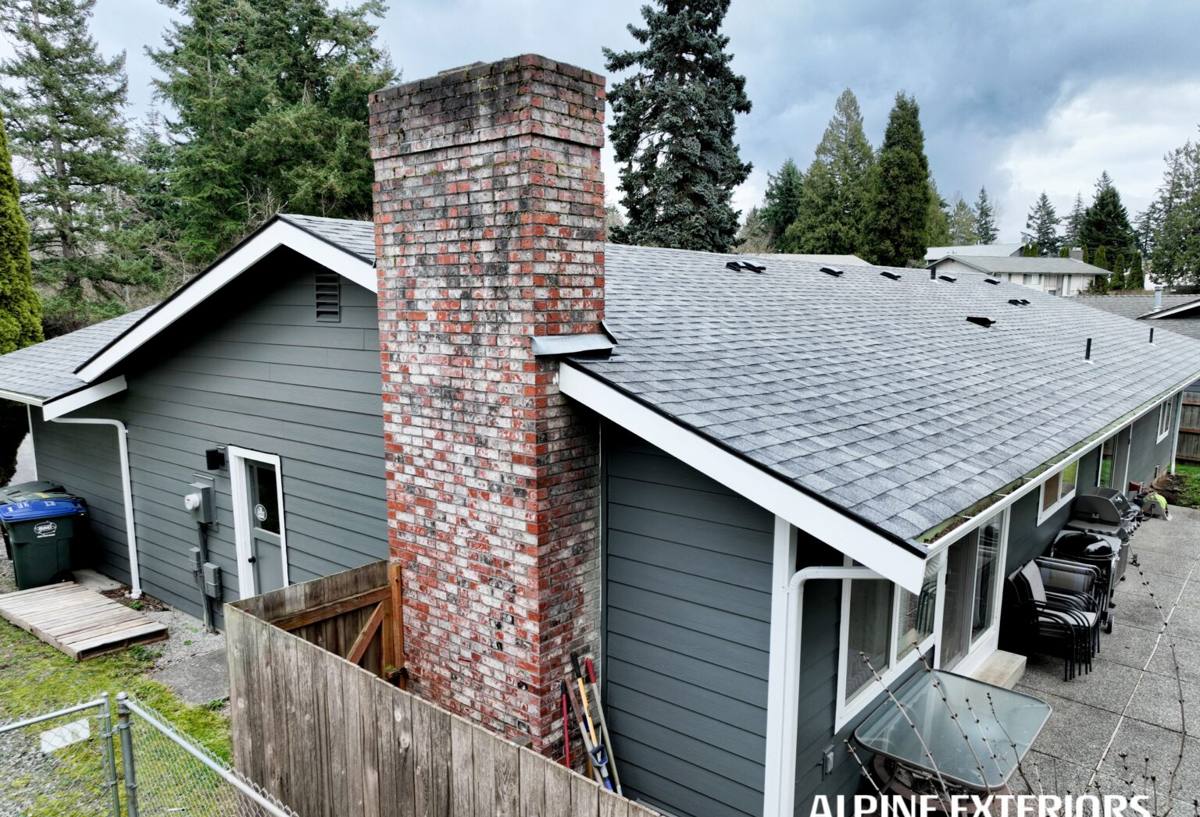
What Shoreline Homes Actually Need From Their Siding
Put those three factors together and the requirements for a Shoreline exterior become pretty specific. It needs to shed wind-driven rain rather than absorb it. It needs a finish that resists salt exposure and biological growth without repainting every few years. And it needs to be dimensionally stable through the Pacific Northwest's wet-dry cycles so caulk joints and paint lines don't fail early.
- A water-resistive barrier and drainage plane behind the cladding, not just a tight-fitting panel
- Factory-cured, baked-on color rather than field-applied paint that weathers unevenly
- Non-combustible material that doesn't need to be treated or sealed against moisture and pests
- Correctly flashed and caulked joints at every penetration, corner, and butt seam
- Proper clearance from grade, decks, and roof lines so water has somewhere to go
None of that is exotic. It's just what a marine climate demands, and it's why the product and the installation matter equally.
Why We Install Only James Hardie Fiber Cement
We made the decision to install James Hardie exclusively — no vinyl, no LP SmartSide, no cedar, no primed spruce — because we wanted one product we could stand behind on every Shoreline job without asterisks. Hardie's fiber cement is non-combustible, doesn't swell or rot the way wood-based products can, and holds its shape through the wet winters and dry summers that stress cheaper claddings. Its ColorPlus finish is baked on at the factory in multiple coats, which matters directly for salt air and moss resistance: a factory finish resists fading, chalking, and staining far longer than a coat of exterior paint applied on site, and it gives the color a much more uniform, consistent look across the whole house.
James Hardie also engineers its panel formulations for the climate they're going into, accounting for the kind of sustained moisture exposure that's normal in the Pacific Northwest rather than the occasional storm exposure in drier regions. That's a meaningful difference from products designed around a national average climate. Combined with a strong transferable warranty, it's the product we're comfortable telling Shoreline homeowners will still look right in fifteen or twenty years — not just at the walkthrough.
What a Correct James Hardie Installation Involves
Hardie siding is only as good as the installation underneath it. The material can be spec-correct and still underperform if the crew skips steps that don't show up until a wall gets wet. Here's what we treat as non-negotiable on every Shoreline install:
| Installation Step | Why It Matters in Shoreline's Climate |
|---|---|
| Weather-resistive barrier, properly lapped | Stops wind-driven rain that gets past the siding from reaching the sheathing |
| Correct fastener type and placement | Prevents corrosion streaking and panel movement over time near the Sound's salt air |
| Proper flashing at windows, doors, and penetrations | These are the highest-failure points for water intrusion in wind-driven rain |
| Minimum clearance from grade, roofing, and decks | Keeps splashback and standing moisture off the bottom courses |
| Factory-cut, sealed panel edges and caulked joints | Unsealed cut edges are the fastest way for a fiber cement panel to take on moisture |
| Ventilated rainscreen gap where appropriate | Lets moisture that does get behind the panel dry out instead of sitting against the sheathing |
Every one of these is a detail an inspector might not catch and a homeowner definitely won't see once the job is done — which is exactly why it has to be right the first time.
Our Process on a Shoreline Job
We start with a walk-around of the existing exterior to check for moisture damage, rot at trim and corners, and any signs the current wall assembly has been letting water in — this is common on older Shoreline homes where the original siding has been patched over rather than properly repaired. From there we talk through Hardie's plank, panel, or shingle profiles and color options, and we account for the home's specific exposure: a wall that catches wind off the Sound or sits in heavy shade under mature trees gets extra attention on flashing and drainage details, not a one-size-fits-all approach.
Once the plan is set, we handle removal of the old siding, inspection and repair of the sheathing underneath, correct installation of the water-resistive barrier, and the Hardie install itself to manufacturer spec. We don't cut corners on the barrier and flashing work because that's the part that determines whether the siding is still doing its job a decade from now.
Cost Factors for a Shoreline James Hardie Project
Every home is different, but the biggest cost drivers on a Shoreline Hardie project tend to be the same handful of things:
| Factor | How It Affects the Job |
|---|---|
| Condition of existing sheathing | Rot or water damage found during tear-off adds repair scope before new siding goes on |
| Home size and wall complexity | More corners, dormers, and trim details mean more labor and cutting |
| Siding profile chosen | Lap plank, shingle-style, and panel systems carry different material and labor costs |
| Trim and accessory work | Fascia, soffits, and trim boards are often replaced or capped at the same time |
| Access and site conditions | Tight lots, slopes, and mature landscaping common in Shoreline can add setup time |
We give homeowners a real number after we've actually looked at the house, not a phone-quote guess — the condition behind the old siding is usually the biggest unknown until it's opened up.
Signs Your Current Siding Is Already Losing the Fight
Shoreline's climate tends to expose problems on a predictable timeline. Watch for these signs, especially on walls facing the Sound or shaded by trees:
- Persistent green or black staining that comes back within a season of cleaning
- Paint that's peeling, bubbling, or chalking heavily on one or two walls but not others
- Soft or spongy spots at corners, butt joints, or near ground level
- Visible gaps, warping, or panels that have pulled away from the wall
- A musty smell or visible moisture inside on an exterior wall
Any one of these is worth a closer look before it turns into sheathing damage that's much more expensive to fix than the siding itself.
Why It Matters That We Already Work in Shoreline
A crew that's installed Hardie siding across Shoreline and the rest of King County has already seen how these homes behave — which walls take the worst of the wind off the Sound, how moss builds up on shaded exposures, and what the older housing stock in this area typically has going on behind the original siding. That's not something you get from a general contractor working the region for the first time. It shows up in small decisions: where we add extra flashing attention, how we sequence a job around Pacific Northwest weather windows, and what we flag during the initial walk-around before a single panel comes off.
If your Shoreline home's siding is showing its age, or you're planning ahead rather than reacting to a problem, we're happy to take a look and give you a straightforward, no-pressure estimate — just fill out the form below.