 King County
 Why Sammamish Siding Takes More Abuse Than It Looks Like
Sammamish doesn't get hammered by storms the way some parts of King County do, but the siding on a Sammamish home works harder than most homeowners realize. The tree canopy that makes these neighborhoods so appealing also means a lot of siding never gets a full day of direct sun. Combine that with the humidity that sits near Lake Sammamish and the marine-influenced air that moves through the broader Puget Sound region, and you get walls that stay damp longer after every rain than they would in a more open, sun-exposed setting.
Add in a wet season that regularly delivers weeks of driving rain, and a moss and algae season that can stretch from fall through spring on shaded north- and east-facing walls, and it's easy to see why siding here needs to manage moisture, not just resist it once and hope for the best. Products that look fine on a spec sheet in a dry climate often behave differently after a few Sammamish winters.
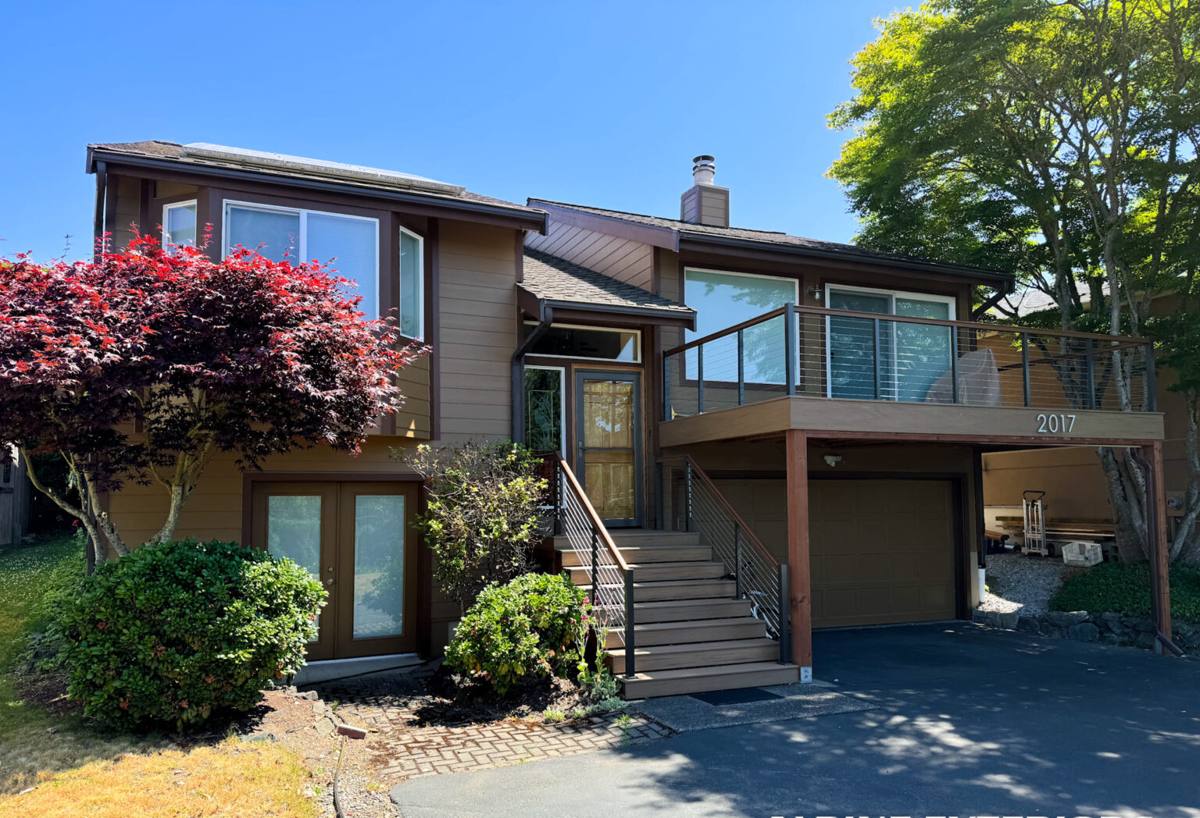
What Local Homes Actually Need From Their Siding
Before we talk about products, it helps to be clear about the job the siding actually has to do here:
- Shed driving, wind-blown rain without letting water track behind the cladding at laps, corners, and penetrations
- Resist moisture absorption on shaded walls where surfaces stay damp for days at a time
- Hold paint and color through repeated wet-dry cycles without cracking, peeling, or delaminating
- Stand up to moss, algae, and mildew growth without softening, swelling, or rotting
- Stay dimensionally stable through King County's swing between damp winters and warm, dry summers
This is the exact list we run through when we're evaluating a product before we'll put our name on it — and it's the reason we only install James Hardie fiber cement siding on Sammamish homes.
Why We Standardized on James Hardie
James Hardie fiber cement is manufactured from cement, sand, and cellulose fiber, cured into a dense, non-combustible board that doesn't absorb water the way wood-based or wood-fiber siding products do. That matters directly in a climate like Sammamish's: a product that swells when it takes on moisture, then dries and shrinks, is a product that eventually opens gaps at joints and fasteners — and those gaps are exactly where moss, algae, and rot get their start on a shaded wall.
James Hardie also engineers its siding by climate zone. The HZ5 formulation used in the Pacific Northwest is specifically built for the freeze-thaw and moisture-cycling conditions common here, which is a meaningfully different product than a generic fiber cement board sold nationwide. Add the factory-applied ColorPlus finish — baked on under controlled conditions rather than field-sprayed — and you get color that holds up to years of wet-dry cycling without the chalking and fading that field-applied paint shows first.
We don't install LP SmartSide, vinyl, Cemplank, Allura, primed spruce, or cedar. Each of those products has legitimate strengths, but every one of them asks a Sammamish homeowner to accept a maintenance burden, a moisture vulnerability, or a warranty structure that we don't think holds up over the long run in this specific climate. Hardie is the one product we've found that consistently performs here when it's installed correctly — and "installed correctly" is doing a lot of work in that sentence.
Which Hardie Products Fit Sammamish Homes
Sammamish has a mix of architectural styles, from craftsman and Northwest contemporary to more traditional two-story builds, and the right Hardie product depends on the look you're going for as much as the performance you need.
| Product | Best for | Notes for Sammamish |
|---|---|---|
| HardiePlank lap siding | Traditional and craftsman exteriors | Available in multiple exposures and textures; the most common choice for full re-sides |
| HardieShingle | Accent gables, craftsman detailing | Popular on the shingle-style accents common in this area's newer builds |
| HardiePanel with battens | Modern and Northwest contemporary homes | Clean vertical lines; needs correct joint and batten detailing to shed water properly |
| HardieTrim | Corners, fascia, window and door surrounds | Matches the fiber cement's moisture performance instead of pairing Hardie field siding with wood trim that rots first |
We'll walk through which combination makes sense for your home's exposure, shade, and style during the estimate — there's no single "right answer" that applies to every house.
What a Correct Installation Actually Involves
James Hardie siding is only as good as the installation behind it. Most of the siding failures we get called out to inspect on shaded, moisture-prone lots trace back to installation shortcuts, not the product itself. A correct install includes:
- A properly lapped weather-resistive barrier behind the siding, with flashing integrated at every window, door, and penetration — not caulk used as a substitute for flashing
- Correct fastener placement and spacing, following James Hardie's published fastening schedule for our wind exposure
- Manufacturer-specified clearances at grade, roof lines, and decks so the board never sits in standing water or constant contact with soil or mulch
- Field-cut edges sealed and primed per Hardie's instructions, since factory ColorPlus edges are pre-sealed but cut edges are not
- Joints and laps installed with the gaps and sealants Hardie specifies — over-caulking or under-lapping both cause problems within a few wet seasons
Skipping any one of these doesn't show up on install day. It shows up two or three winters later, usually as a soft spot, a stain, or paint failure at exactly the joint or corner where the shortcut was taken.
Our Process on a Sammamish Job
We run the same disciplined process on every Sammamish project, adjusted for the specific exposure of your lot:
- On-site assessment — we look at your home's shade pattern, drainage, existing moisture damage, and which walls take the worst of the driving rain
- Product and detailing plan — we specify the Hardie product lines, trim, and flashing details for your home's style and exposure, not a one-size-fits-all spec
- Tear-off and substrate check — we inspect sheathing and framing as the old siding comes off, since this is often the only chance to catch hidden rot before it's covered again
- Weather barrier and flashing install — done to manufacturer spec before a single piece of siding goes up
- Hardie installation — fastened, lapped, and sealed to James Hardie's published instructions for our climate zone
- Final walkthrough — we go over caulking, paint lines, and trim details with you before we call the job done
Living With Hardie Siding in a Shaded, Moss-Prone Climate
Even the right product needs a little ongoing attention in a climate like Sammamish's. The good news is that Hardie's maintenance list is short compared to wood-based sidings, and none of it is technical:
- Rinse siding annually, focusing on shaded north- and east-facing walls where moss and algae take hold first
- Keep gutters clear so overflow doesn't run down the face of the siding during heavy rain events
- Trim back tree limbs and shrubs that keep a wall in constant shade and restrict airflow
- Re-caulk joints if you notice cracking or gaps, rather than waiting for a full repaint cycle
- Repaint on the cycle recommended for your ColorPlus finish, if and when it's eventually needed — most ColorPlus finishes go far longer between repaints than field-applied paint on other sidings
Why Hiring a Crew That Already Works in Sammamish Matters
A lot of siding problems we see aren't about the product at all — they're about a crew that installed the same way they would in a drier, sunnier market and didn't adjust for a shaded, moisture-heavy King County lot. Working in Sammamish regularly means we already know which wall orientations need extra flashing attention, which lots hold moisture longest into spring, and how local permitting and inspection expectations run for a full re-side. That familiarity shows up in details you won't notice until years later — because they were done right the first time.
It also matters for warranty support. James Hardie's product warranty is only as good as the installation behind it, and a local crew that stands behind its own work is worth more than a lower bid from a company that won't be around, or won't be local, if a detail needs revisiting down the road.
What Affects the Cost of a Sammamish Hardie Project
| Factor | Why it matters here |
|---|---|
| Extent of hidden moisture damage | Shaded, humid walls are more likely to have sheathing or framing repairs discovered at tear-off |
| Product mix | Lap siding, shingle accents, and board-and-batten panel all carry different material and labor costs |
| Trim and detail work | Homes with more corners, gables, and window trim take more labor to flash and finish correctly |
| Access and site conditions | Tree cover, slope, and tight lot lines common in Sammamish can affect equipment access and labor time |
| Full re-side vs. partial repair | Full tear-off lets us address the weather barrier and flashing properly; patch repairs over old barriers carry more risk |
We'll give you a real, itemized number after we've actually looked at your home — not a phone-quote guess that changes once we're on the roofline.
If your Sammamish home's siding is showing moss staining, paint failure, or soft spots on the shaded side, or you're planning ahead for a full re-side, we're happy to come take a look. Request a free, no-pressure estimate below and we'll walk the property with you and talk through what your home actually needs.