 King County
 Storm Damage Roof Repair Built for Woodinville Conditions
Woodinville sits in a heavily wooded pocket of King County, and that tree cover is part of what makes the area what it is. It's also the single biggest storm risk to a Woodinville roof. When a fall or winter system moves through with sustained wind, it's rarely the wind alone that causes damage — it's the wind acting on mature trees, dropping limbs, whole branches, and sometimes entire trees onto roofs that were fine the day before. Add in wind-driven rain that gets pushed sideways into laps and flashing lines never meant to handle water moving that direction, and a moss season that runs long across our wet, mild winters, and you have a specific combination of stresses that a storm repair needs to account for, not just patch over.
This page covers what storm damage roof repair actually involves for a Woodinville home — what to do right after a storm, what a correct repair looks like once the immediate danger is handled, how we decide between a repair and a full section replacement, and why working with a crew that's already familiar with this part of King County matters when you're dealing with a damaged roof.
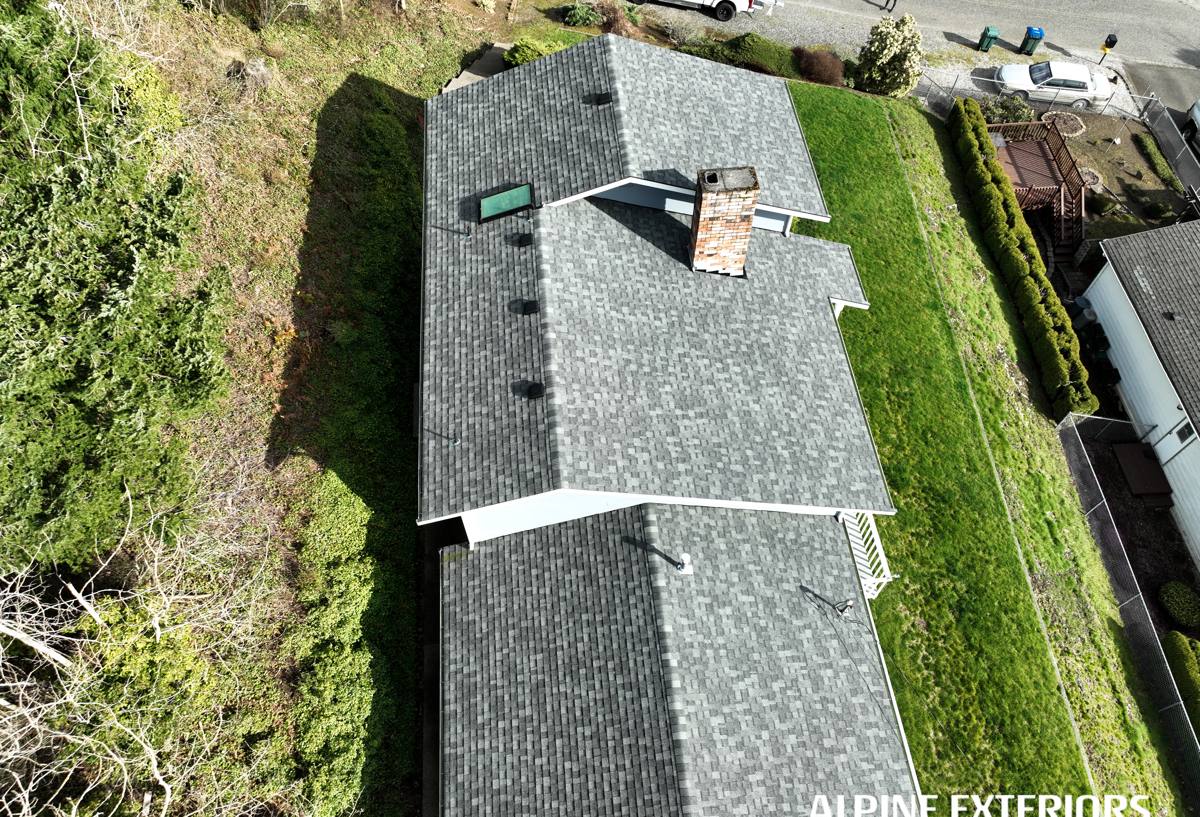
What Storm Damage Actually Looks Like Here
Wind and Falling Debris
The most common storm damage call we get from Woodinville homeowners isn't wind uplift on its own — it's a limb or branch coming down on the roof during a windstorm. Even a moderate branch strike can crack shingles, punch through underlayment, or dent and displace flashing at a valley or penetration. A full tree failure is less common but far more serious, and can compromise the roof deck itself, not just the shingle layer.
Wind-Driven Rain
Rain that falls straight down is relatively easy for a roof to shed. Rain that's being pushed sideways by 30-40 mph gusts behaves differently — it gets forced up under shingle tabs, into valleys, and around flashing that was only detailed to handle water moving downward. A roof with any pre-existing weakness, even a small one, tends to show it during exactly this kind of event.
Snow and Ice Load
Woodinville doesn't see heavy snow every winter, but when a wet, heavy snowfall does hit, it adds real weight to a roof and can also mean water backing up under shingles as it melts and refreezes at the eaves. Roofs already carrying some age or hidden moisture damage are the ones most likely to show a problem after one of these events.
Why the Damage You Can't See Matters More Than What You Can
A branch strike or a section of missing shingles is obvious. What's often not obvious is what happened around it — granules knocked loose from surrounding shingles, a flashing edge nudged just enough to open a gap, or underlayment torn beneath shingles that still look intact from the ground. None of that shows up from the driveway. It shows up eighteen months later as a ceiling stain, and by then the moisture has usually been finding its way in through more than one storm.
This is the main reason a storm damage repair should never be scoped from a photo or a quick look from the ground. The visible damage tells you where to start looking, not the full extent of what needs fixing.
What a Correct Storm Damage Repair Involves
Emergency Mitigation First
If a roof is actively letting water in, the first job is stopping that, not debating repair scope. A proper tarp job is tied down and sealed at the edges so it survives the next round of wind rather than peeling back and making the opening worse. This step buys time to do the actual repair correctly instead of rushing it.
A Full Inspection, Not Just the Damaged Section
Once the roof is safe, the inspection needs to cover more than the obvious impact point. We check the surrounding shingle field for loosened tabs and granule loss, walk every flashing line and penetration near the damage, and check the attic from inside for signs of moisture that haven't reached the ceiling yet. Storm damage rarely stays confined to a single tidy area, and a repair scoped only to the visible hole tends to leave a second problem behind.
Matching Materials and Manufacturer Requirements
Shingle repairs need to follow the manufacturer's fastening and layout specifications, not just visually resemble the surrounding roof. Weathered shingles also won't match a brand-new patch in color exactly — sun exposure and time change shingle color gradually, and no repair can fully erase that visual line. We're upfront about that rather than promising an invisible patch.
Flashing and Underlayment Repair, Not Just Shingles
If flashing was bent, torn, or displaced by the impact, it needs to be replaced or properly re-secured, not just caulked back into place. Torn underlayment beneath the shingle line needs to be cut back and replaced with a proper lap, because a shingle repair over damaged underlayment is only a partial fix.
Repair or Replace: How We Make That Call
Not every storm-damaged roof needs a full replacement, and not every roof can be fully fixed with a localized repair. The right call depends on a few factors more than on how big the visible damage looks.
| Factor | Leans Toward Repair | Leans Toward Replacement |
|---|---|---|
| Roof age | Roof is under 10-12 years old with remaining service life | Roof is already near or past its expected lifespan |
| Extent of damage | Damage is contained to one section or slope | Multiple areas affected, or damage is scattered across the roof |
| Deck condition | Decking underneath is sound once exposed | Decking shows rot or soft spots from prolonged moisture |
| Shingle availability | A close material and color match is realistically available | Discontinued product or heavy weathering makes a clean match impossible |
| Underlying condition | Rest of the roof is otherwise in good shape | Storm exposed pre-existing wear that was already close to needing attention |
We walk through this with you directly rather than defaulting to the more expensive option. If a repair is the honest answer, that's what we recommend.
Working With Your Insurance Claim
Most storm damage repairs in Woodinville go through homeowners insurance, and the documentation matters as much as the repair itself for getting the claim handled fairly. We photograph and document the damage before any repair work begins, provide a written scope and estimate that an adjuster can review, and can walk an adjuster through the roof in person if that's useful to your claim. The final decision on your policy and coverage is always between you and your insurer — our job is to make sure the roof's actual condition is documented accurately so that decision is based on real information.
- Photograph visible damage yourself before any tarping or cleanup, if it's safe to do so
- Keep a copy of any repair estimate separate from what you submit to your insurer
- Ask your contractor whether they document with photos before and after the repair
- Get emergency mitigation done regardless of claim status — most policies expect reasonable steps to prevent further damage
- Don't sign over your claim or insurance proceeds directly to a contractor before work is scoped and agreed to
How Our Process Works
- Emergency response: If your roof is actively leaking, we prioritize tarping and mitigation before anything else.
- Full roof inspection: We check the impact area and the surrounding roof, flashing, and attic, in person.
- Written estimate: You get a clear, itemized scope covering repair or replacement, materials, and flashing work — not a vague single-line number.
- Documentation for insurance: We provide photos and a written scope that supports your claim if you're filing one.
- Repair or replacement: Work is completed to manufacturer specification, with particular attention to flashing and underlayment around the damaged area.
- Final walkthrough: We review the completed work with you and confirm the roof is fully sealed before calling the job done.
Why Hiring a Crew That Already Works in Woodinville Matters
A crew that regularly works roofs around Woodinville has already seen how heavy tree cover translates into recurring limb-strike damage, which roof orientations hold moss longest through a wet King County winter, and how wind-driven rain from a Puget Sound storm system tends to find the weak points in flashing that was detailed for straight-down rain instead. That's the kind of practical knowledge that shows up in the specific decisions made during a repair — not something a crew unfamiliar with this area is likely to think through on the fly.
It also matters after the storm has passed and the immediate crisis is over. Storm damage from wind-driven rain and hidden moisture doesn't always show up right away, and a workmanship warranty only means something if the company behind it has an established, reachable presence in the area — not a phone number that stops answering once the season's storm rush ends.
A Practical Checklist Before You Choose a Storm Repair Contractor
- Do they inspect the full roof and attic, not just the visibly damaged section?
- Does the estimate specify flashing and underlayment repair, not just "patch shingles"?
- Will they document the damage with photos to support an insurance claim?
- Do they carry current WA contractor licensing, liability insurance, and workers' compensation?
- Can they point to recent, real repair work in or near Woodinville and King County?
- Are they willing to give you a repair-vs-replace recommendation in writing, with the reasoning behind it?
Signs Your Roof May Have Storm Damage
Not all storm damage announces itself with an obvious hole or a fallen branch still sitting on the roof. Some of the more common signs are easy to miss from ground level.
- Shingle granules collecting in gutters or at downspout outlets after a windstorm
- Curling, cracked, or lifted shingle edges, especially on wind-exposed slopes
- Visible dents or displacement in flashing around chimneys, skylights, or valleys
- Water staining on interior ceilings or attic framing after a storm, even a small spot
- A branch, even a small one, that made contact with the roof during high wind
- Moss or dark streaking that's suddenly heavier in one area than the rest of the roof
If you're seeing any of these after a recent storm, it's worth having the roof looked at before the next system moves through rather than waiting for a leak to force the issue.
If your Woodinville roof took a hit in a recent storm, or you just want a straight, no-pressure opinion on whether what you're seeing is worth worrying about, we're glad to come take a look. Use the form below to request a free estimate.