 King County
 Board & Batten Siding on Mercer Island: A Look That Has to Do More Than Look Good
Board and batten has become one of the most requested siding styles on Mercer Island, and it's easy to see why. The vertical lines read as clean and modern on newer builds, and they read as classic farmhouse or Craftsman on older homes and additions. It also pairs well with the mix of architecture you see around the island — updated ramblers, newer construction near the shoreline, and additions that blend traditional and contemporary elements on the same block.
But board and batten is also one of the least forgiving siding styles if it's installed wrong. The vertical battens create dozens of extra seams compared to standard lap siding, and every one of those seams is a potential path for water if the install isn't done to spec. In a King County climate, that's not a small detail — it's the whole ballgame. This page covers what board and batten actually needs to hold up on Mercer Island, what a correct installation looks like, and why we only do it in James Hardie fiber cement.
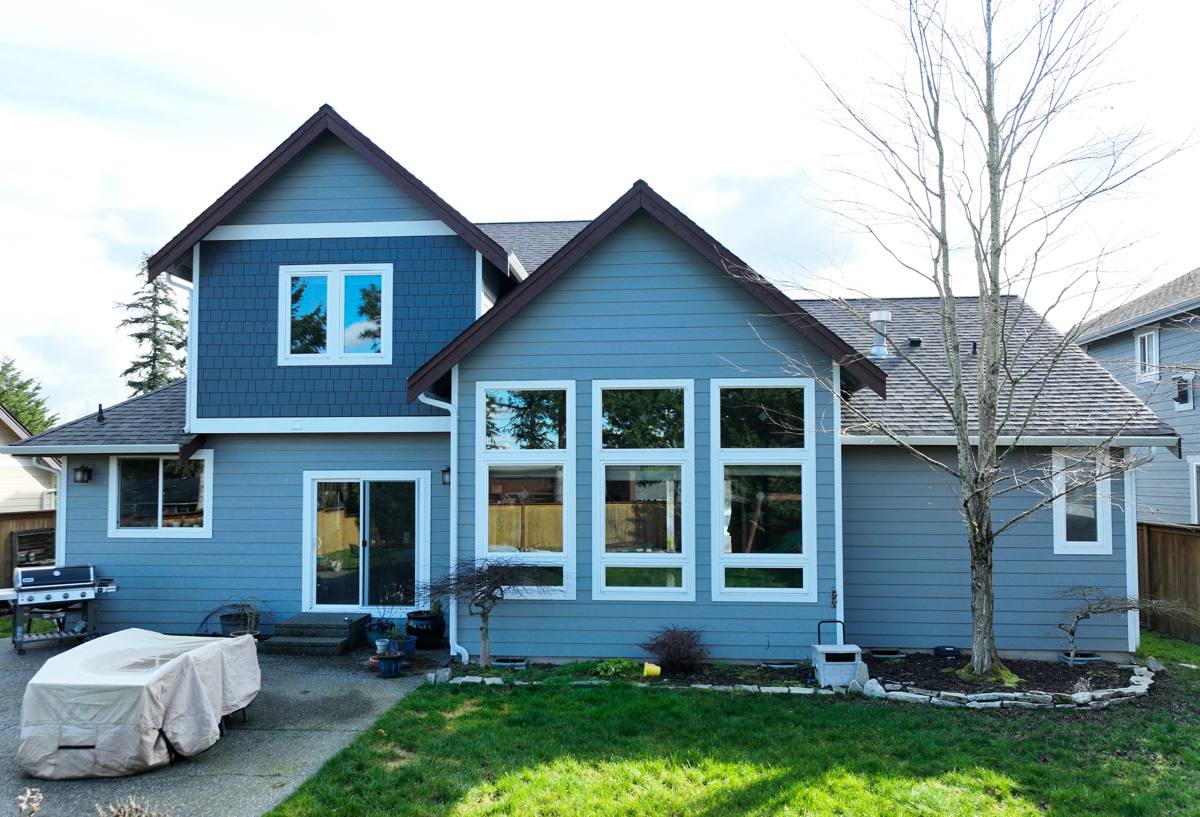
What King County's Climate Does to Vertical Siding
Mercer Island sits surrounded by water, under a tree canopy that keeps a lot of the island shaded and damp for much of the year. Combine that with King County's long wet season, driving rain that comes in sideways off the water during storms, and the extended moss season that follows — and you've got a climate that's genuinely hard on exterior materials, especially anything with vertical seams that can trap moisture against the wall.
Board and batten siding has more linear feet of seam per square foot of wall than horizontal lap siding does. Every batten strip creates a joint, and every joint needs to shed water instead of holding it. On a home exposed to Puget Sound's marine climate and King County's persistent shoulder-season rain, an installer who treats board and batten like "just another siding pattern" is setting a homeowner up for problems — trapped moisture behind the battens, moss and algae growth in shaded, damp sections of wall, and premature paint or finish failure at the seams.
None of that means board and batten is a bad choice for Mercer Island. It means the installation details matter more here than they would in a drier climate, and the material has to be one that can handle repeated wetting and drying without breaking down.
Why We Only Install James Hardie for Board & Batten
We install James Hardie fiber cement exclusively — we don't install LP SmartSide, vinyl, Cemplank, Allura, primed spruce, or cedar board and batten. That's a deliberate standard, not a sales pitch, and it matters more for board and batten than almost any other siding style because of how much seam exposure this pattern has.
Wood-based battens and boards (cedar or primed spruce) can look great going in, but they're organic material in a climate that stays damp for months at a time. They absorb moisture at cut ends and seams, which is exactly where board and batten has the most exposure, and that leads to swelling, cupping, and rot over time if maintenance slips even a little. Vinyl board and batten profiles are low-maintenance but they're thin, they expand and contract with temperature swings, and the seams and corners are a common weak point for wind-driven rain to get behind the panel. Engineered wood products like LP SmartSide use a resin-treated wood strand core — better moisture resistance than raw wood, but still a wood-based product with wood-based failure modes if the coating gets breached at a fastener or cut edge.
James Hardie fiber cement is different because it's not wood and it's not vinyl — it's cement, sand, and cellulose fiber, engineered to be non-combustible and dimensionally stable in wet climates. It doesn't rot, it doesn't swell at the seams the way wood does, and it holds paint and factory finish far longer than wood substrates in a damp environment. Hardie also makes a HZ5 product line engineered specifically for climates like ours — wetter, milder, more moss-prone than the Midwest or Southwest lines are built for. For a siding style that lives or dies on how well its seams perform, that's the material difference that matters.
The Hardie Products We Use for Board & Batten
For board and batten, we typically build the wall using James Hardie's vertical panel siding (HardiePanel) with HardieTrim battens over the joints, or a true board-and-batten profile depending on the look the homeowner wants and the wall's existing condition. Both use the same core Hardie fiber cement formulation and both come with Hardie's factory-applied ColorPlus finish, which is baked on and warranted separately from the substrate — meaning the color coat is engineered to resist fading and chipping in exactly the marine, wet climate Mercer Island sits in.
The HZ5 engineering means the product is formulated for the freeze-thaw and moisture cycling of the Pacific Northwest rather than a generic national spec. Combined with Hardie's transferable warranty, that gives homeowners a documented, backed product rather than a best-guess material choice.
What a Correct Board & Batten Installation Actually Involves
- Weather-resistive barrier, done right: a continuous, correctly lapped water barrier behind the panel — this is the layer that actually stops bulk water, not the siding itself.
- Rain screen gap: furring strips or a drainage mat behind the panel so any moisture that gets past the surface has somewhere to drain and dry instead of sitting against the wall.
- Correct fastener pattern: Hardie specifies fastener type, spacing, and edge distance — skipping this is one of the most common ways installers void the manufacturer warranty.
- Batten spacing and seam treatment: consistent spacing, properly caulked or capped seams, and attention to how each batten meets trim, corners, and window openings.
- Flashing at every penetration: windows, doors, hose bibs, light fixtures, and the base of the wall all need dedicated flashing details — vertical siding has more penetrations to manage per square foot than horizontal lap.
- Proper clearance at grade: siding held up off the ground, decks, and patios so splashback and standing water don't sit against the bottom course.
Our Process, Start to Finish
1. On-Site Assessment
We walk the exterior, check the current siding and sheathing condition, look at drainage patterns around the foundation, and identify any moisture damage or rot that needs to be addressed before new siding goes up — putting new siding over a compromised wall just hides the problem.
2. Product and Pattern Selection
We go over panel vs. true board-and-batten profiles, batten spacing options, and ColorPlus color choices, so the final look matches the home's architecture and the homeowner's preference.
3. Tear-Off and Wall Prep
Old siding comes off, the sheathing gets inspected and repaired as needed, and we install a continuous, correctly lapped weather-resistive barrier before anything else goes up.
4. Rain Screen and Fastening
Furring strips or drainage mat go in to create the rain screen gap, then panels and battens go up following Hardie's fastening specification — not a generalized "close enough" pattern.
5. Flashing and Trim Details
Every window, door, and penetration gets proper flashing before trim and battens close it in, and we pay particular attention to how the assembly meets rooflines, decks, and grade.
6. Final Walkthrough
We walk the finished exterior with the homeowner, check every seam and corner, and go over warranty documentation and any care recommendations specific to the home's site conditions.
Board & Batten Material Comparison
| Material | Moisture Behavior in Wet Climates | Maintenance Burden | Typical Warranty Structure |
|---|---|---|---|
| James Hardie fiber cement | Non-combustible, dimensionally stable, HZ5 engineered for wet/marine climates | Low — factory ColorPlus finish, periodic caulk/seam checks | Manufacturer product warranty, transferable |
| Cedar / primed spruce | Absorbs moisture at seams and cut ends; prone to swelling and rot over time | High — regular refinishing, sealing exposed ends and battens | Typically none beyond installer workmanship |
| Engineered wood (LP SmartSide) | Resin-treated wood core; better than raw wood but still wood-based at the core | Moderate — coating integrity at seams and fasteners matters | Manufacturer warranty, terms vary by product line |
| Vinyl board and batten profile | Doesn't rot, but seams and corners are common entry points for wind-driven rain | Low, but limited repairability if a panel is damaged | Manufacturer warranty, often prorated over time |
Cost Factors for a Mercer Island Board & Batten Project
| Factor | Why It Affects Price |
|---|---|
| Wall prep and sheathing condition | Rot or moisture damage found during tear-off needs repair before new siding goes up |
| Panel vs. true board-and-batten profile | Labor and material quantities differ between the two approaches |
| Number of penetrations and trim details | More windows, doors, and fixtures mean more flashing and cutting labor |
| Home access and site conditions | Sloped lots, mature landscaping, and limited staging area all affect labor time |
| Color and finish selection | ColorPlus factory finishes vary slightly in cost by color and sheen |
We give exact numbers only after walking the property — anything else is a guess, and guesses don't help homeowners plan.
Maintenance and Longevity on Mercer Island
Correctly installed Hardie board and batten needs far less upkeep than wood alternatives, but "low maintenance" doesn't mean "no maintenance" in this climate. A short seasonal checklist goes a long way:
- Rinse off accumulated moss, pollen, and organic debris in shaded, damp sections of wall once or twice a year.
- Check caulked seams and joints annually for cracking or separation, especially around windows and battens.
- Keep gutters clear and downspouts directed away from the wall so water isn't running down the siding face.
- Trim back landscaping and tree branches that keep sections of the wall shaded and slow-drying.
- Watch for any staining or discoloration at the base of the wall, which can signal a grade or splashback issue rather than a siding problem.
Why a Local King County Crew Matters Here
Board and batten's biggest risk isn't the material — it's installation shortcuts that don't show up until the first hard wet season. A crew that already works homes around Mercer Island and the rest of King County has seen how this climate actually behaves on vertical siding: where moss tends to establish, which wall orientations stay damp longest, and how driving rain during winter storms tests seams and flashing that looked fine on a dry install day.
That local experience shows up in the details — rain screen execution, flashing sequencing, batten spacing that accounts for expansion — the parts of the job that don't get seen once the siding is up, but determine whether it performs for decades or needs attention in a few years. Hiring a crew with that context, working a product engineered for this exact climate, is what makes the difference between board and batten that looks good on install day and board and batten that still looks good after a decade of King County winters.
If you're considering board and batten siding for a Mercer Island home, we're happy to walk the property, look at your specific site conditions, and put together a free, no-pressure estimate using the form below.