 King County
 Why Composite Decking Makes Sense in Woodinville
Woodinville sits in one of the wetter, more tree-covered pockets of King County. Between the vineyard country's open fields and the heavily wooded residential lots closer to the Sammamish River, most homes here deal with long stretches of damp, overcast weather from October through May, plus shade patterns that keep certain sections of a deck wet for days after a storm passes. Add in the region's driving rain and the moss season that follows, and a wood deck's finish is fighting an uphill battle almost year-round.
Composite decking was built for exactly this kind of climate. It doesn't absorb water the way wood does, it won't splinter or cup as it dries out between rains, and it doesn't need to be sanded, stained, or sealed on a yearly schedule just to keep it looking decent. That doesn't mean every composite board or every installation handles King County's moisture load equally well — the difference between a deck that looks good in year eight and one that's already showing mildew streaks and soft spots comes down to product choice and how the frame underneath was built.
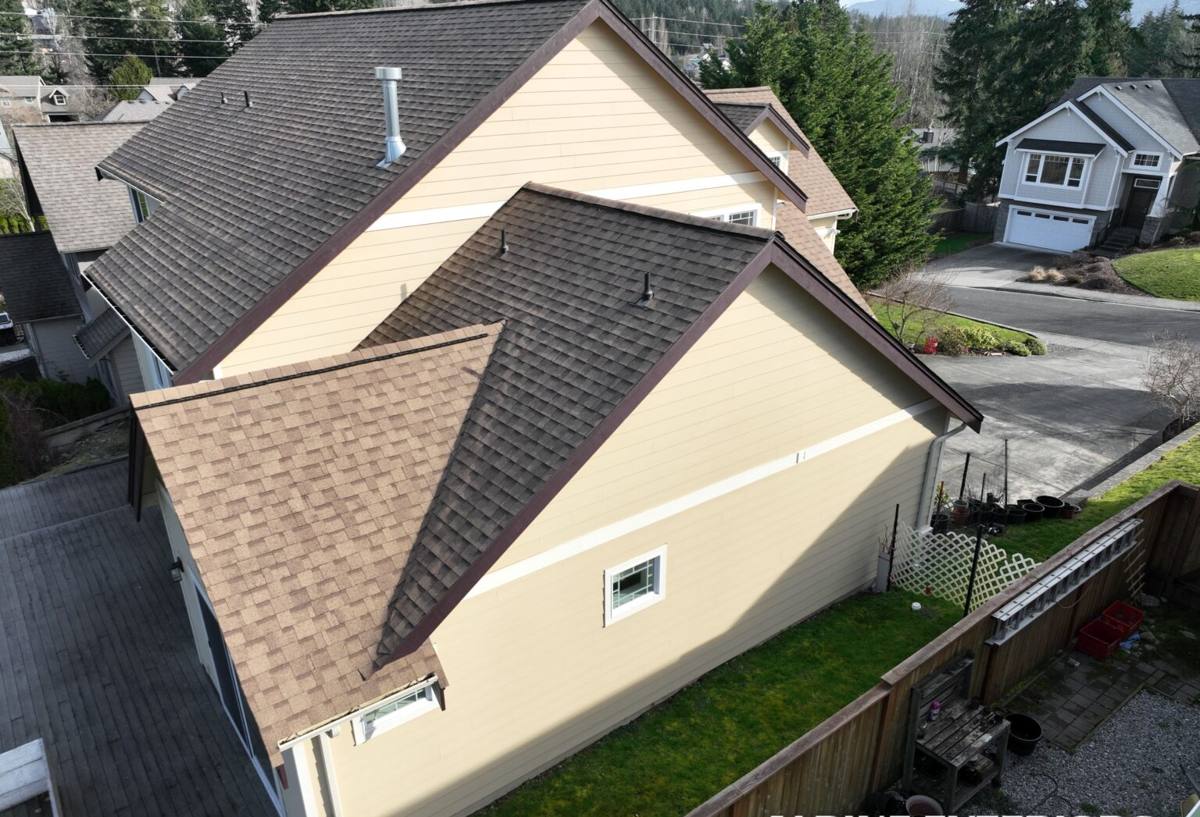
What Woodinville's Climate Actually Does to a Deck
It helps to be specific about what's working against a deck here instead of talking about "weather" in the abstract:
- Prolonged dampness: Shaded yards and tree canopy mean surfaces stay wet longer after rain, which is exactly what moss and algae need to take hold.
- Driving rain: Wind-driven rain gets pushed sideways into ledger connections, rim joists, and any gaps in flashing — this is where hidden rot starts, not on the visible deck boards.
- Marine-influenced air: The moisture-laden air that moves through the greater Puget Sound region carries salt and humidity that accelerates corrosion on unprotected metal fasteners and hardware, even well inland.
- Freeze-thaw cycling: King County doesn't get deep freezes often, but the repeated freeze-thaw swings in winter stress any water that's found its way into wood framing or fastener holes.
None of this is unique to composite decking — it's the environment any deck in this part of King County has to survive. But it's the reason we treat the framing and fastening details as seriously as the decking material itself.
What a Correctly Built Composite Deck Involves
The Framing Comes First
Composite boards are only as good as what they're screwed into. Pressure-treated joists and beams sized correctly for the span, proper joist spacing (usually tighter than what's allowed for wood decking, per the manufacturer's specs), and adequate ventilation underneath the deck all matter more in a wet climate than in a dry one. A frame that can't shed water or breathe will hold moisture against the underside of the boards regardless of how water-resistant the composite is on top.
Ledger Flashing Is Non-Negotiable
Where a deck attaches to the house is the single most common source of hidden water damage we see on older decks in this area. Proper ledger flashing — installed so water is directed out and away from the house band joist rather than behind it — is standard on every deck we build, not an upgrade. This detail is invisible once the deck is finished, which is exactly why it's the detail that gets skipped by crews trying to save time.
Fasteners and Hardware
Given the corrosion pressure from King County's damp, marine-influenced air, we use fasteners and structural hardware rated for exterior and coastal-adjacent exposure — hot-dip galvanized or stainless connectors, and hidden fastener systems compatible with the specific composite board being installed. Mixing incompatible metals or using interior-grade hardware is a slow-motion failure that won't show up for a few years, which is part of why it happens more often than it should.
Footings and Ground Clearance
Footings need to be sized and set to local frost depth and soil conditions, and the deck needs enough clearance above grade for airflow. On sloped or heavily wooded Woodinville lots, this sometimes means additional footings or engineering beyond a basic square deck, which is something worth discussing before a project is priced.
Choosing the Right Composite Board for This Climate
Not all composite decking is built the same way, and the differences matter more here than in a dry climate. The table below compares the general categories of composite boards we work with.
| Board Type | Moisture Behavior | Moss & Algae Resistance | Maintenance |
|---|---|---|---|
| Uncapped composite | Wood fibers can absorb moisture at cut ends and surface over time | Lower — more prone to surface staining in shaded, damp areas | Periodic cleaning; more attention to end-cut sealing |
| Capped composite | Polymer shell resists moisture absorption on the wearing surface | Good — smoother, less porous surface sheds spores more easily | Occasional washing; low overall upkeep |
| Cellular or solid PVC | No wood content, essentially moisture-inert | Very good, though still needs cleaning in shaded spots | Lowest; mainly surface cleaning |
For most Woodinville projects — especially anything under tree cover or on the shaded side of a house — we lean toward capped composite or PVC decking specifically because of how this region's damp shade behaves. Uncapped composite still has its place on sunnier, open lots where it dries out faster between rains, and it typically costs less.
Why We're Selective About Uncapped Products in Shaded Yards
We're not going to tell a homeowner a product is "bad" — every composite manufacturer builds to a spec and stands behind their own warranty. But as a professional standard, we're cautious about recommending uncapped composite for the shadiest, wettest sections of a Woodinville lot, because that's where moisture sits longest and where a fully capped surface earns its keep. It's a maintenance and moisture-behavior tradeoff, not a knock on any brand — and it's the kind of judgment call we'll walk through honestly during an estimate rather than defaulting to whatever's cheapest.
Preventing Moss and Slippery Decks in Shaded Yards
Moss season is a real seasonal event in this part of King County, and decks under tree canopy or on the north side of a house are the most exposed to it. A few things reduce how much of a problem this becomes:
- Choosing a capped or PVC board with a textured, less porous surface in shaded areas
- Building in proper gaps between boards so water and debris drain through instead of pooling
- Keeping the underside of the deck ventilated so moisture doesn't get trapped and wick back up
- Trimming back overhanging branches where practical to let more light and airflow reach the deck
- A simple seasonal wash-down before the wet months set in, rather than waiting until moss is established
Composite decking makes this maintenance dramatically easier than a wood deck — there's no re-staining involved, just periodic cleaning — but "low maintenance" doesn't mean "no maintenance" in a climate this wet.
Permits and Site Considerations in King County
Most new deck construction and significant deck replacement in unincorporated King County and surrounding jurisdictions requires a building permit, and requirements can shift based on deck height, size, and proximity to property lines. Woodinville properties also vary quite a bit — some lots are flat and open, others are sloped or heavily treed, which affects footing layout, access for equipment, and sometimes tree protection considerations during construction. We handle the permit process as part of the job rather than leaving it to the homeowner to sort out, and we scope each site individually rather than quoting off a generic template.
Our Process
Every composite deck project follows the same sequence, whether it's a small platform deck or a large multi-level build:
- On-site assessment of the existing structure (if replacing a deck), soil, slope, and shade exposure
- Product selection conversation — capped composite, uncapped composite, or PVC — based on sun exposure, budget, and how the space will be used
- Permit drawings and submission where required
- Demolition of the old deck (if applicable) and inspection of the ledger and rim joist area for hidden water damage
- Framing, footings, and ledger flashing installed to code, sized for King County's snow and wind loads
- Composite board installation with manufacturer-specified fastening and spacing
- Railing, stairs, and any lighting or fascia details
- Final walkthrough and cleanup
Here's a quick checklist worth going through with any contractor before work starts on a Woodinville deck:
- Is a permit required for this size and height of deck, and who is pulling it?
- What fastener and hardware grade is being used, and is it rated for this climate?
- Is ledger flashing included as standard, and can it be explained in plain terms?
- What's the joist spacing, and does it match the composite manufacturer's requirements?
- What's the manufacturer's warranty on the specific board being installed, and what voids it?
Why Local Experience Matters
A deck built to a generic national spec sheet isn't necessarily built for Woodinville's specific mix of shade, slope, and driving rain. A crew that regularly works in King County knows which sides of a lot tend to hold moisture longest, how local soil and drainage patterns affect footing placement, and which framing and flashing details actually hold up through a full wet season rather than just looking finished on installation day. That local pattern-recognition is hard to replace with a one-size-fits-all approach, and it's usually the difference between a deck that needs attention in year five and one that's still solid at year twenty.
If you're planning a new composite deck or replacing an aging wood one in Woodinville, we're happy to walk the site, talk through board options for your specific yard, and put together a straightforward, no-pressure estimate — just fill out the form below to get started.