 King County
 Redmond's Climate Is Harder on Siding Than It Looks
Redmond doesn't get the headline weather of coastal Washington, but King County's climate still puts a steady, cumulative load on exterior siding. The Eastside sits close enough to Puget Sound and Lake Washington that salt-tinged, moisture-laden air reaches inland further than most homeowners assume, and it combines with driving rain that comes in sideways during fall and winter storms rather than falling straight down. Add a moss and mildew season that runs across most of the calendar because temperatures rarely get cold enough or dry enough to interrupt it, and you have three separate stresses working on a wall system at the same time, year after year.
None of those three factors is dramatic by itself. A single wet season doesn't ruin siding. What actually causes problems in Redmond is the accumulation: finish coatings that fade and chalk a little faster than they would in a drier climate, caulked joints that get tested by wind-driven rain more often than the product spec sheet assumes, and organic growth that takes hold on shaded, tree-lined lots and stays there because the moisture never really lets up long enough to dry it out. Siding that isn't built and installed for this specific combination tends to show its weaknesses slowly, over five to fifteen years, rather than failing outright in year one.
Why Redmond Specifically
Redmond's mix of mature tree canopy, proximity to water, and typical Eastside lot layout (homes tucked against greenbelt, partial shade for much of the day) means moss and moisture retention are usually a bigger practical issue here than wind exposure alone. Siding on a shaded north wall in a Redmond neighborhood works under different conditions than the same product on an open, sun-exposed elevation, and a correct installation accounts for that difference rather than treating every wall of the house the same way.
What We Install, and What We Don't
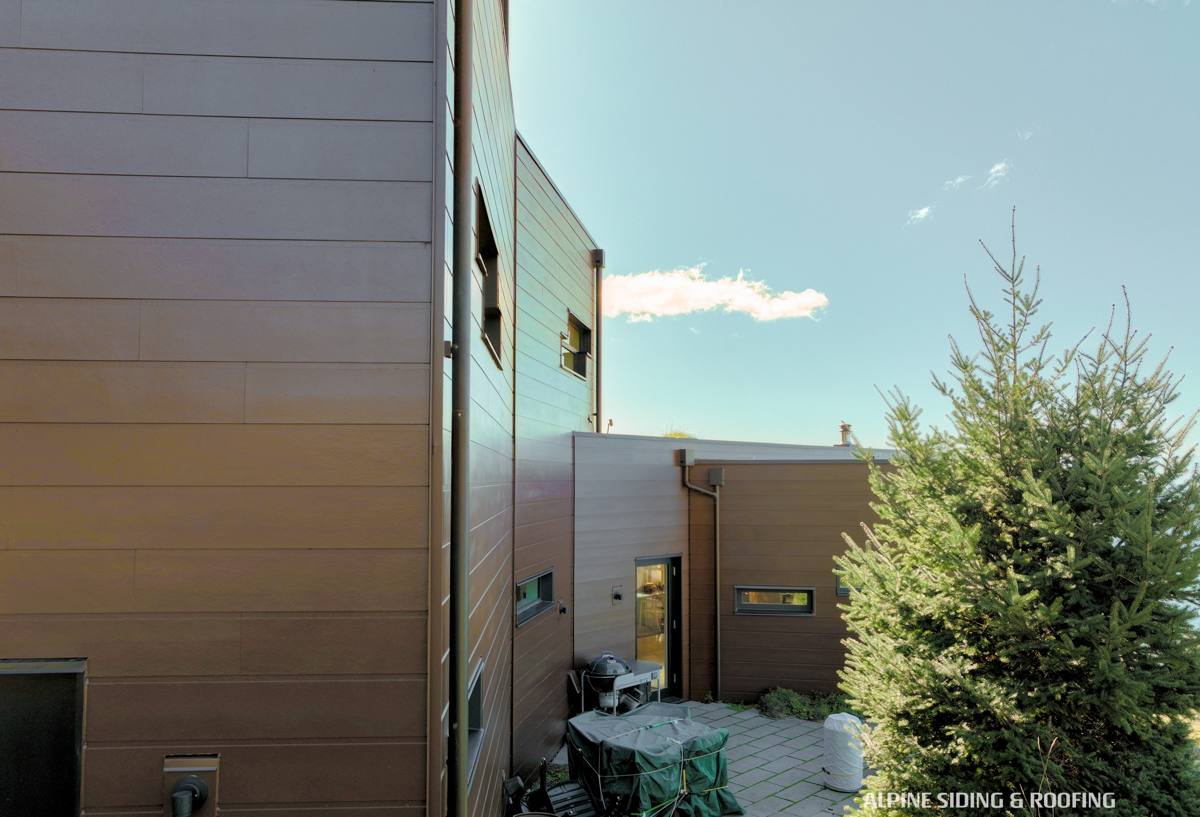
We install James Hardie fiber cement siding exclusively. We don't install vinyl, LP SmartSide or other engineered wood products, primed spruce, cedar, or fiber cement from other manufacturers like Cemplank or Allura. That's a narrower offering than most siding contractors advertise, and homeowners in Redmond sometimes ask us why we don't just carry more options.
The honest answer is that we used to install a broader range of products, and years of callbacks, tear-offs, and re-caulk visits in this specific climate convinced us that carrying five materials meant we could only stand fully behind one of them. Vinyl expands and contracts significantly with temperature swings and relies on lapped, unsealed joints that aren't built to shed the kind of wind-driven rain King County regularly delivers. Engineered wood products perform well as long as the factory coating and every field-cut edge stays sealed indefinitely, which is a lot of ongoing maintenance to ride on a wood-fiber core in a climate where wet weather is the default. Cedar and primed spruce are genuine, attractive materials, but they're organic, combustible, and dependent on a paint or stain cycle that has to be kept up consistently, and moss finds an organic surface especially easy to colonize when the air stays damp most of the year.
Fiber cement as a category is the right direction for this climate. We standardized on James Hardie specifically, not fiber cement generically, because of its factory-applied ColorPlus finish, its climate-engineered product lines, and the depth of installer training and warranty support behind it in the Pacific Northwest.
What James Hardie Fiber Cement Actually Is
James Hardie siding is fiber cement: a cured blend of Portland cement, sand, and cellulose fiber formed into rigid boards and panels. Because it's an inorganic material, it doesn't have a wood-based or foam core that can absorb water and swell, delaminate, or feed insects the way organic siding products can. It's also non-combustible, and it holds a factory finish differently than wood or vinyl because it doesn't expand and contract with temperature and humidity the way those materials do.
HZ5 Engineering for This Climate
James Hardie engineers its siding differently for different climate zones. The HZ5 line is built for regions with sustained moisture exposure and freeze-thaw cycling, which is a closer match to King County's winters than a product engineered primarily for hot, dry markets. That's a concrete, checkable reason to specify this manufacturer rather than treating fiber cement as an interchangeable commodity product.
ColorPlus Factory Finish
Instead of a field-applied paint job, Hardie's ColorPlus finish is baked on in multiple coats under controlled factory conditions before the boards reach the jobsite. That finish carries its own warranty, separate from the substrate warranty, and it's formulated to hold color and resist fading better than a site-painted finish exposed to Redmond's UV and moisture cycle over many years.
The Product Lines Available for Redmond Homes
| Product | Typical Use | Why It Fits Redmond |
|---|---|---|
| HardiePlank lap siding | Traditional horizontal lap, most common residential profile | Widest color and texture selection, proven track record in wet Pacific Northwest climates |
| HardiePanel vertical siding | Modern vertical panel look, often paired with lap siding | Common on updated Eastside exteriors; sheds water efficiently when flashed correctly |
| HardieTrim boards | Corners, window and door trim, fascia | Matches expansion behavior of the field siding, avoiding mismatched movement at joints |
| HardieShingle siding | Accent gables, dormers, architectural detail | Non-combustible alternative to cedar shingle look, no shingle-specific maintenance cycle |
What a Correct Fiber Cement Installation Involves
Fiber cement's real-world performance depends heavily on installation quality, and that's true everywhere, but it matters more in a climate like Redmond's where the siding is tested by moisture more often than it gets a chance to fully dry. A rushed or out-of-spec install can undercut even a well-engineered product.
- Manufacturer-specified clearances from grade, roofline, and deck surfaces, so splash-back and standing moisture don't sit against the board edge
- Correct fastener type, spacing, and penetration depth, which affects both structural performance and long-term crack resistance
- A continuous, correctly lapped water-resistive barrier and flashing behind the siding, since the siding itself is one layer of a larger water management system, not the only line of defense
- Properly sized and sealed joints, with factory-cut or correctly field-primed cut edges so no raw fiber cement is left exposed to moisture
- Kick-out flashing and proper terminations at rooflines, so roof runoff is directed away from the wall assembly instead of behind it
- Consistent nailing patterns and blind-nailing where the product design calls for it, to keep fastener heads from becoming a long-term water entry point
Every one of those details is inspectable after the fact, which is part of why we walk Redmond homeowners through what was actually done on their house rather than asking them to take installation quality on faith.
How We Approach a Redmond Siding Job
The process starts with a walkthrough of the whole exterior, not just the elevation the homeowner called about. Moss patterns, caulk condition, trim rot, and paint failure tell us a lot about how water has actually been moving around a specific house, and that assessment shapes the installation plan more than a generic spec sheet does.
1. Exterior Assessment
We look at existing siding condition, sheathing and framing where it's exposed, window and door flashing, and drainage at grade. On older Redmond homes this often surfaces moisture issues that predate the siding itself, which need to be addressed before new material goes on, not covered over.
2. Water Management Plan
Before a single board goes up, we plan the water-resistive barrier, flashing details, and clearances for that specific house, accounting for shaded and sun-exposed elevations differently where the lot layout calls for it.
3. Installation to Manufacturer Spec
James Hardie publishes detailed installation requirements, and warranty coverage depends on following them. We install to that spec as a baseline, not as an upsell, because it's the difference between siding that performs for decades and siding that looks fine for a few years before problems start showing up at the seams.
4. Final Walkthrough
We go over what was installed, why specific details were handled the way they were, and what warranty coverage applies, so the homeowner has a clear record rather than just a finished-looking wall.
Why a Crew That Already Works King County Matters
Installation quality is the single biggest variable in how long fiber cement siding actually performs, and a lot of that comes down to whether the crew is used to building for this specific climate. A contractor who mostly works drier inland markets can install a technically code-compliant job that still under-performs here, because clearances, flashing choices, and cut-edge sealing that are "good enough" in a drier climate aren't good enough where wind-driven rain and a long moss season are the norm rather than the exception.
A crew that regularly works Redmond and the surrounding King County area has already seen how moss establishes on shaded north walls, how wind-driven rain behaves on exposed Eastside elevations, and how local drainage and grading issues show up at the base of a wall. That local pattern recognition shows up in the small decisions on a jobsite that don't appear on a proposal, like where extra flashing gets added or how a problem detail from the old siding gets corrected instead of repeated.
Maintenance Expectations After Installation
James Hardie siding is genuinely lower-maintenance than wood or engineered wood alternatives, but "lower-maintenance" isn't "no-maintenance," and setting realistic expectations up front avoids surprises later.
| Task | Typical Frequency in King County |
|---|---|
| Rinse siding to remove pollen, dust, and early moss growth | 1-2 times per year, more often on heavily shaded walls |
| Inspect and re-caulk joints at trim, windows, and penetrations | Every few years, or as caulk shows cracking or separation |
| Check for and clear moss or debris buildup at horizontal ledges and trim | Annually, especially before the wet season |
| Repaint (only if ColorPlus finish is not used, or at trim requiring field paint) | Not required for ColorPlus-finished boards under normal conditions |
Signs Your Current Siding May Need Attention
- Visible moss or dark staining that returns quickly after cleaning, especially on shaded or north-facing walls
- Soft spots, bubbling, or visible swelling, which usually indicates moisture has already reached the substrate
- Cracked, peeling, or chalking paint on wood or engineered wood siding that keeps recurring despite repainting
- Gaps opening up at seams, corners, or trim joints where caulk has failed
- Warping or visible panel movement on vinyl siding after temperature swings
- Any musty smell or interior staining near exterior walls, which can point to moisture already past the siding layer
Getting an Honest Estimate
Every Redmond property is a little different once you account for shade, exposure, existing siding condition, and how the house sits relative to drainage and grade, so we'd rather look at the actual house than quote a number sight unseen. If you're weighing a siding replacement or just want a straight answer about what your current siding is telling you, we're happy to walk the exterior with you and give a clear, no-pressure estimate using the form below.