 King County
 Why Sammamish Siding Takes More Punishment Than It Looks Like It Should
Sammamish sits up on the plateau east of Lake Sammamish, and that setting is a mixed blessing for siding. The tree canopy that makes the neighborhoods here so pleasant also means a lot of homes get shaded walls that stay damp for hours after every rain. Add King County's long wet season, the driving rain that comes sideways off winter storms, and a moss season that can run from October into May, and you've got conditions that expose weak siding fast. Homes closer to open water elsewhere in the county deal with salt air on top of that; Sammamish's version of the same problem is humidity trapped by trees and slow-drying north and east walls.
None of this is dramatic on its own. It's cumulative. Siding that's marginal — a cheap product, a rushed install, caulk instead of proper flashing — doesn't fail in year one. It fails in year eight or ten, quietly, behind a wall you can't see until the sheathing underneath is already soft. A correct installation is what keeps that timeline from ever starting.
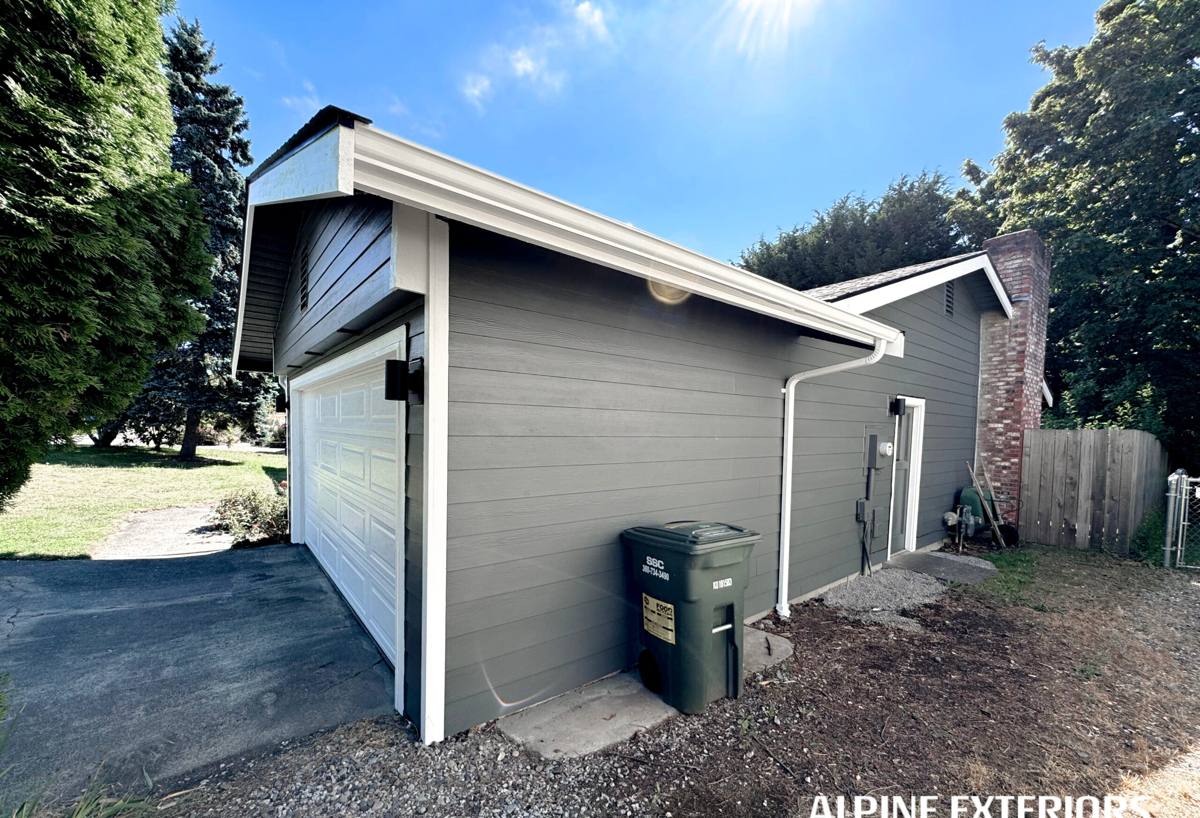
What Sammamish's Climate Actually Does to a Wall
Moisture that doesn't dry out
Shaded, tree-lined lots are common on the plateau, and shade means slower drying. Siding on the north or east side of a heavily treed lot can stay wet for days after a storm system passes through. Wood-based products swell and soften under that pattern. Fiber cement doesn't, but even fiber cement needs to be installed with the right gaps, clearances, and flashing details so trapped water has somewhere to go.
Moss and algae growth
Moss doesn't just grow on roofs here — it colonizes any siding surface that stays damp and shaded long enough, especially at ground level, under eaves, and anywhere sprinklers or landscaping keep a wall wet. Moss holds moisture against the surface, and on the wrong substrate that moisture eventually finds its way behind the cladding.
Driving, wind-driven rain
King County's fall and winter storms don't just fall straight down — wind pushes rain sideways into laps, corners, and window and door trim. Siding systems are only as good as their weakest joint. Butt joints, corner boards, and penetrations for hose bibs, vents, and light fixtures are where driving rain finds a way in if they weren't detailed correctly the first time.
Temperature swings and material movement
Sammamish gets cold snaps and the occasional heat spell along with everything in between, and materials expand and contract with those swings. Products with poor dimensional stability show it in cracked caulk lines, popped nails, and gaps that open up at the seams within a few years.
Signs a Sammamish Home Needs New Siding
- Soft spots, bubbling, or visible warping, especially on shaded north- and east-facing walls
- Persistent moss or algae staining that comes back within a season of cleaning
- Paint that's peeling, alligatoring, or needing repainting more often than every 8-10 years
- Visible gaps opening at butt joints, corners, or trim where caulk has failed
- Siding that feels spongy or gives when pressed near the bottom of walls or below windows
- Interior signs — musty smell, discoloration on interior walls, or trim that's swelling near exterior corners
Any one of these on its own might be minor. Several together, or any sign of soft sheathing underneath, usually means it's time for a real inspection rather than another round of caulk and paint.
What a Correct Siding Installation Actually Involves
Siding is a system, not a product. The board itself matters, but most siding failures we get called out to fix trace back to installation shortcuts, not the material. A correct job includes:
- Tear-off and inspection. Old siding comes off so the sheathing and framing underneath can actually be checked, not guessed at.
- Sheathing repair. Any soft, rotted, or water-damaged sheathing gets replaced before anything new goes up. Siding over bad sheathing just hides the problem.
- Weather-resistive barrier. A properly lapped house wrap, installed shingle-style so water sheds outward and never behind the layer above it.
- Flashing at every penetration. Windows, doors, hose bibs, vents, and any fixture that punches through the wall needs correctly integrated flashing — not just a bead of caulk.
- Rainscreen gap where called for. A furring strip or drainable wrap that lets any moisture that does get behind the siding drain and dry, instead of sitting against the sheathing.
- Correct fastening. Manufacturer-specified nailing patterns, fastener type, and clearances — over-driven or under-driven nails are one of the most common causes of early siding failure.
- Proper clearances. Siding held up off decks, patios, and grade per code and manufacturer spec, so it's never sitting in standing water or snow.
- Finish detailing. Caulking only where it belongs, factory-finished trim and corners, and paint-matched touch-up where a factory finish gets field-cut.
Skip any one of those steps and the siding can look fine for years while a real problem builds behind it. This is exactly the kind of work where the installer matters as much as the product.
Why We Install Only James Hardie Fiber Cement
We don't install vinyl, LP SmartSide, Cemplank, Allura, or primed wood siding. That's a deliberate standard, not a sales pitch, and it's worth explaining why.
Vinyl is inexpensive and low-maintenance, but it's a thin plastic product that can warp in heat, crack in cold, and fade over time — and in King County's climate, low-cost vinyl often shows its age at the seams and corners within a decade or two. Engineered wood products like LP SmartSide use real wood strand technology with a resin-based coating; it's a legitimate product, but wood-based composites are inherently more sensitive to sustained moisture exposure than fiber cement, and Sammamish's shaded, slow-drying lots are exactly the environment where that sensitivity shows up. Other fiber cement brands compete reasonably well on paper, but James Hardie's HardieZone engineering, ColorPlus factory finish, and track record in the Pacific Northwest are what we've chosen to stand behind.
James Hardie fiber cement is non-combustible, doesn't rot, doesn't attract insects, and holds its factory-baked ColorPlus finish far longer than field-applied paint on wood or composite products. It's engineered specifically for regional climate zones — more on that below — and it comes with a strong, transferable warranty when installed to spec. For a climate defined by long wet seasons and shaded, slow-drying walls, it's the product we're willing to put our name behind.
HardieZone Product Lines
| Product | Best Use | Why It Fits Sammamish |
|---|---|---|
| HardiePlank lap siding | Most homes, traditional and modern styles | Widest color range in ColorPlus finish, engineered for the Pacific Northwest's HZ5 climate zone |
| HardieShingle | Accent gables, Craftsman and Cape Cod-style homes | Common architectural accent on plateau homes; resists the moss and staining that plague cedar shingle |
| HardiePanel | Modern facades, board-and-batten sections | Clean vertical lines for contemporary Sammamish builds, installed with proper rainscreen detailing |
| HardieTrim | Corners, fascia, window and door surrounds | Matches the lap or panel finish and resists the rot that plagues painted wood trim in wet shade |
James Hardie's HardieZone system engineers products for specific climate conditions — HZ5 for the wetter, more temperate zones that cover most of the country including King County, and HZ10 for hot, humid regions. Every Hardie product we install here is the HZ5 formulation, engineered for exactly the moisture and temperature pattern Sammamish sees.
Our Installation Process
We've worked King County long enough to know that a good install here starts before anyone touches the walls.
- On-site inspection and estimate. We walk the whole exterior, note shaded and high-exposure areas, check trim and window details, and give a straight assessment of what's actually needed.
- Written scope and product selection. Profile, color, and trim decisions get locked in writing before work starts — no surprises mid-project.
- Permitting. King County and Sammamish permitting requirements get handled up front, along with any HOA design review that applies in your neighborhood — many Sammamish communities have architectural standards for exterior materials and color.
- Tear-off, sheathing repair, and weather barrier installation. This is the stage where most of the long-term performance of the job actually gets decided.
- Hardie installation to manufacturer spec. Correct fastening, clearances, and flashing at every penetration, by a crew that installs this specific product regularly rather than occasionally.
- Final walkthrough. We go over the finished work with you directly before calling the job done.
What Siding Installation Costs Depend On
We don't publish blanket per-square-foot prices because they're close to meaningless without seeing the house — but these are the real factors that move the number up or down on a Sammamish job.
| Factor | Impact on Cost |
|---|---|
| Tear-off vs. install over existing siding | Full tear-off costs more up front but is the only way to actually inspect and repair sheathing |
| Sheathing or framing damage found underneath | The single biggest variable — hidden rot repair can add meaningfully to a project |
| Home size and wall complexity | More corners, dormers, and roofline intersections mean more cutting, flashing, and labor time |
| Siding profile mix | Lap-only jobs are simpler than homes combining lap, shingle accents, and panel sections |
| Trim and fascia scope | Replacing all trim in matching HardieTrim adds cost but avoids mismatched old wood trim failing next to new siding |
| Site access | Steep lots, limited driveway access, and tree-crowded walls common on the plateau can add labor time |
Maintaining Hardie Siding in Sammamish's Climate
Fiber cement is genuinely low-maintenance compared to wood or vinyl, but "low-maintenance" isn't "no-maintenance" in this climate.
- Rinse siding annually, especially shaded north- and east-facing walls, to keep moss and algae from establishing
- Keep landscaping and sprinkler heads from spraying directly onto siding or holding moisture against it
- Check and re-caulk trim joints and penetrations every few years — caulk is a maintenance item on any siding system, Hardie included
- Watch gutters and downspouts; overflow running down a wall accelerates staining and moss growth
- Address any impact damage (branches, equipment) promptly rather than letting a cracked panel sit exposed
Why Hiring a Crew That Already Works Sammamish Matters
Siding installation isn't just a product question — it's a local-conditions question. A crew that mostly works drier, more open sites will size up clearances and drying assumptions differently than a crew that's used to shaded, tree-heavy plateau lots where a wall might not fully dry out between storms for a week at a time. Local experience also means knowing King County and Sammamish permitting requirements without a learning curve, and being familiar with the HOA design-review process that applies in many of the area's neighborhoods, so approvals don't stall a project. It also means we're not disappearing after the invoice clears — if a warranty question comes up five years from now, we're still working in the same county.
If your Sammamish home's siding is showing its age, or you're planning ahead rather than waiting for a problem, we're happy to take a look. The estimate is free, there's no pressure, and you'll get a straight answer about what your home actually needs — use the form below to get started.